
Marrakech to Ouarzazate: Scenic Stops, Cinematic History and Local Tips
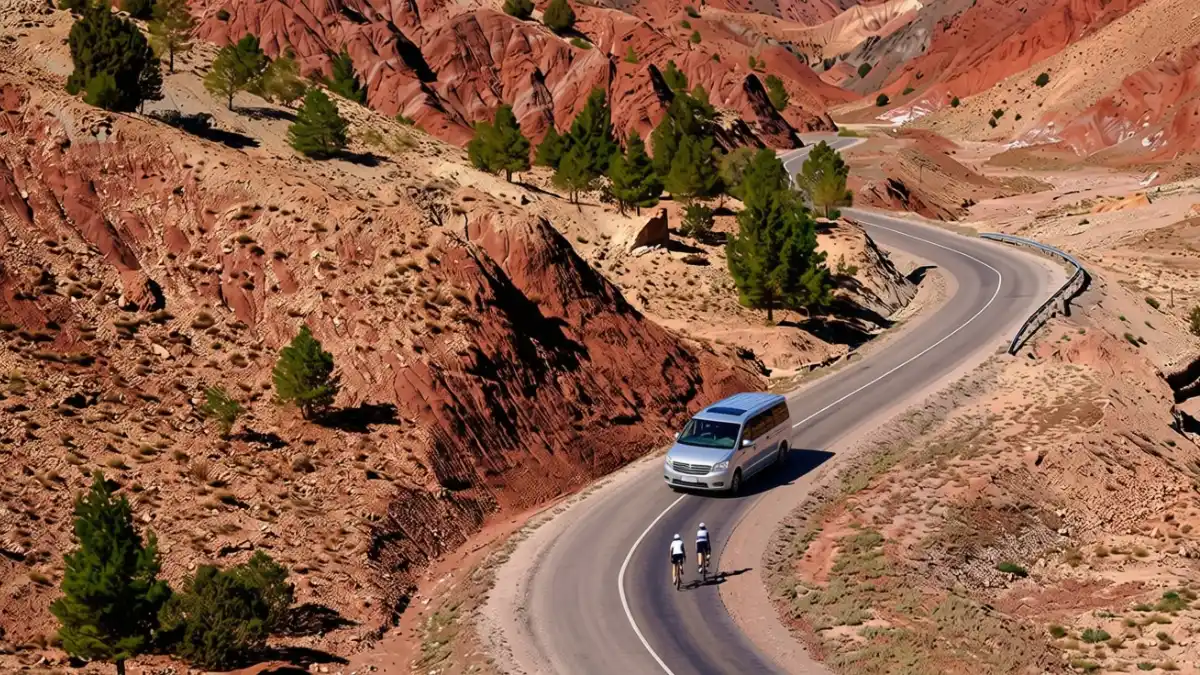
The journey from Marrakech to Ouarzazate is where Morocco changes in front of you.
You leave the traffic, scooters and red walls of Marrakech, climb into the High Atlas Mountains, cross the winding Tizi n’Tichka road and descend toward dry valleys, mud-brick kasbahs and open desert plateaus.
Ouarzazate is often called the “Door of the Desert” and the “Hollywood of Morocco.” Both descriptions are useful, but neither tells the whole story. The city is not the Sahara, and it is more than a collection of film sets. It is a practical regional center surrounded by historic caravan routes, Amazigh villages, oasis landscapes and some of southern Morocco’s finest earthen architecture.
After more than 20 years of guiding travelers around Morocco, my advice is simple: do not treat this as an ordinary transfer between two cities. The road is part of the experience.
| Quick fact | What to expect |
|---|---|
| Marrakech to Ouarzazate distance | Approximately 195–200 km |
| Direct driving time | Around 4 hours in favorable conditions |
| Realistic time with breaks | Around 5–6 hours |
| Main route | N9 through the High Atlas |
| Highest road section | Tizi n’Tichka, signposted around 2,260 meters |
| Best seasons | Spring and autumn |
| Typical private-car planning price | Around 1,200–1,500 MAD one way |
| Budget option | CTM or Supratours bus |
Table of Contents
Table of Contents
Marrakech to Ouarzazate Distance, Driving Time and Route
The Marrakech to Ouarzazate distance is approximately 198 kilometers by road. Mapping tools may suggest a drive of around three and a half hours, but that assumes steady movement with no meaningful stops. On a real journey, I recommend allowing four to five hours for a direct transfer and five to six hours if you want coffee, photographs and a proper break.
The normal route follows the N9 southeast from Marrakech. It passes Aït Ourir, climbs through the High Atlas Mountains and crosses the Tizi n’Tichka area before descending toward Ouarzazate.
The road is paved, but it is not a fast motorway. You will encounter:
- Long curves and hairpin bends
- Slow trucks
- Changing speed limits
- Villages built close to the road
- Police checkpoints and radar controls
- Occasional roadwork
- Snow, ice or rockfall risks during severe winter weather
The Marrakech to Ouarzazate drive becomes much longer when you add Telouet and Aït Benhaddou. Those stops are worthwhile, but they turn a transfer into a full road-trip day.
Navigating the Tizi n’Tichka Pass
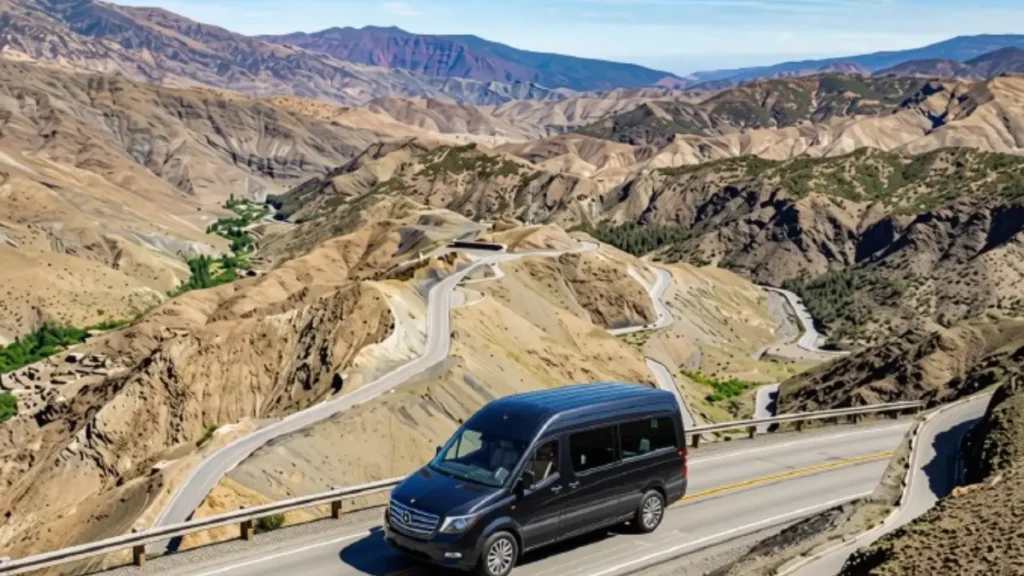
What the mountain crossing feels like
The climb begins gradually. Marrakech disappears behind you, the landscape becomes greener and more rugged, and the road starts following deep valleys through the High Atlas.
Higher up, the bends become tighter and the temperature can drop surprisingly quickly. On a summer morning, Marrakech may already feel hot while the summit area remains windy and cool.
You will often see the pass described as Africa’s highest road. I would use more careful wording. It is one of North Africa’s highest major paved mountain crossings. The summit sign commonly gives an elevation of 2,260 meters, while modern mapping places the road’s highest point closer to 2,205–2,207 meters. The exact number matters less than the reality: this is a serious high-altitude mountain road. (Tripadvisor)
Is Tizi n’Tichka safe to drive?
The road is much better than it was decades ago. Many sections have improved surfaces, wider lanes and protective barriers.
It still requires attention.
The main risks are not simply the height or the view. They include impatient overtaking, slow commercial vehicles, sharp bends, changing weather and drivers who underestimate how tiring several hours of mountain concentration can be.
My driving advice is:
- Leave Marrakech early.
- Avoid crossing the pass after dark.
- Do not overtake unless visibility is completely clear.
- Slow down before villages, not after entering them.
- Leave more braking distance than you would on a flat road.
- Check the forecast during winter and early spring.
- Never continue because “a 4×4 can manage anything” if authorities have closed the road.
Travelers prone to motion sickness should sit near the front, avoid a heavy breakfast, keep water available and consider appropriate motion-sickness medication before the bends begin.
For a broader explanation of Morocco’s mountain roads, elevations and route-planning considerations, read my Atlas Morocco map and mountain-pass guide.
Practical scenic stops
A few short stops make the road more comfortable:
- Aït Ben Barka: A useful early break after leaving Marrakech, with views of rural life and the changing landscape.
- Taddart and mountain cafés: A sensible place for tea, coffee, an omelet or a simple tagine. Establishments such as Argan Tichka are often valued as much for their clean restrooms as for the food.
- Agul Mous: A practical tea stop away from the coldest summit winds. Quality can change anywhere, so I still advise checking recent reviews or asking your driver.
- Tizi n’Tichka viewpoint: Stop briefly for the mountain panorama, but expect vendors and strong wind. Keep valuables inside the vehicle and do not let an aggressive sales approach spoil the view.
How to Get to Ouarzazate From Marrakech
There is no single best answer to how to get to Ouarzazate from Marrakech. Your choice depends on whether you value price, flexibility, comfort or the freedom to explore.
Self-driving from Marrakech
Driving yourself gives you the greatest independence.
You can stop at viewpoints, spend extra time at Telouet and continue through the Ounila Valley without following a group schedule. It also works well when Ouarzazate is only the first stage of a longer trip toward Skoura, the Dadès Valley, Zagora or Merzouga.
Self-driving makes sense when:
- You are comfortable with mountain roads.
- You want a multi-day itinerary.
- You are traveling with light luggage.
- You understand your rental insurance.
- You will avoid driving after dark.
It makes less sense when the driver wants to enjoy the scenery, the group includes someone with motion sickness, or you are planning a tiring same-day return.
For travelers continuing toward Erg Chebbi, my Merzouga Desert guide explains the three-day route, camp choices and realistic driving times.
Hiring a private driver
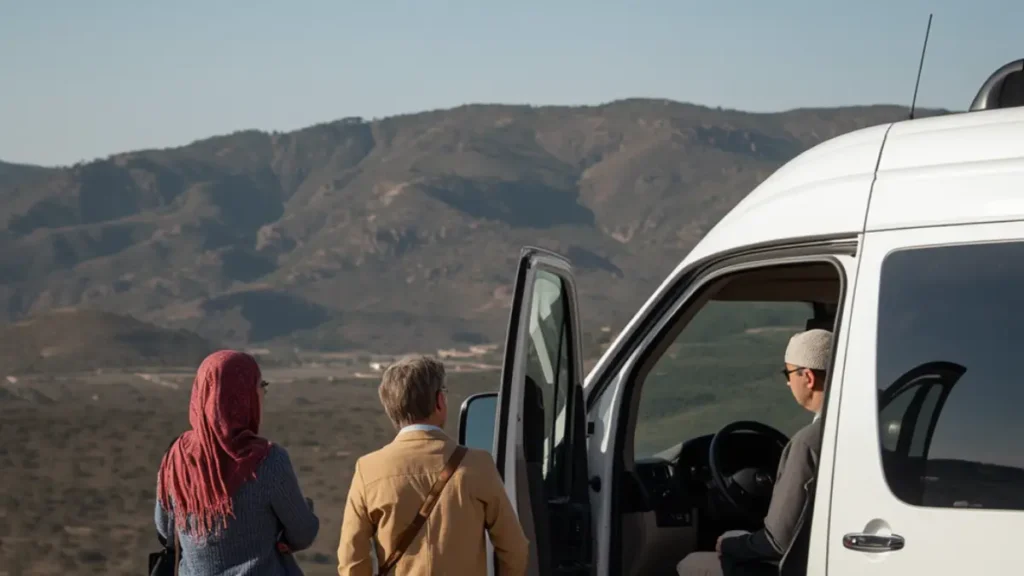
For many travelers, hiring a private driver for the Atlas Mountains pass offers the best balance between comfort and flexibility.
A current planning range for a private one-way vehicle is approximately 1,200–1,500 MAD, although the final quote depends on the vehicle, group size, luggage, pickup location and planned stops. Do not assume that a Telouet and Aït Benhaddou sightseeing route is included in the price of a direct transfer.
A professional private service should clearly confirm:
- Pickup time and location
- Vehicle type
- Luggage capacity
- English-speaking assistance
- Direct route or sightseeing route
- Waiting time
- Entrance fees
- Lunch arrangements
- One-way or return service
- Cancellation terms
A private driver is particularly useful for families, older travelers, groups with luggage and anyone continuing to the Sahara.
How to get from Marrakech to Ouarzazate by bus
CTM and Supratours provide the main budget-friendly bus services.
Recent listings show Supratours fares around 90–140 MAD, with a journey time of roughly four hours and ten minutes. CTM also operates on the route. Schedules and fares can change, so check the live company website or station before planning a tight connection.
The bus is best when:
- Your budget is the priority.
- You only need transportation.
- You are staying in Ouarzazate.
- You do not need scenic stops.
- You can work around fixed departure times.
Book in advance during holidays, weekends and busy travel periods. A full bus can leave you waiting for a later departure.
Transport comparison
| Option | Typical cost | Flexibility | Stress level | Best for |
|---|---|---|---|---|
| Public bus | About 90–180 MAD | Low | Low to moderate | Solo budget travelers |
| Shared grand taxi | Variable | Low | Moderate | Flexible travelers with light luggage |
| Rental car | Live rental rate plus fuel | Very high | High for inexperienced drivers | Independent road trips |
| Private driver | Often around 1,200–1,500 MAD one way | High | Low | Families, couples and small groups |
| Organized day tour | Varies by group and inclusions | Low to moderate | Low | Travelers with only one available day |
Bus schedules and prices change. Check the official CTM or Supratours booking platform for the live fare and departure time before arranging a connection.
The Five Best Stops and Detours
Not every place below sits directly beside the main N9. Some require a detour or an additional night. That distinction matters when planning a realistic itinerary.
1. Kasbah Telouet
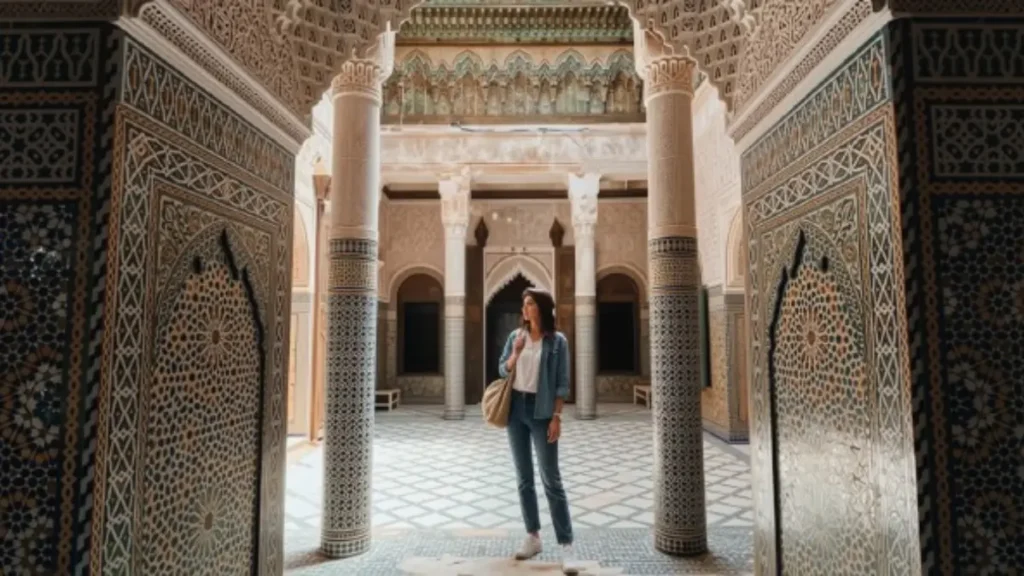
Telouet was associated with the powerful Glaoui family, once known as the Lords of the Atlas.
From the outside, parts of the kasbah appear badly weathered. Inside, restored rooms reveal carved cedar, painted ceilings, geometric plasterwork and intricate zellij tilework.
That contrast is what makes Telouet special. It is not a perfectly restored monument. It shows both power and decline.
Allow approximately one hour for the kasbah itself, plus extra driving time. From Telouet, the scenic Ounila Valley road continues toward Aït Benhaddou.
The palace deserves more than a quick paragraph, so I have prepared a complete guide to visiting Telouet Kasbah from Marrakech, including its Glaoui history, road access and realistic timing.
2. Aït Benhaddou
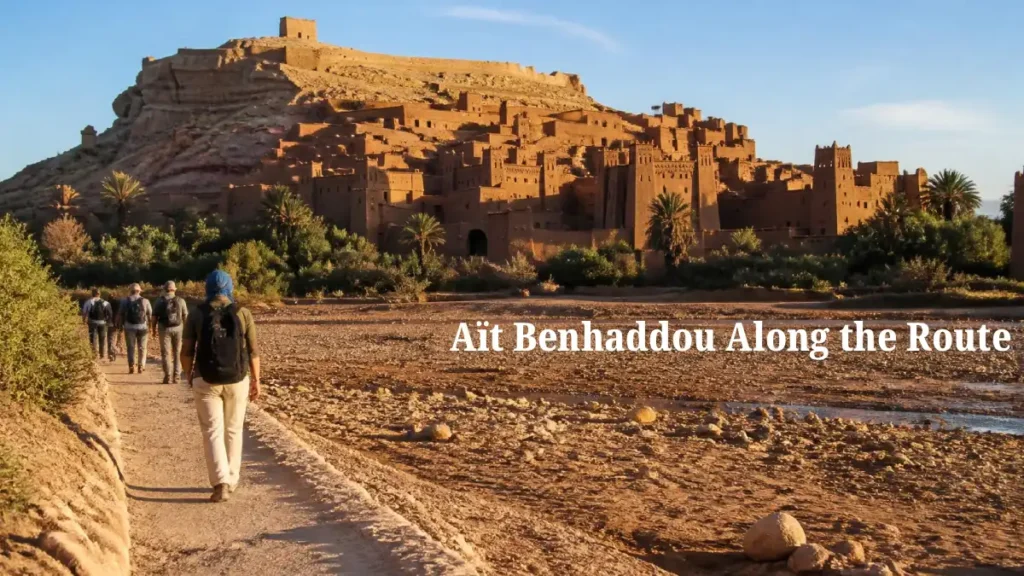
Aït Benhaddou is a fortified earthen village, or ksar, and has been a UNESCO World Heritage Site since 1987. UNESCO recognizes it as an important example of the traditional earthen architecture of southern Morocco. (UNESCO World Heritage Centre)
The village has appeared in major international productions, but it is not only a film location. Families, preservation workers, guides and small businesses remain connected to the site.
Allow at least two hours. Half a day is better if you want to cross the river, climb to the granary, explore slowly and eat lunch without watching the clock.
When Aït Benhaddou is your main destination, see my detailed guide to traveling from Marrakech to Aït Ben Haddou for transport choices, route options, prices and day-trip advice.
3. Oasis Fint
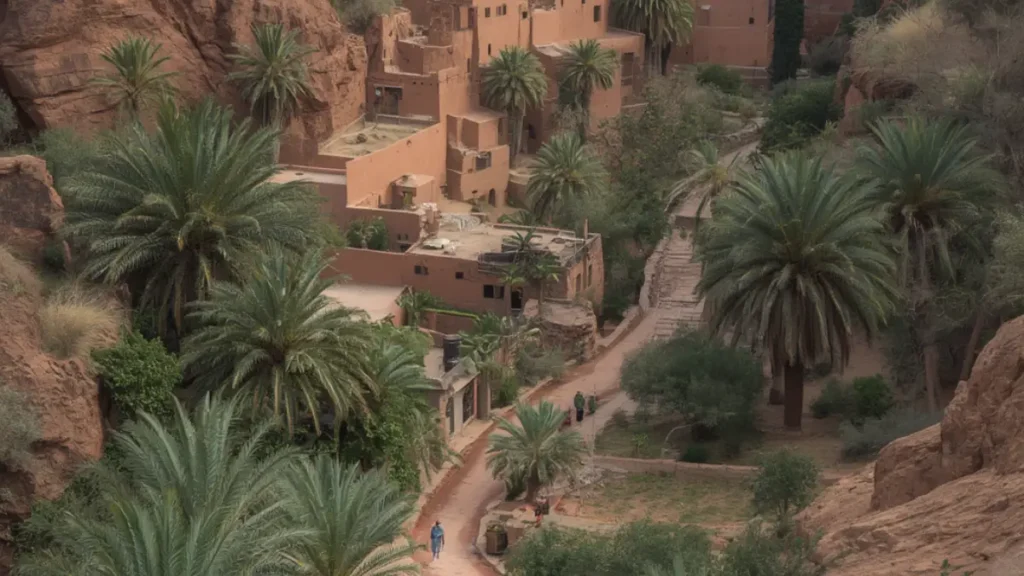
Oasis Fint lies south of Ouarzazate rather than directly on the Marrakech road.
The appeal is the contrast: palms, cultivated gardens and village homes sit inside a dry red-rock canyon.
Allow approximately one to one and a half hours for a relaxed visit. A local guide can be useful when you want to understand irrigation, farming and village life rather than simply photograph the palms.
This is where respectful Amazigh hospitality, often described as Berber hospitality in older travel writing, matters more than staged entertainment.
4. Kasbah Amridil in Skoura
Kasbah Amridil is east of Ouarzazate, so it belongs on an overnight or onward itinerary rather than a rushed Marrakech day trip.
The property provides one of the clearest introductions to traditional kasbah life, including food storage, irrigation, household organization and defensive architecture. Its image was also associated with an older Moroccan 50-dirham banknote. (Slow Morocco)
Combine it with the Skoura palm grove and stay overnight if your schedule permits.
5. The “Gas Haven” film set
The abandoned roadside set associated with The Hills Have Eyes appeals to horror-film fans.
It is eerie, dusty and deliberately artificial, with decaying vehicles and a staged American gas-station atmosphere.
Access conditions can change. Do not enter unstable structures, cross barriers or assume that an apparently abandoned set is public property. Ask locally before visiting.
Ouarzazate fits naturally into a longer southern Morocco route. See my 10-day Morocco itinerary for a balanced journey through Marrakech, the High Atlas, Aït Benhaddou and the Sahara.
Things to Do in Ouarzazate: Morocco’s Film Capital
Atlas Film Studios
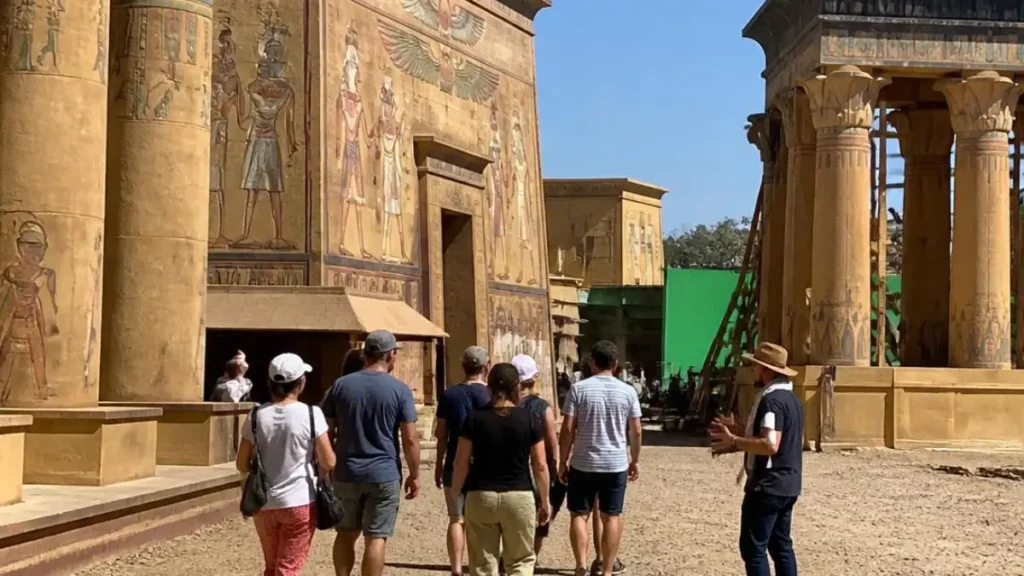
Atlas Studios is one of Ouarzazate’s main attractions and one of the world’s largest studio complexes by land area.
The attraction is not polished like a modern theme park. You walk through freestanding walls, aging props, temples, palaces and streets built to become ancient cities on camera.
The official studio currently lists admission at 80 MAD, or 110 MAD for a combined visit including the Kingdom of Heaven set. It is generally open daily from 8:30 a.m. until sunset, although the visitor route can change when filming is underway. Confirm live details before going. (atlasstudio)
Films and series associated with the studios include Gladiator, The Mummy, Kingdom of Heaven, Ben Hur, The Passion of the Christ and Game of Thrones.
My honest advice: visit if you enjoy cinema or production design. Skip it if you expect a highly interactive attraction with digital exhibitions and perfect maintenance.
CLA Studios
CLA Studios offers another view of Ouarzazate’s cinema industry, including the large Jerusalem set built for Kingdom of Heaven.
The studio’s official site says it is open to visitors, but recent traveler reports about public access have been inconsistent. Confirm directly before making a special journey. (atlasstudio)
Kasbah Taourirt
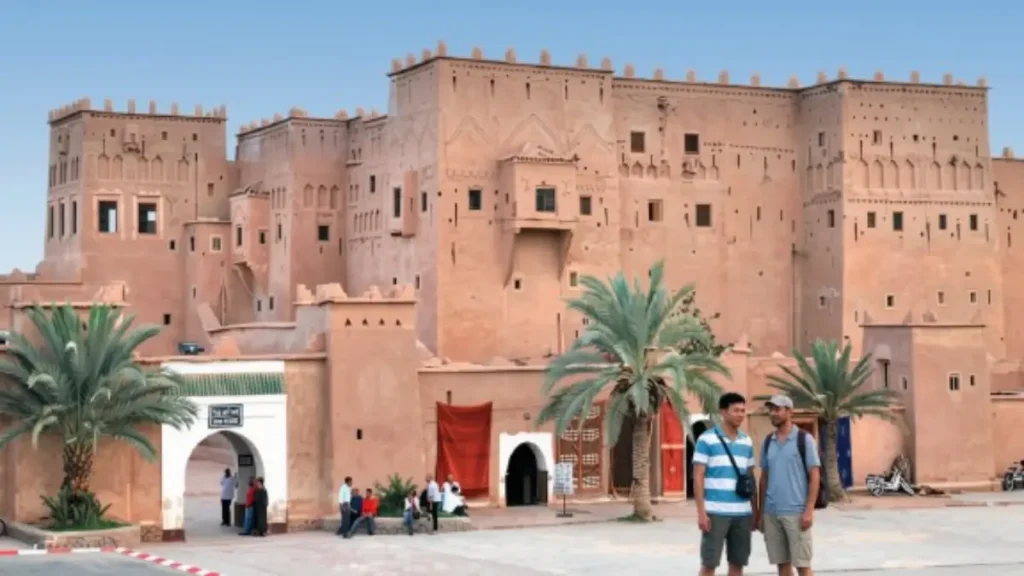
Kasbah Taourirt dominates central Ouarzazate and was an important Glaoui residence.
Its corridors, courtyards and decorated rooms once formed part of a much larger complex. Earthquake damage and restoration work have affected visitor access, and recent reports indicate that only part of the monument may be open. Check the accessible area and fee before hiring a guide. (OUARZAZATE EVENTS)
Never accept an unofficial guide simply because someone is wearing a badge. Ask for the price, duration and credentials before the tour begins.
Cinema Museum
The Cinema Museum sits opposite Kasbah Taourirt and historically displayed sets, props and older film equipment.
A serious fire in June 2024 caused substantial damage. Because local listings have not always been consistent about reopening and access, confirm its current status on the day rather than building your itinerary around it. (Ouarzazate.city)
Noor Solar Energy Complex
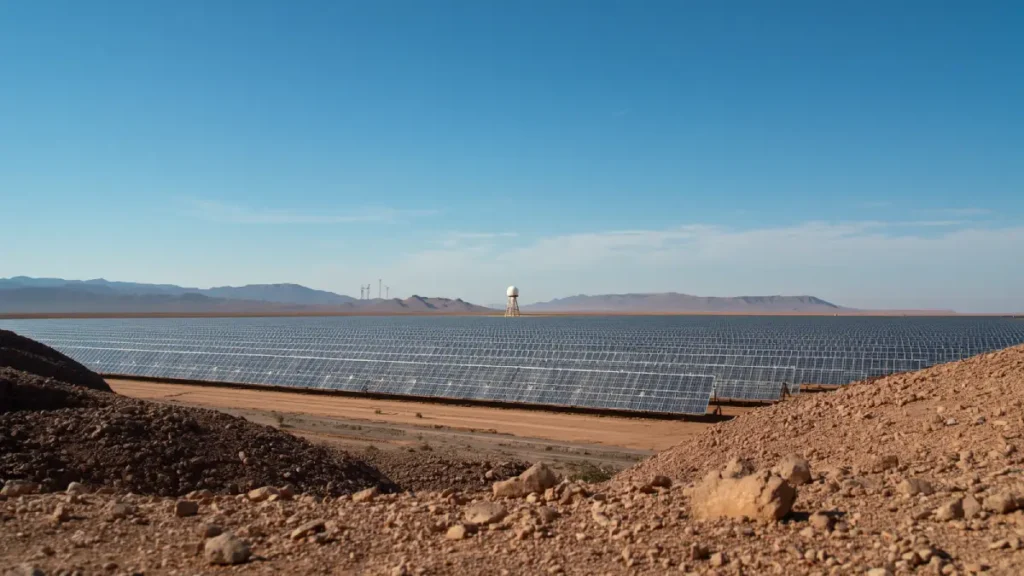
The Noor complex is one of the region’s most striking modern landmarks, bringing together several solar-power technologies outside Ouarzazate.
The bright central tower can be visible from a considerable distance. This is not normally a casual walk-in attraction. Local visitor information indicates that an advance request may be required, sometimes around one month before the proposed visit. (Ouarzazate.city)
For most travelers, Noor is something to understand and view from a permitted distance rather than tour spontaneously.
Where to Stay: Ouarzazate, Aït Benhaddou or Skoura?
Some links in this guide are affiliate links. If you book through them, I may earn a small commission at no additional cost to you. I only recommend options that appear relevant and useful for travelers.
Oscar Hotel by Atlas Studios
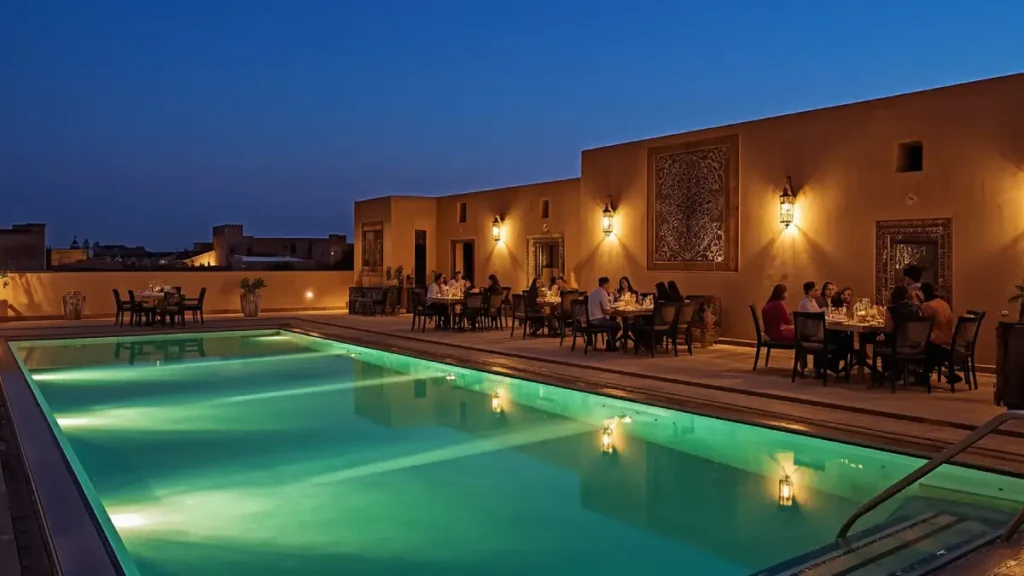
This is the obvious choice for movie fans. It sits next to Atlas Studios and offers cinema-themed rooms, a pool and convenient access to studio tours. (Oscar Hotel)
Kasbah Tebi in Aït Benhaddou
Kasbah Tebi is inside the old ksar and describes itself as an approximately 400-year-old fortified Amazigh house restored by descendants of its builders. It is one of the strongest options for travelers who want the experience of staying in an authentic mud-brick kasbah. (Kasbah Tebi on Booking)
The main advantage is location. After the day-trip groups leave, Aït Benhaddou becomes much quieter.
Berbère Palace
Berbère Palace suits travelers seeking higher-end comfort in Ouarzazate, with facilities including a pool, hammam, sauna and spa services. (Berber Palace on Booking)
Riad Dar Daïf
Dar Daïf is outside the busy center near Lake Mansour Eddahbi. It emphasizes traditional architecture, gardens, terraces, a pool and a quieter atmosphere. (Hôtel Riad Dar Daïf on Booking)
Which base should you choose?
- Choose Ouarzazate for restaurants, fuel, supermarkets and practical convenience.
- Choose Aït Benhaddou for sunrise, sunset and atmosphere.
- Choose Skoura for palm groves, kasbahs and a slower experience beyond the standard circuit.
Still deciding whether Ouarzazate should be an overnight base? Compare the regions and accommodation styles in my guide to where to stay in Morocco.
Is an Ouarzazate Day Trip From Marrakech Worth It?
An Ouarzazate day trip from Marrakech is possible, but it is demanding.
Even without delays, you may spend eight or more hours inside a vehicle. Add mountain stops, Aït Benhaddou, lunch and a studio visit, and the day can stretch to 12 or 13 hours.
My honest answer to “Is a Marrakech to Ouarzazate day trip worth it?” is:
Yes, when it is your only opportunity and you accept a long day. No, when you have enough time to stay overnight.
For a realistic same-day itinerary, choose no more than two major attractions in addition to short road stops. For example:
- Tizi n’Tichka viewpoint
- Aït Benhaddou
- One Ouarzazate attraction
Trying to include Telouet, Aït Benhaddou, Atlas Studios, Kasbah Taourirt, Oasis Fint and a relaxed lunch is not good planning. It is a checklist.
An overnight stay gives you time to see Aït Benhaddou after the crowds, explore Ouarzazate properly and continue toward Skoura or the Sahara without repeating the pass in one day.
Ouarzazate is only one of several long excursions from the city. Compare it with the other best day trips from Marrakech before committing to eight or more hours on the road.
Safety, Scams and Practical Logistics
Driving and police controls
Police patrols and radar checks are common, especially near villages and changing speed zones.
You may see Moroccan drivers flash their headlights to warn others about controls. Treat that only as local road behavior, not permission to speed. Follow the posted limit.
False “road closed” warnings
A genuine closure after snow, flooding or rockfall is possible.
A stranger casually telling you that a road, alley or attraction is closed may also be trying to redirect you toward a shop or paid guiding service.
Check with:
- Police
- Gendarmerie
- Your hotel
- Your licensed guide
- Your driver
- An official ticket office
Do not follow someone simply because they appear confident.
Fake guides and unclear prices
At kasbahs and popular stops, confirm the full guiding fee before beginning. Ask whether the guide is official and whether entrance tickets are included.
A friendly conversation can become an expensive misunderstanding when nobody agrees on the price.
Mobile coverage
For a road trip through rural Morocco and the Atlas, I generally favor Maroc Telecom for reach outside major cities. Inwi can offer good value, but coverage varies by valley and exact location. Download offline maps before departure and do not depend on continuous reception. Recent comparisons also tend to favor Maroc Telecom for remote and Atlas coverage.
Need Mobile Data for Your Morocco Road Trip?
Compare Moroccan SIM cards and travel eSIMs before you arrive, including network coverage, data packages, activation steps, and the best option for rural routes.
Drinking water
Water quality and traveler tolerance vary.
For drinking, I recommend sealed bottled water or properly treated water, especially in remote areas. General travel-health guidance recommends factory-sealed bottled water wherever tap-water safety is uncertain. (CDC)
Clothing and cultural respect
Women do not need to cover their hair for ordinary travel, but loose clothing covering the shoulders and knees is practical and respectful in villages.
Men should also avoid very short shorts in conservative rural areas.
Carry a light scarf for sun, wind, dust and visits where more coverage feels appropriate. Linen and cotton work well in hot weather, but always keep a warmer layer for the mountain crossing.
Best Time to Visit Ouarzazate and What to Pack
The best periods are usually:
- Late March to May
- September to November
Spring and autumn offer the best balance between clear mountain roads and manageable desert temperatures.
July and August can be extremely hot in Ouarzazate. Plan outdoor visits early, rest during the hottest part of the afternoon and carry more water than you think you need.
Winter can be beautiful, but snow and ice may affect Tizi n’Tichka. When heavy weather is forecast, check current conditions immediately before departure and be prepared to delay.
Pack:
- Motion-sickness medication
- Sun hat and sunglasses
- Sunscreen
- Warm layer
- Light scarf
- Comfortable walking shoes
- Bottled water
- Cash in small denominations
- Power bank
- Offline maps
- Travel insurance details
My Honest Recommendation
The best way to travel from Marrakech to Ouarzazate depends on your time, confidence on mountain roads, and how many stops you want to include.
- For a direct journey, take the N9 and allow enough time for safe breaks.
- For the best scenery and history, travel through Telouet and the Ounila Valley to Aït Benhaddou, then continue to Ouarzazate. This route deserves a full day.
- For a budget trip, take CTM or Supratours and explore after arrival.
- For families, photographers, film enthusiasts and travelers continuing toward the Sahara, a private driver is usually worth the additional cost. You gain control over timing, luggage, stops and road decisions.
Ouarzazate is an important gateway rather than the final desert destination. Travelers continuing south should compare the routes in my guide to the best Sahara Desert tours from Marrakech.
Morkosh Tours can arrange one-way transfers, customized road trips, overnight routes and multi-day Sahara journeys from Marrakech through Ouarzazate. Contact me with your date, group size, luggage and preferred stops, and I will tell you honestly what fits into the available time.
Planning a Marrakech to Ouarzazate trip? Send me your date, group size, luggage, and preferred stops. I will suggest a realistic route and explain what can comfortably fit into your available time.
Frequently Asked Questions
How long is the drive from Marrakech to Ouarzazate?
A direct drive normally takes around four hours in favorable conditions. Allow five to six hours when you include coffee, photographs, traffic and rest stops.
What is the Marrakech to Ouarzazate distance?
The road distance is approximately 195–200 kilometers. The journey takes longer than the distance suggests because it crosses the High Atlas Mountains.
Is it safe to drive over Tizi n’Tichka?
Yes, in normal weather and with careful driving. The road is paved, but it has sharp bends, steep sections, trucks and changing weather, so inexperienced drivers may prefer a professional driver.
How do I get to Ouarzazate from Marrakech by bus?
CTM and Supratours operate intercity buses on the route. Check the live schedule and fare before traveling, and book early when your dates are fixed.
Can I visit Aït Benhaddou in one day from Marrakech?
Yes, but it creates a long day with at least eight hours of return driving. Staying overnight allows you to see the ksar at sunrise or sunset without the busiest day-trip crowds.
Is an Ouarzazate day trip from Marrakech too tiring?
It can be. The trip is reasonable for travelers with limited time, but you should restrict the number of major stops and avoid turning the day into a rushed checklist.
What movies were filmed in Ouarzazate?
Productions connected to Atlas Studios and the surrounding region include Gladiator, The Mummy, Kingdom of Heaven, Ben Hur, The Passion of the Christ and Game of Thrones. Exact locations vary between the studios, Aït Benhaddou and other regional sets.
Should I stay in Ouarzazate or Aït Benhaddou?
Stay in Ouarzazate for practical facilities and easier access to studios. Stay in Aït Benhaddou for atmosphere, heritage accommodation and a quieter sunrise or sunset experience.
