
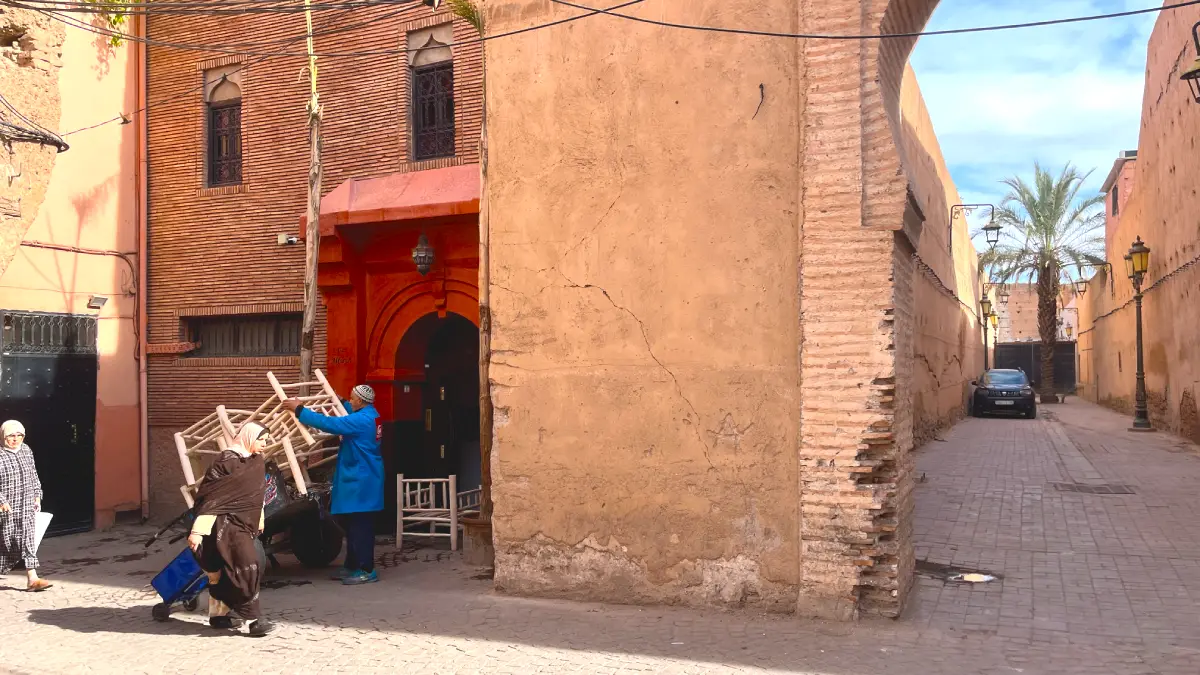
Where to Stay in Marrakech: Best Areas for First-Time Visitors
Choosing where to stay in Marrakech matters more than many first-time visitors expect.
Two riads can look almost identical in photographs but give you completely different trips depending on their location.
One might put you five minutes from the souks and Jemaa el-Fna.
Another may be buried deep inside narrow Medina alleys where taxis cannot reach, Google Maps struggles, and finding the entrance after dark becomes part of the adventure — whether you wanted that adventure or not.
I have been a licensed Moroccan tour guide since 2004, and when guests ask me where they should stay in Marrakech, I normally start with one question:
What kind of Marrakech experience do you actually want?
For most first-time visitors, my overall recommendation is Mouassine.
It gives you the atmosphere people imagine when they picture Marrakech, while keeping the main souks and Jemaa el-Fna within easy walking distance.
But Mouassine is not right for everybody.
Dar El Bacha is better for travelers who want a quieter, more polished Medina base. Kasbah works well if easier vehicle access matters. The Mellah can offer a more local and less commercial atmosphere. And Gueliz or Hivernage are better choices if you prefer modern hotels, pools, elevators and straightforward taxi access.
This guide will help you choose the area first.
Once you know the right neighborhood, choosing the riad or hotel becomes much easier.
For general planning, transport, airport arrival and first-time advice, also see my Marrakech Travel Guide.
Table of Contents
Table of Contents
Where to Stay in Marrakech: Quick Answer
If you do not want to read the whole guide, this is how I would summarize it.
Best overall for first-time visitors:
Mouassine
Best for a quieter, stylish Medina stay:
Dar El Bacha
Best for walking to Jemaa el-Fna:
Riad Zitoun / southern central Medina
Best for quieter Medina atmosphere and easier access:
Kasbah
Best for history, value and a less commercial atmosphere:
Mellah
Best for easier Medina access from main roads:
Bab Doukkala / Bab Laksour area
Best for modern comfort:
Gueliz
Best for luxury hotels and pools:
Hivernage
Best for resort holidays:
Palmeraie
Area I would normally choose for a first Marrakech trip:
Mouassine
Best Areas to Stay in Marrakech at a Glance
| Area | Best For | Main Advantage | Main Trade-Off |
|---|---|---|---|
| Mouassine | First-time visitors | Central, atmospheric, highly walkable | Busy at peak times |
| Dar El Bacha | Couples, food lovers, stylish stays | Quieter, polished Medina atmosphere | Slightly farther from Jemaa el-Fna |
| Riad Zitoun | Short stays, square access | Very convenient for Jemaa el-Fna | Can feel touristy/busy |
| Kasbah | Families, calmer Medina stay | Easier access, quieter feel | Less central for northern souks |
| Mellah | Value, history, local atmosphere | Less commercial and near major sights | Different atmosphere from postcard souks |
| Bab Doukkala / Bab Laksour | Nervous first-timers | Easier access from real streets/gates | Location varies property by property |
| Gueliz | Modern comfort | Taxis, restaurants, hotels, easy access | Requires taxi/walk to Medina |
| Hivernage | Luxury | Resorts, pools, nightlife, vehicle access | Less traditional atmosphere |
| Palmeraie | Resort stays | Space, pools, tranquility | Poor choice for short sightseeing trips |
1. Mouassine — Best Overall for First-Time Visitors
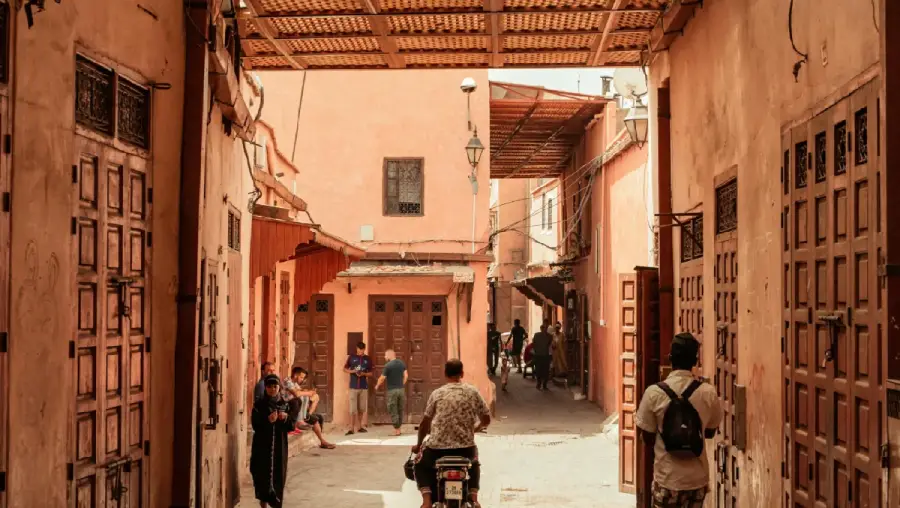
If a first-time visitor asks me for one Marrakech neighborhood without giving me any other preferences, Mouassine is usually where I start.
It sits inside the Medina close to the souks and within comfortable walking distance of Jemaa el-Fna, but it also has enough attractive riads, cafés, boutiques and traditional architecture to give visitors the Marrakech atmosphere they came for.
This is what I mean by full immersion without making the trip unnecessarily difficult.
You can step outside your riad and immediately feel that you are inside the old city.
At the same time, you are not spending half your day commuting into the Medina.
Who I recommend Mouassine for
- first-time visitors
- couples
- travelers staying two to four nights
- people who want the classic riad experience
- visitors who plan to explore mainly on foot
- travelers who want easy access to souks and Jemaa el-Fna
The downside
Central means central.
Mouassine is not a silent residential retreat.
Depending on the exact riad and alley, you may hear street activity, people returning at night or the normal sounds of Medina life.
That is why I always tell travelers:
Choose the street and room location as carefully as you choose the riad itself.
My rating for first-timers: ★★★★★
2. Dar El Bacha — Best for a Quieter, Stylish Medina Stay
I often group Dar El Bacha and Mouassine together because they occupy a similar part of the northwestern Medina and attract travelers looking for beautiful riads, boutiques and a more polished atmosphere.
But they are not exactly the same.
If Mouassine is my recommendation for travelers who want to be right in the action, Dar El Bacha is better for visitors who want the Medina experience with slightly more breathing room.
I particularly like it for:
- couples
- repeat Marrakech visitors
- travelers interested in restaurants and cafés
- boutique-hotel travelers
- people who want Medina atmosphere without staying beside Jemaa el-Fna
Mouassine or Dar El Bacha?
If this is your first trip and you want maximum walkability:
Mouassine.
If you want a slightly quieter, stylish base:
Dar El Bacha.
Neither choice is wrong.
My rating: ★★★★★
3. Riad Zitoun — Best for Jemaa el-Fna Access
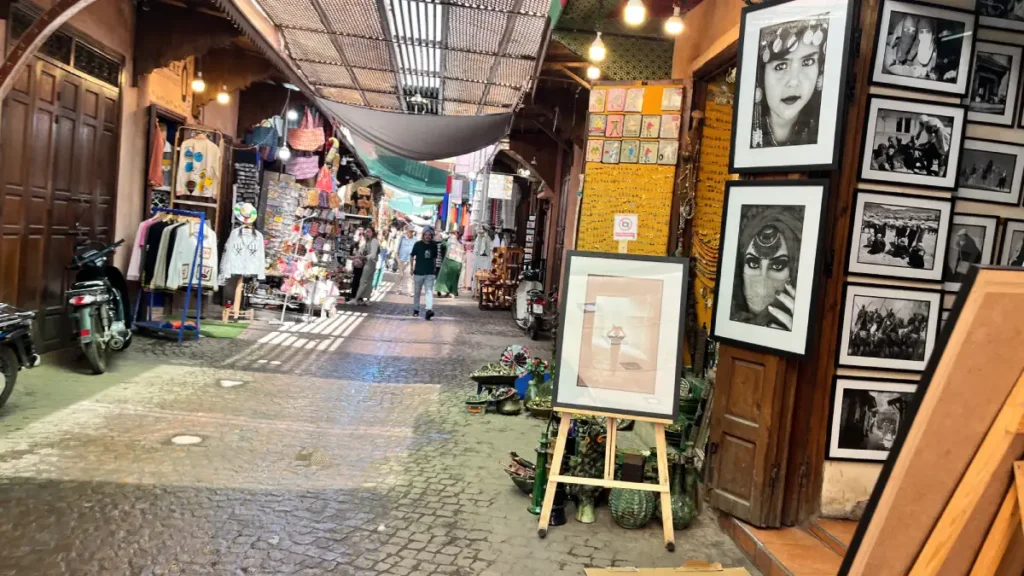
Riad Zitoun remains one of the most practical places to stay for travelers who want easy access to Jemaa el-Fna, Bahia Palace, the Mellah and the southern Medina.
You can walk into the heart of Marrakech quickly, and many first-time visitors appreciate not having to learn a complicated Medina route immediately.
I still recommend it.
But today, if someone asks me where I would choose for the strongest first-trip atmosphere, I generally put:
Mouassine → first
Dar El Bacha → second
Riad Zitoun → practical alternative
Riad Zitoun is particularly useful for visitors who:
- have only two or three nights
- want to walk easily to Jemaa el-Fna
- prefer a straightforward location
- want to combine the square with Bahia Palace and the Mellah
The trade-off
The closer you stay to Marrakech’s busiest tourist routes, the more commercial and energetic the surroundings can feel.
That is convenient.
It is not always peaceful.
My rating: ★★★★☆
4. Kasbah — Best for a Quieter Medina Stay and Easier Access
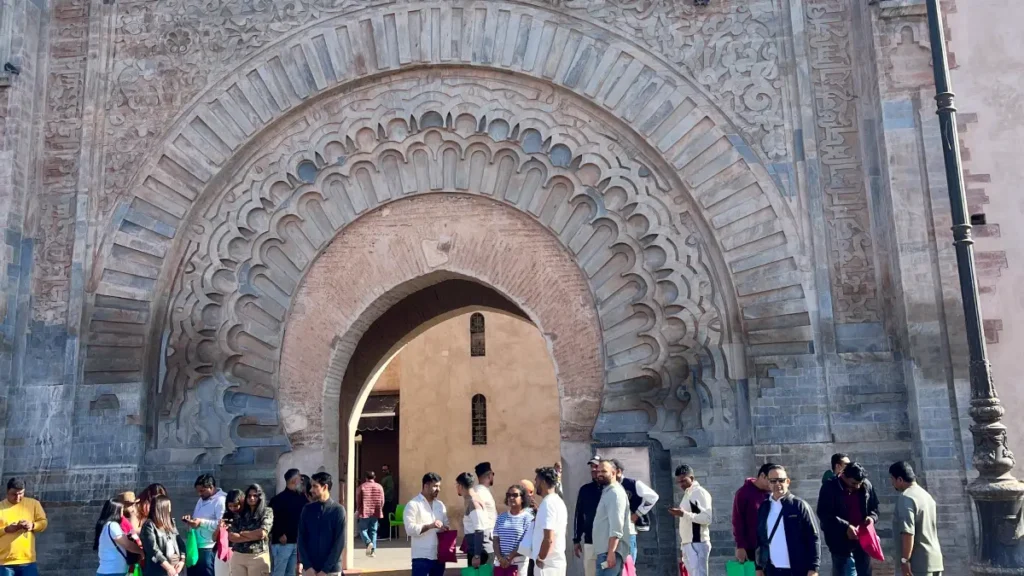
The Kasbah is one of my favorite recommendations for travelers who like the idea of staying inside the old city but do not need to be directly beside the central souks.
It feels more residential in places and gives you easy access to attractions such as the Saadian Tombs and the southern Medina.
Another advantage is vehicle access.
Not every riad is directly reachable by taxi, but compared with properties hidden deep inside the central souks, finding accommodation close to an accessible street or gate is often easier.
That matters more than it sounds.
Who should consider Kasbah?
- families
- couples who want a quieter base
- travelers with heavier luggage
- visitors who are nervous about deep Medina navigation
- people who still want a riad rather than a modern hotel
The trade-off
You will walk farther to some northern Medina attractions such as Ben Youssef Madrasa and parts of the souks.
For me, that is often a reasonable compromise.
My rating: ★★★★☆
5. Mellah — Best for History, Value and a Less Commercial Atmosphere
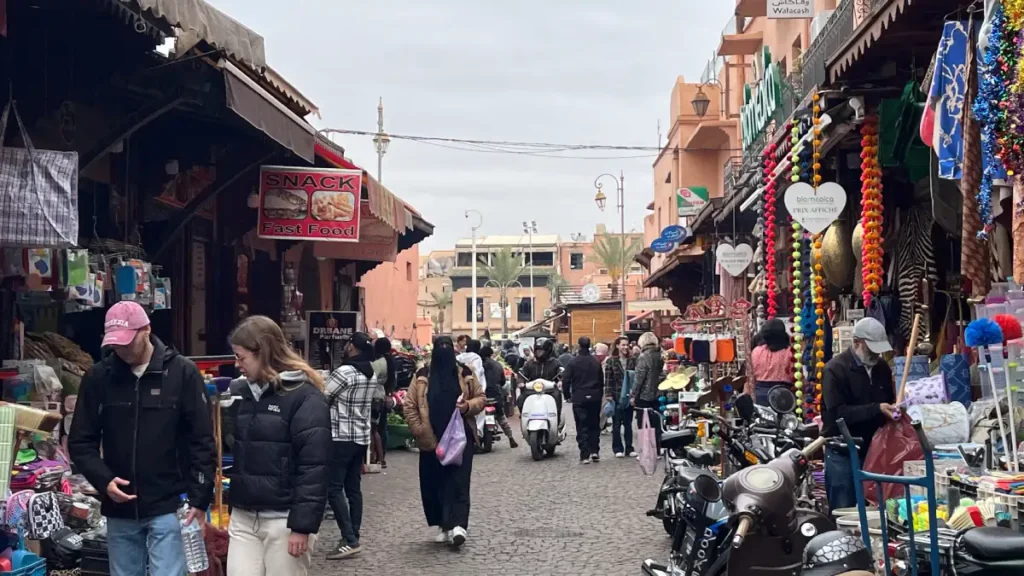
The Mellah is sometimes treated only as somewhere to visit.
I think that undersells it.
You can absolutely stay here.
For first-time visitors who want something quieter and less commercial than the central souks, the Mellah can be a very good choice.
You are still within walking distance of major attractions such as Bahia Palace, the southern Medina and the Kasbah, while experiencing a different part of Marrakech.
I also like the neighborhood for travelers interested in:
- history
- street food
- local markets
- better-value accommodation
- quieter evenings than the central souks
Who might prefer somewhere else?
If your dream Marrakech trip means stepping out of your riad directly into postcard-perfect northern Medina lanes and design boutiques, Mouassine or Dar El Bacha will probably suit you better.
But if you want less polish and more everyday neighborhood atmosphere, consider the Mellah seriously.
My rating: ★★★★☆
6. Bab Doukkala and Bab Laksour — Good for Easier Medina Access
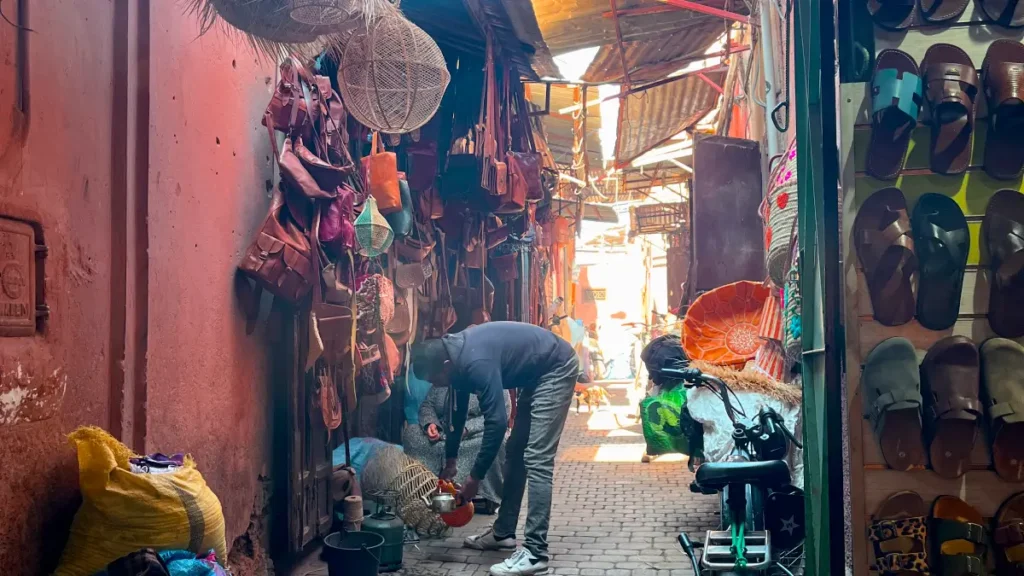
One of the most overlooked things when choosing where to stay in Marrakech is the final five minutes.
Travelers look at Google Maps and think:
“The riad is only 900 metres from the square.”
That tells you almost nothing about the actual arrival experience.
A riad located close to a proper street, taxi drop-off point or Medina gate can be dramatically easier to reach than one hidden deep inside twisting lanes.
For nervous first-time visitors, I often prefer accommodation near accessible areas such as Bab Doukkala or Bab Laksour rather than somewhere buried deep inside the souks.
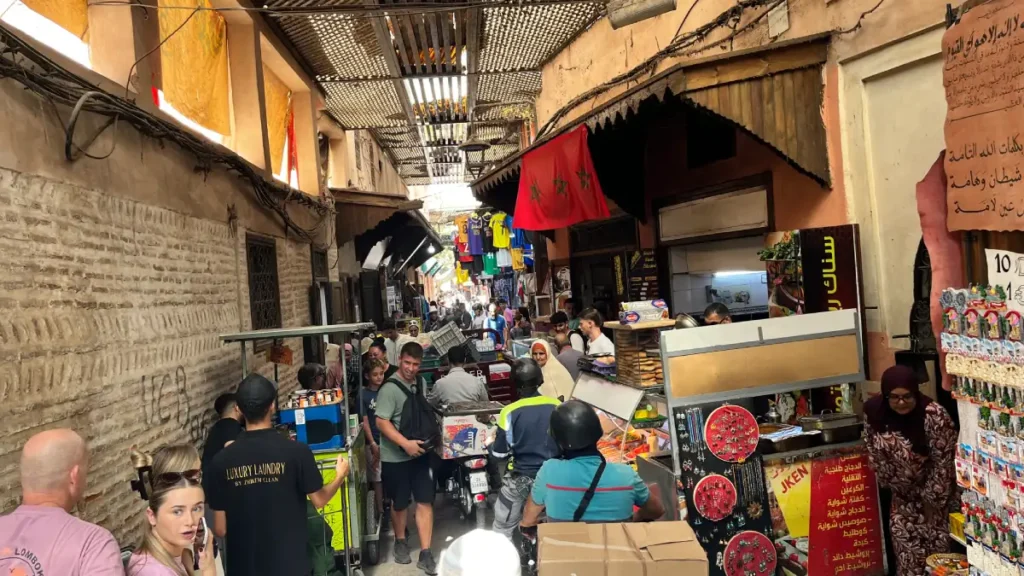
My five-minute rule
Before booking, ask:
How long do I have to walk from the nearest place a taxi can actually reach?
If the answer is more than about five minutes through complicated alleys, understand what you are choosing.
For adventurous travelers, that may be fine.
For a family arriving at 11 PM with suitcases, it can feel very different.
7. Gueliz — Best for Modern Comfort
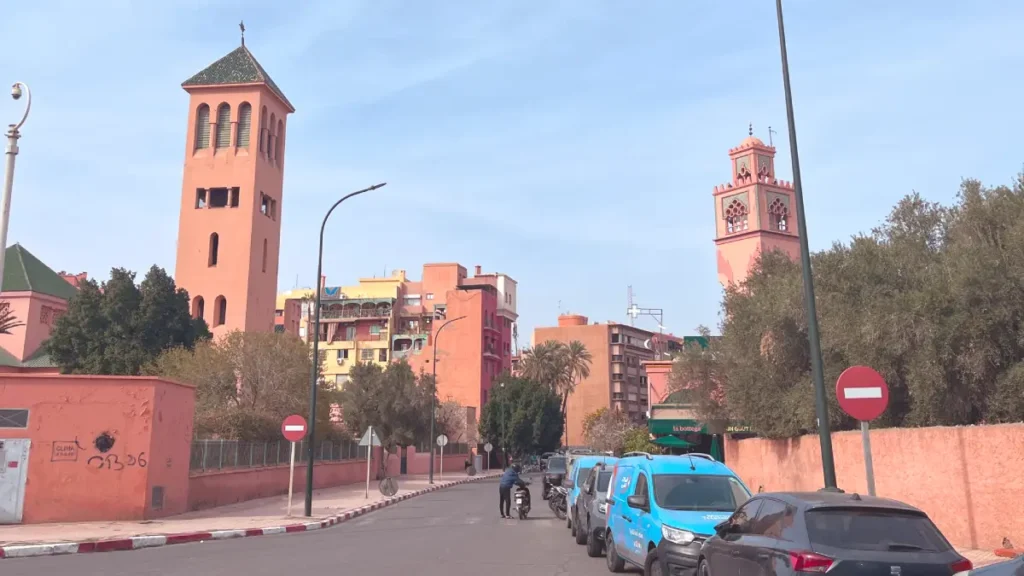
Not everyone should stay in the Medina.
Some travelers are simply happier in Gueliz.
This is modern Marrakech: wide streets, cafés, restaurants, shops, modern hotels and easier vehicle access. Morocco’s official tourism site also presents Gueliz as part of the city’s modern side, contrasting it with the historic Medina.
You can leave your hotel, get into a taxi and go.
No luggage porter.
No hidden alley.
No trying to remember whether the blue door was before or after the bakery.
I recommend Gueliz for
- travelers who prefer modern hotels
- people with reduced mobility
- visitors who dislike navigating narrow Medina streets
- digital nomads
- travelers who want nightlife/restaurants nearby
- anyone who values elevators, large rooms and straightforward access
If evening options are part of your decision, use my Marrakech nightlife guide to compare relaxed Gueliz bars with Hivernage clubs and Medina rooftops.
The disadvantage
You lose the experience of waking up inside the Medina.
You will normally need a taxi or longer walk for old-city sightseeing.
There is no universal answer here.
Some travelers come to Marrakech specifically for the riad experience.
Others sleep much better in Gueliz and enjoy visiting the Medina during the day.
My rating: ★★★★☆
8. Hivernage — Best for Luxury Hotels, Pools and Easy Access
Hivernage is another modern alternative to the Medina, but its personality is different from Gueliz.
Think more:
- upscale hotels
- resort-style pools
- restaurants
- bars and nightlife
- easier vehicle access
- larger properties
If your idea of Marrakech includes sightseeing during the day and returning to a comfortable luxury hotel with a pool afterward, Hivernage makes sense.
It is particularly good for:
- luxury travelers
- couples
- travelers who want resort facilities
- short stays where convenience matters
The trade-off is obvious:
you are staying near historic Marrakech rather than inside it.
My rating: ★★★★☆ for luxury travelers
9. Palmeraie — Best for Resorts, Not Short Sightseeing Trips
Palmeraie can look extremely appealing in photographs.
Large gardens.
Pools.
Space.
Resort hotels.
Quiet.
And for the right trip, it is excellent.
But I would not normally recommend Palmeraie for a first-time visitor with only two or three days whose main goal is exploring Marrakech.
Why?
Because every trip into the Medina becomes transport.
You lose the ability to walk out of your accommodation and immediately start exploring.
Who should stay in Palmeraie?
- resort-focused travelers
- families who want pools and space
- people staying longer
- repeat visitors
- travelers who want relaxation more than sightseeing
Who should not?
A first-time visitor with 48 hours who wants to explore the Medina intensively.
For that traveler, location beats resort space.
Riad or Hotel in Marrakech?
This is one of the biggest decisions travelers make.
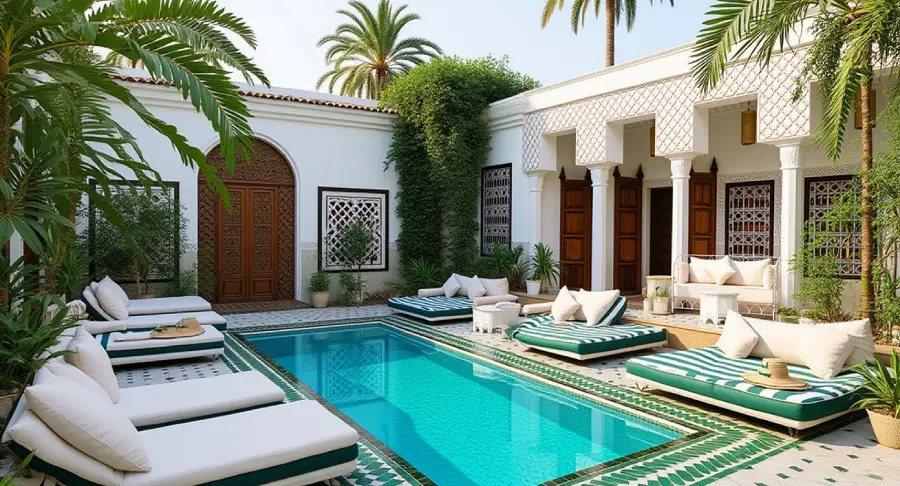
Choose a riad if you want:
- traditional Moroccan architecture
- a smaller, more intimate stay
- Medina atmosphere
- courtyards and rooftop terraces
- personal service
- the feeling of living inside the old city
Choose a hotel if you want:
- easier vehicle access
- elevators
- large swimming pools
- more predictable room layouts
- modern facilities
- larger rooms
- easier luggage handling
Neither is more “authentic” simply because of the label.
A badly located riad can make your trip stressful.
A good hotel can make Marrakech much easier for the right traveler.
Choose based on how you actually travel — not on what Instagram says a Morocco holiday should look like.
If you have already decided to stay in the medina and want specific properties, see my guide to the best riads in Marrakech, with options for luxury, families, pools and better-value stays.
The Biggest Marrakech Accommodation Mistake I See
The biggest mistake is surprisingly simple:
arriving at a Medina riad without arranging how you will actually reach the door.
A taxi can rarely drive directly to a riad hidden inside the old Medina.
The driver may leave you at a nearby gate, square or accessible street.
Then what?
You have luggage.
It may be dark.
Google Maps may be struggling inside narrow covered alleys.
Before choosing or arriving at a riad, use my Marrakech city map to understand the main districts, Medina gates and vehicle-accessible areas.
And every doorway starts looking the same.
This is how many Marrakech trips begin unnecessarily badly.
What I recommend
Before arrival, ask your riad:
Where exactly will my taxi drop me?
How far is the walk?
Can someone meet me?
Can you arrange a porter?
For a first arrival, especially after dark, I strongly recommend having the riad send someone to the nearest taxi drop-off point.
After one or two days, the route may feel obvious.
On the first night it often does not.
For airport transport itself, see my Marrakech Airport to Medina guide.
7 Things to Check Before Booking a Marrakech Riad
A beautiful Booking.com or Instagram gallery is not enough.
Before booking, check these seven things.
1. Distance From the Nearest Vehicle Access
Do not measure only the distance to Jemaa el-Fna.
Ask how far you must walk with luggage from where a taxi can stop.
2. Ground-Floor or Upper-Floor Room?
Riad courtyards are beautiful.
They also carry sound.
Ground-floor rooms can sometimes hear breakfast preparation, conversations, reception activity and people crossing the courtyard.
If you are a light sleeper, ask about room position.
3. Mosque Proximity
The call to prayer is part of life in Marrakech.
Some travelers love waking to it.
Others discover at dawn that their riad is immediately beside a mosque.
If you are extremely sensitive to sound, check the location before booking.
4. Heating and Air Conditioning
Do not assume Marrakech is hot all year.
Winter nights can feel surprisingly cold inside traditional buildings.
Likewise, good air conditioning matters enormously during hotter periods.
Ask what the room actually has.
This matters especially during January, when sunny afternoons can hide surprisingly cold mornings, evenings and interior courtyards; my Marrakech January guide explains what conditions to expect.
For December stays, my Marrakech in December guide explains what to expect from winter temperatures and what to confirm about bedroom heating before you book.
5. Pool or Plunge Pool?
Many riads advertise a “pool.”
Look carefully.
It may be a small courtyard plunge pool rather than somewhere designed for swimming.
That can still be lovely.
Just understand what you are booking.
6. Stairs
Traditional riads frequently have narrow staircases and no elevator.
This matters for:
- older travelers
- families with small children
- mobility limitations
- large luggage
Ask before booking, not after arriving.
7. Night-Time Route
Look at how you will return after dinner.
A beautiful riad five minutes down a complicated alley may feel completely different at midnight than at noon.
For nervous first-timers, I prefer simpler access.
How Much Does Accommodation Cost in Marrakech in 2026?
Prices vary substantially by season, room type, weekends, events and how far ahead you book.
But as a realistic high-season planning range, I would currently use roughly:
Budget riad or dar
€40–€70 per night
Expect simpler rooms, fewer facilities and sometimes a less central location.
Good mid-range riad
€100–€180 per night
This is where many travelers find the best balance of location, design, comfort and service.
Boutique or luxury riad
€200–€400 per night
At this level you are paying for design, service, location, larger rooms and a more refined experience.
Some famous luxury properties can cost considerably more.
Quality Gueliz hotel
€110–€220 per night
Modern facilities, straightforward taxi access and larger hotel infrastructure often make this attractive for travelers who do not need the riad experience.
Important
These are planning ranges, not fixed tariffs.
Marrakech accommodation prices can move dramatically between quiet periods and major holiday/high-demand dates.
Best Marrakech Areas for Different Travelers
Couples
My first choices:
Mouassine
Dar El Bacha
Both give you atmosphere, restaurants and beautiful riads without requiring a resort-style stay.
For luxury hotel couples:
Hivernage.
Families
I often prefer:
Kasbah
Gueliz
or a carefully chosen Medina riad with straightforward access.
Families should pay particular attention to:
- stairs
- pool safety
- family rooms
- vehicle access
- luggage
- distance from taxis
Solo Travelers
Mouassine is excellent if you want to be central.
Gueliz is easier if you prefer straightforward streets and modern infrastructure.
For a Medina riad, I would place extra importance on simple night-time access rather than choosing the prettiest property hidden deepest inside the alleys.
First-Time Visitors
Mouassine is my overall winner.
Then:
Dar El Bacha if you want quieter and stylish.
Kasbah if easier access matters.
Gueliz if you already know you prefer modern hotels.
Luxury Travelers
For traditional luxury:
choose a high-end riad in the Medina.
For full hotel facilities:
Hivernage.
For resort seclusion:
Palmeraie.
These are three completely different luxury experiences.
Where I Would Stay for 2, 3 or 5+ Nights
Two Nights
Stay central.
I would choose:
Mouassine
or
Riad Zitoun
You do not have enough time to waste commuting.
Three Nights
This is where you have more flexibility.
My choices:
Mouassine
Dar El Bacha
Kasbah
Pick according to whether you prioritize central atmosphere, quiet style or easier access.
Once you have chosen your base, use my 3 Days in Marrakech itinerary to plan those three days without wasting time crossing the city unnecessarily.
Five Nights or More
At this point Gueliz, Hivernage and even Palmeraie become more realistic because you have time to move between areas.
You could also split the stay.
For example:
three nights in a Medina riad + two nights in a hotel with a proper pool.
That gives you both experiences without forcing one property to do everything.
Want Specific Riad or Hotel Recommendations?
Once you have chosen the right neighborhood, then choose the property.
For dedicated accommodation recommendations, continue with:
You can also explore my broader Best Places to Stay in Morocco guide if Marrakech is only one stop on a longer trip.
Where to Stay in Marrakech FAQ
What is the best area to stay in Marrakech for first-time visitors?
For most first-time visitors, Mouassine is my overall recommendation.
It combines Medina atmosphere, excellent walkability and easy access to the souks and Jemaa el-Fna.
Is it better to stay in the Medina or Gueliz?
Choose the Medina if you want traditional riad atmosphere and to explore mainly on foot.
Choose Gueliz if you prefer modern hotels, easier taxis, larger rooms and straightforward access.
Is it safe to stay inside the Marrakech Medina?
Yes, but location matters.
The bigger issue for most visitors is not serious danger — it is confusion, complicated navigation and arriving through unfamiliar alleys after dark.
Choose a riad with a clear arrival plan.
Should I stay near Jemaa el-Fna?
If you have a very short trip, being close to the square is convenient.
But you do not need to sleep directly beside it.
Mouassine gives you central access with a different atmosphere, while Dar El Bacha is better if you prefer quieter evenings.
Is Mouassine a good place to stay?
Yes.
For first-time visitors, Mouassine is currently my favorite overall balance of location, atmosphere and walkability.
Is the Mellah a good place to stay?
Yes.
It can be particularly good for travelers who want history, value and a quieter, less commercial atmosphere while still being able to walk to major southern Medina attractions.
Should I stay in Palmeraie?
Only if the resort itself is part of the holiday.
For a short first visit focused on Medina sightseeing, I would stay closer to central Marrakech.
How much should I spend on a riad in Marrakech?
During high-demand periods, a rough planning guide is:
€40–€70 for budget options,
€100–€180 for a good mid-range riad,
and €200–€400 for boutique/luxury riads.
Actual prices vary significantly.
Should my riad arrange my airport pickup?
For your first Medina arrival, I strongly recommend arranging either a pickup or at least a meeting point with the riad or porter.
The important part is knowing how you will get from the taxi drop-off point to the actual door.
Final Recommendation From a Marrakech Guide
If this is your first trip and you are still unsure where to stay in Marrakech, this is how I would simplify the decision.
Choose Mouassine if you want the best all-round first-time experience.
Choose Dar El Bacha if you want something quieter and stylish.
Choose Kasbah if easier access and a calmer Medina atmosphere matter.
Choose Mellah if you want history, value and something less commercial.
Choose Gueliz if you value modern comfort more than sleeping inside the old city.
Choose Hivernage if you want a luxury hotel and pool.
And choose Palmeraie only if you genuinely want a resort holiday rather than using your hotel mainly as a base for sightseeing.
But whatever area you choose, remember this:
Do not book the room before understanding the location.
A beautiful riad can still be the wrong riad if you hate the walk to reach it.
And for your first arrival in the Medina, ask somebody from the property to meet you.
Once you know the route, Marrakech becomes much easier.
Shwiya b’shwiya — little by little.