
Volubilis Morocco is one of the country’s most rewarding historical stops: a large Roman archaeological site set among rolling farmland near Moulay Idriss and within easy reach of Meknes. The ruins are best visited with a little planning, especially if you are coming independently from Fes or Meknes.
This guide covers the current Volubilis entrance fee, how much time to allow, transport options, what to see among the ruins, and how to combine Volubilis with Moulay Idriss and Meknes in one well-paced day.
Is Volubilis worth visiting?
Yes. Volubilis is worth visiting if you enjoy history, archaeology, photography, or simply want to see a side of Morocco that feels completely different from the medinas and kasbahs.
The site is large enough to reward a proper 1.5–2 hour visit, with Roman streets, monumental buildings, mosaics, private houses, and views across the surrounding countryside.
For most travelers, Volubilis works best as part of a day combining Moulay Idriss and Meknes, rather than as a rushed photo stop.
Contents
Table of Contents
Why visit Volubilis Morocco?
Volubilis is Morocco’s best-known Roman archaeological site and a UNESCO World Heritage Site. It offers a very different perspective on the country from the medinas, kasbahs, and mountain villages that feature on many itineraries.
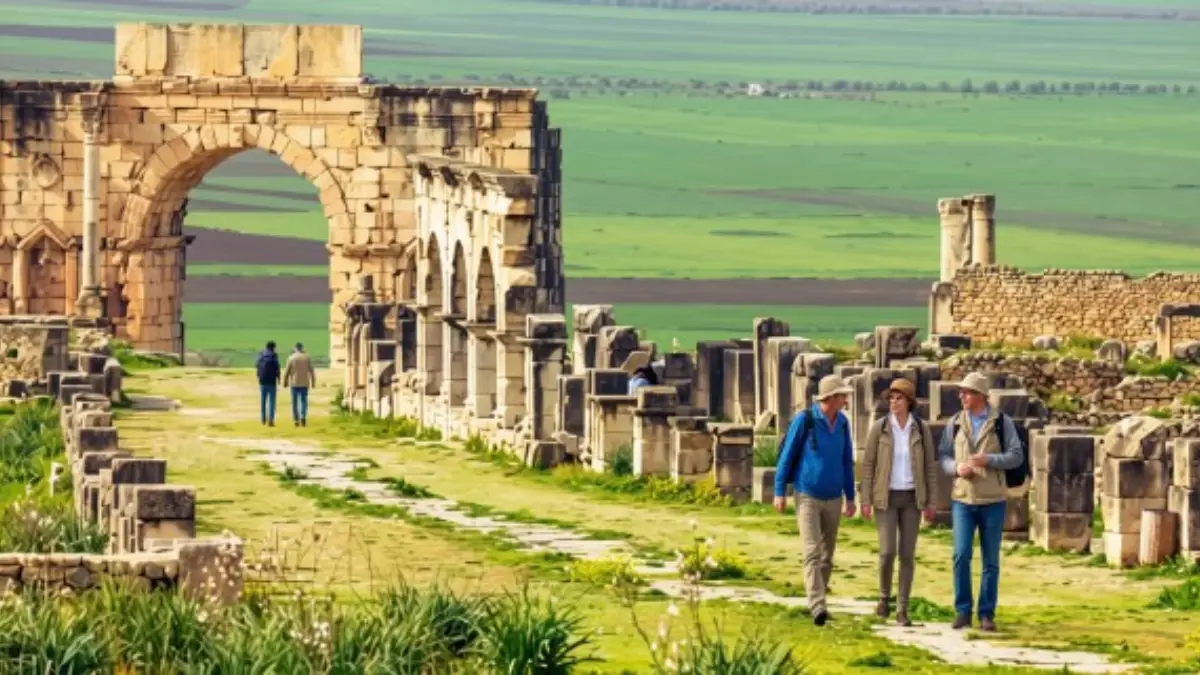
The site is extensive rather than compact. You can walk along the old Roman streets, see the remains of public buildings and houses, and look closely at floor mosaics that are still visible in their original settings. The open setting is part of the appeal: there is no modern city built tightly around the ruins, so it is easy to understand the scale of the former settlement.
For travelers interested in Roman ruins in Morocco, Volubilis is worth prioritising over a quick photo stop. Give it enough time, arrive prepared for the sun, and consider pairing it with nearby Moulay Idriss.
Volubilis entrance tickets and practical information for 2026
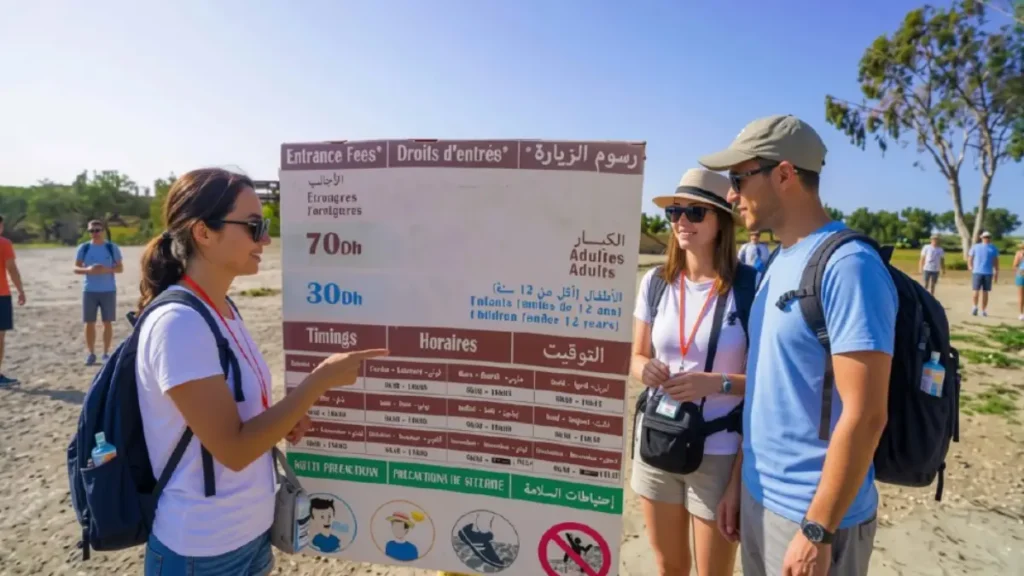
As of August 2026, the official Moroccan Ministry of Culture ticketing portal lists the following Volubilis entrance prices:
- Foreign adults: 100 MAD
- Foreign children aged 7–13: 50 MAD
- Moroccan or resident adults: 30 MAD
- Moroccan or resident children aged 7–13: 10 MAD
The official visiting hours are currently 9:00 AM to 5:00 PM, seven days a week.
Moroccan nationals receive free admission every Friday and on the first day of national and religious holidays. The official ticket portal also grants free admission to visitors with reduced mobility.
I still recommend checking the official ticket portal shortly before your visit, especially around major religious holidays. Volubilis has traditionally closed on the first day of Eid al-Adha, so do not make a special trip that day without confirming the site is open.
During Ramadan, plan conservatively and check the current schedule before setting out. The official portal currently lists the same 9:00 AM–5:00 PM visiting hours, but holiday or operational changes can occasionally affect access.
There are modern toilets near the entrance, which is useful before heading into the archaeological area. There is also a café or simple food option near the site. Around the car park and entrance, some vendors may quote higher tourist prices, so ask the price before ordering or buying anything.
Local guide tip: Try to arrive reasonably early rather than close to the 5:00 PM closing time. Volubilis is extensive, and I recommend allowing around 1.5–2 hours to explore it properly.
Parking at Volubilis
There is an informal car park directly beside the Volubilis entrance, making it straightforward to visit with a rental car, private driver, van, or minibus.
Parking currently costs around 5 MAD, paid to the parking attendant or guardian.
From the parking area, it is only about a 2-minute walk to the ticket entrance, so there is no long approach to the archaeological site.
In my experience, the parking area is generally safe for visitors leaving normal luggage inside a locked vehicle. As anywhere, keep the car locked and avoid leaving valuable items such as passports, cameras, phones, or cash clearly visible.
The parking area has enough space for ordinary rental cars as well as larger vans and minibuses, making it practical for both independent travelers and small tour groups.
Local guide tip: Keep a few small Moroccan dirham coins or notes with you for parking. The current charge is only around 5 MAD, so having exact change makes things easier.
How long to spend at the Volubilis ruins
Allow around 1.5 to 2 hours inside Volubilis. This is enough time to walk through the main areas at a relaxed pace, stop at the mosaics, read selected information panels, and take photographs without racing through the site.
A 45-minute visit is usually too rushed. Volubilis is a large archaeological site, and the most interesting features are spread across it. A quick visit may cover the main road and a few headline monuments, but it leaves little time to properly appreciate the mosaics or understand how the city was arranged.
For a practical day plan, budget for:
- Time to buy your ticket and enter
- 1.5–2 hours among the ruins
- Travel onward to Moulay Idriss or Meknes
- A lunch stop if you are combining the places
If you are joining a group tour, check how much actual time is allocated inside Volubilis. Some itineraries cover several destinations in a single day and can make the ruins feel rushed.
What to see at Volubilis
The appeal of the Volubilis ruins is not just one monument. It is the combination of streets, civic buildings, private homes, views over the surrounding countryside, and mosaics that have survived on site.
The Roman streets and city layout
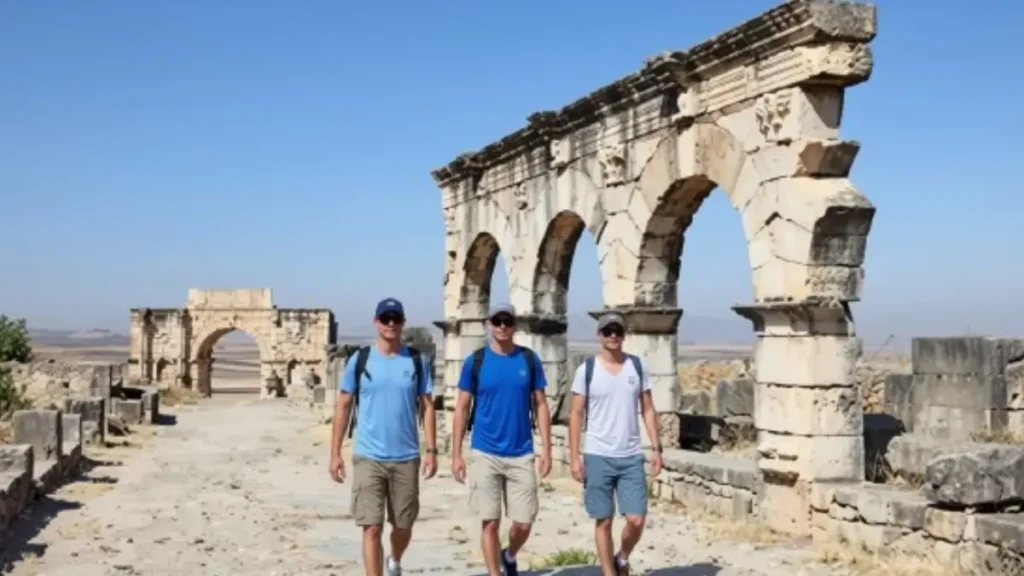
Start by getting oriented around the main paved streets. Walking these routes helps make sense of the site: residential spaces, public areas, and larger structures are positioned along a clear urban plan.
The information plaques are useful for independent visitors, particularly if you prefer to explore at your own pace. Read enough of them to understand what you are seeing rather than treating Volubilis as a collection of isolated stones.
The Arch of Caracalla
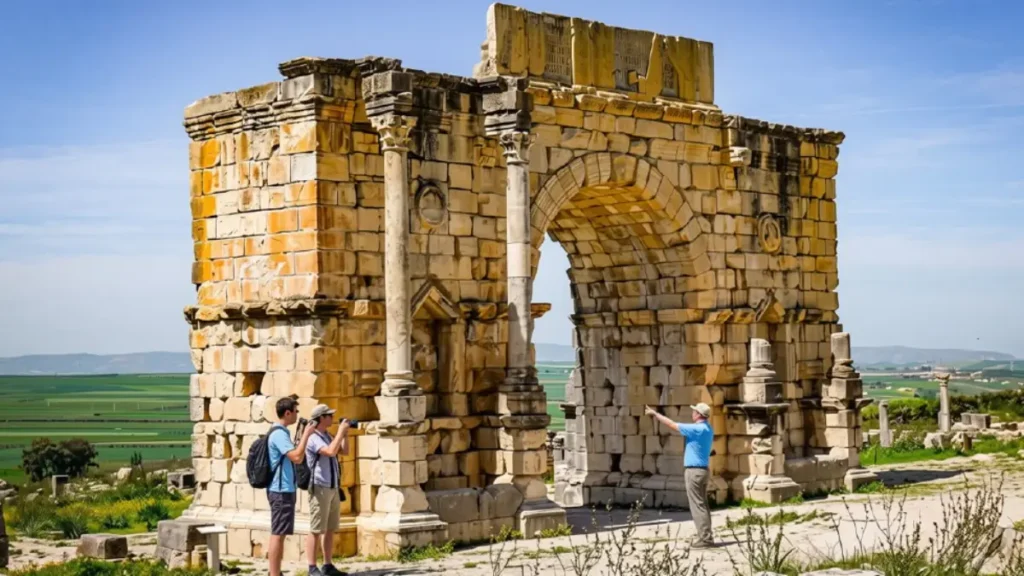
The Arch of Caracalla is one of the most recognizable monuments at Volubilis and one of the best places to appreciate the scale of the ancient city. Standing across the Decumanus Maximus, the main Roman street, the arch was erected in 217 AD in honor of Emperor Caracalla and his mother, Julia Domna.
What you see today includes restoration work carried out between 1930 and 1934, so it is useful to remember that the monument is not exactly as it stood in Roman times. Walk a short distance down the ancient street before turning back toward the arch—the view along the stone roadway is one of the best photo opportunities at Volubilis.
Decumanus Maximus
The Decumanus Maximus was one of the main streets of Roman Volubilis and is one of the best places to imagine how the city once functioned. Walking along it takes you past substantial houses, public fountains, and some of the site’s better-known mosaic remains.
Look closely at the paving as you walk. Beneath the center of the street ran part of Volubilis’ drainage system, including a covered collector that carried rainwater and wastewater away from the city. This kind of infrastructure is easy to overlook, but it helps show that Volubilis was a functioning urban settlement rather than simply a collection of monumental buildings.
Local guide tip: Do not rush straight from the arch to the next major monument. Walk part of the Decumanus slowly and look into the houses on either side—some of the most interesting mosaics are found away from the biggest structures.
The Basilica and Forum
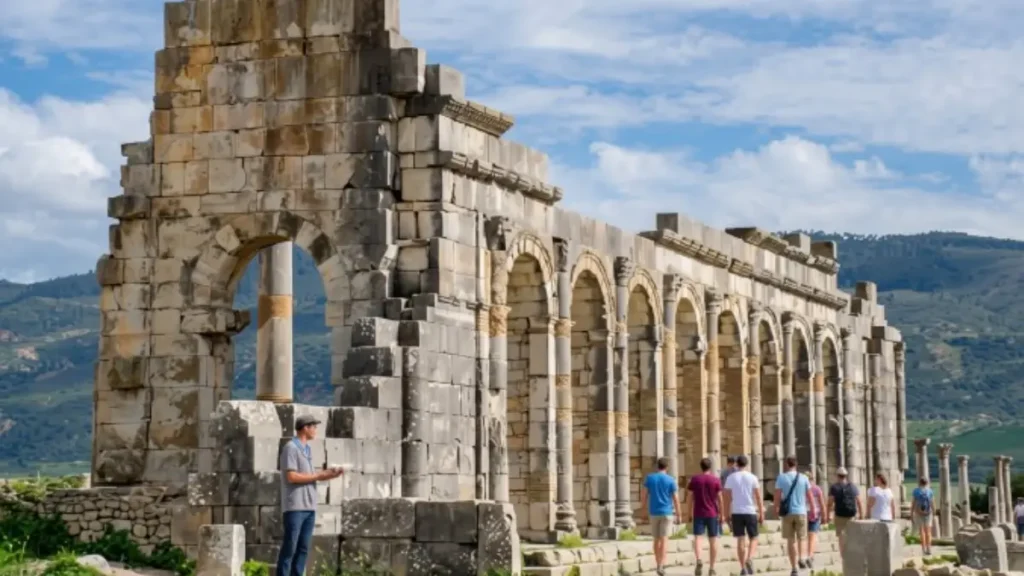
The Forum and Basilica formed the civic heart of Roman Volubilis. This is where public, administrative, legal, and commercial life was concentrated, and the scale of the surviving structures makes this one of the most impressive parts of the site.
The Basilica stands along the eastern side of the Forum and was one of the largest public buildings in Volubilis. Its reconstructed stone arches are among the most photogenic remains at the site and help give a much clearer sense of the height and monumentality of the Roman city.
The Forum itself is smaller and more open, but it is worth pausing here rather than simply walking through. Look around at how the Basilica, temples, and other civic buildings were grouped together—this area helps you understand where the political and public life of Volubilis was centered.
Local guide tip: This is one of the best places to stop for a few minutes and look back across the ruins rather than focusing only on individual stones. The relationship between the Forum, Basilica, and nearby Capitol is easier to understand when you view them as one civic complex.
The Capitoline Temple
Beside the Forum and Basilica stands the Capitoline Temple, one of the most important religious buildings at Volubilis. An inscription found at the site dates the Roman temple to 219 AD.
The temple stood on a raised podium at the end of a paved sacred area. Inside were niches for statues of the Capitoline Triad — Jupiter, Juno, and Minerva, the three deities closely associated with official Roman civic religion.
The surviving steps, columns, and elevated position help you picture how different this part of Volubilis would once have looked. Rather than viewing the temple on its own, turn around and look back toward the Forum and Basilica; together, these buildings formed the political, administrative, and religious center of the Roman city.
There is also a much older layer beneath this area. Parts of the Roman sanctuary were built over an earlier open-air sacred site dating back to around the 2nd century BC, showing that Volubilis had an important religious life long before its Roman monumental phase.
Local guide tip: Walk up toward the temple rather than photographing it only from below. The raised position gives you a much better sense of how the Capitol, Basilica, and Forum were arranged together.
The House of Orpheus
The House of Orpheus is one of the best-known private residences at Volubilis and is worth seeking out because it helps balance the monumental side of the site with a glimpse into Roman domestic life.
Its most famous feature is a mosaic showing Orpheus charming animals with his music. The scene survives in the floor of the house and is one of the clearest examples of the mythological mosaics that make Volubilis especially rewarding for visitors who take the time to explore beyond the main monuments.
The house also included reception rooms and other domestic spaces arranged around an internal courtyard, giving you a better sense of how wealthier residents may have lived inside the city.
Local guide tip: Do not rush past the houses after seeing the Basilica and Arch. The mosaics are often lower, less dramatic, and easier to miss than the monumental buildings, so slow down and look carefully at the floors and room layouts.
The House of the Labours of Hercules
Another house worth looking for is the House of the Labours of Hercules, named after its large mosaic showing the legendary tasks performed by Hercules.
The mosaic decorated the house’s triclinium, or dining room, and depicts the series of challenges traditionally known as the Twelve Labours of Hercules. It is one of the most memorable mythological mosaics at Volubilis and another good reason not to focus only on the monumental arch and public buildings.
The residence itself was very large, covering roughly 2,000 square metres, with dozens of rooms. Its scale gives you an idea of the wealth enjoyed by some of Volubilis’ elite residents.
Local guide tip: The mosaic is easier to appreciate if you already know what you are looking for. Pause and identify the individual figures rather than taking one quick photograph and moving on.
The House of the Procession of Venus
The House of the Procession of Venus, often shortened to the House of Venus, was one of the grand residences in the northeastern part of Volubilis, an area occupied by some of the city’s wealthier inhabitants.
Like other large houses in this quarter, it was arranged around an open courtyard and decorated with elaborate mosaic floors. Two of the most interesting surviving scenes show Diana and Actaeon and Hylas being carried away by the nymphs.
These mosaics are worth more than a quick photograph. Their mythological scenes give you a glimpse of the tastes and wealth of Volubilis’ elite residents and show how sophisticated the decoration inside private houses could be.
Local guide tip: When exploring the houses in this part of Volubilis, keep looking down as well as ahead. It is easy to concentrate on walls, columns, and distant monuments and walk straight past some of the site’s best surviving mosaics.
Other mosaics worth looking for
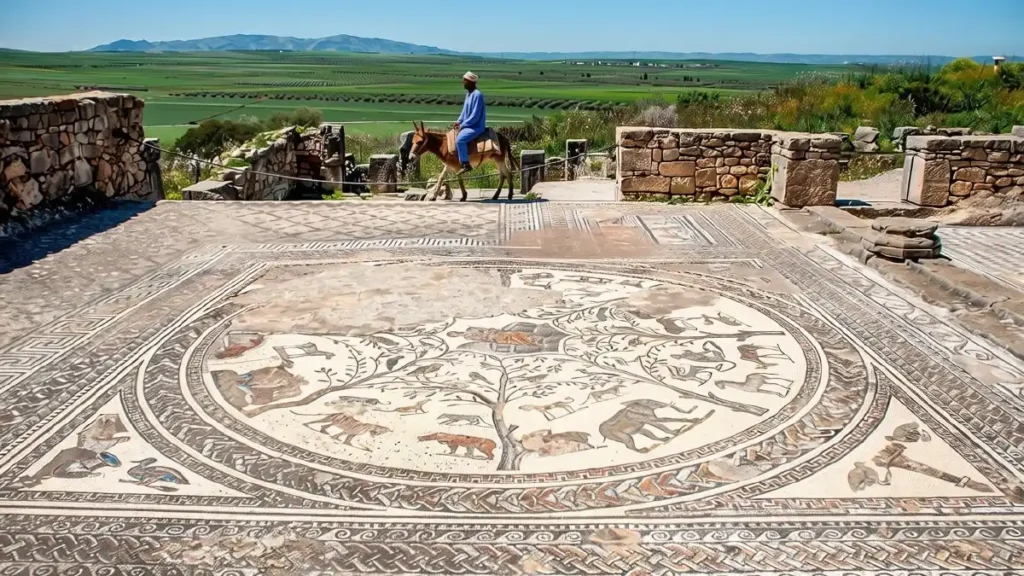
Volubilis contains many more mosaics than the few most famous examples, so keep looking into the smaller rooms and houses as you explore.
Among the scenes worth watching for are Bacchus discovering the sleeping Ariadne in the nearby House of the Cavalier, marine and dolphin motifs, fishing scenes, and geometric or protective designs used around pools and reception rooms.
In the House of the Labours of Hercules, for example, a small circular basin is decorated with symbols including a trident and dolphin, motifs intended to protect against bad luck or the evil eye.
You do not need to identify every mosaic to enjoy Volubilis. The important thing is to slow down and look carefully at the floors as you move between the larger monuments—some of the site’s most interesting details are surprisingly easy to walk past.
Roman olive presses and everyday life
Volubilis was not only a city of temples, mosaics, and wealthy houses. Olive-oil production was an important part of its economy, taking advantage of the fertile agricultural land surrounding the city.
As you explore the ruins, look for the remains of olive presses and production areas. These included equipment for crushing the olives, pressing the resulting paste, and collecting the oil.
Some production facilities were even incorporated into large private residences, showing how closely agriculture, business, and domestic life could be connected.
Olive oil had many uses in the Roman world. It was used for cooking, lamps, bathing, and other everyday purposes, so these relatively modest industrial remains help explain how the people of Volubilis actually lived and worked.
Local guide tip: The olive presses are much less dramatic than the Arch of Caracalla or the mosaics, so many visitors walk past them without realizing what they are. If you hire a guide, ask them to point out at least one olive-oil production area during your visit.
For more context on the site and Morocco’s archaeological heritage, see Morocco’s official tourism overview of archaeological treasures in Morocco.
Best photo spots at Volubilis
Volubilis is very photogenic, but the best images usually come from stepping back rather than photographing every monument close-up.
For a strong overview of the site, walk along the Decumanus Maximus and photograph the Arch of Caracalla with the ancient road leading toward it. The Basilica and Forum are also excellent for wider architectural shots, especially when the light creates stronger shadows on the surviving arches and columns.
For detail photographs, spend time around the mosaic houses. The House of Orpheus, House of the Labours of Hercules, and House of Venus all give you opportunities to capture the smaller details that are easy to miss when concentrating only on the large monuments.
The surrounding countryside is part of what makes Volubilis special. In spring and winter, the greener landscape can create a particularly attractive contrast with the pale stone ruins.
Local guide tip: Early morning and late afternoon generally give you softer light and fewer harsh shadows than the middle of the day. They are also more comfortable times to walk around this exposed site.
Should you hire a guide at Volubilis?
For a first visit, I recommend hiring a guide.
Volubilis is easy enough to walk around independently, but without explanation it is also easy to see the Arch of Caracalla, Basilica, mosaics, houses, and olive presses simply as separate ruins. A good guide helps connect those remains and explain how the Roman city actually functioned.
How much does a guide cost at Volubilis?
In 2026, expect roughly 200–600 MAD for a guided visit of around 1.5–2 hours, depending on the arrangement.
For a small group of around 2–4 people, approximately 200 MAD per group is a normal starting price.
The price is generally per group rather than per person, and the language you choose does not normally change the rate.
Are the guides official?
Yes. The guides working at the Volubilis entrance are licensed guides and are organized to work on a rotation system, so visitors are not normally surrounded by guides competing aggressively for business.
You also should not expect guides to immediately chase or pressure you as soon as you arrive.
Can you bargain with the guides?
Not really.
Unlike some informal tourist services in Morocco, I would not approach an official Volubilis guide expecting a long bargaining session. Ask the price and length of the tour before starting so everyone understands the arrangement.
If you are happy with the tour, a tip at the end is appreciated in addition to the agreed guiding fee.
Guide or independent visit?
Independent exploration is possible because there are information panels around the archaeological site, and it can suit travelers who mainly want to take photographs or explore slowly.
But for a first visit to Volubilis, I would choose a guide. The mosaics, private houses, Roman streets, religious buildings, and everyday-life details make much more sense when someone explains how they fit together.
My local guide recommendation: Spend around 1.5–2 hours exploring the ruins with a licensed guide, then enjoy the late-afternoon light around Volubilis. If the archaeological site has already closed before sunset, the countryside around the ruins and nearby Moulay Idriss can still be beautiful places to finish the day.
How to get to Volubilis from Meknes
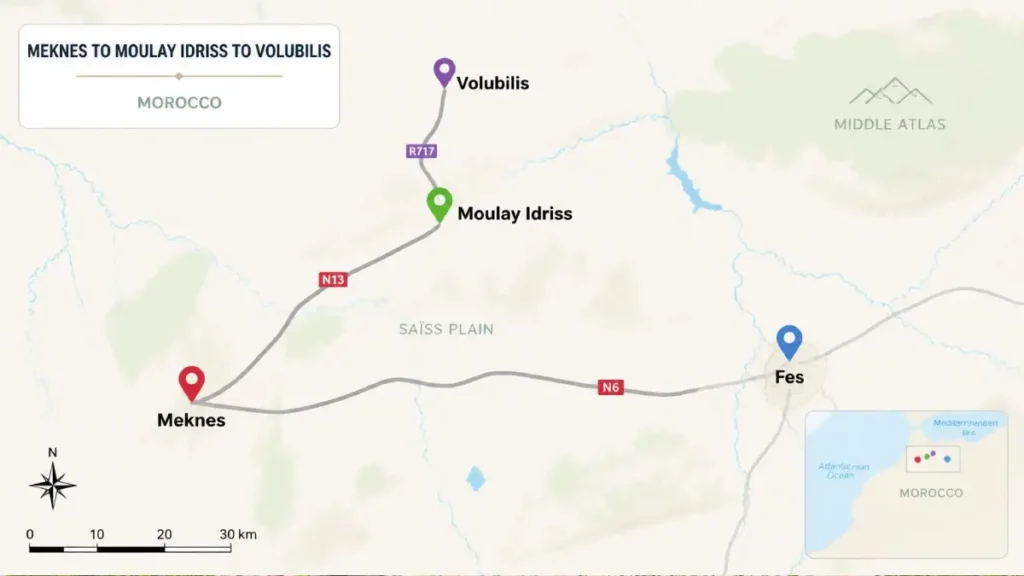
Volubilis from Meknes is the simplest independent option for many travelers. Meknes is the main practical base for visiting the ruins, and it also works well as part of a day that includes Moulay Idriss.
Shared grand taxi from Meknes
A shared grand taxi travelling toward Moulay Idriss costs about 15 DH. The trade-off is that it normally waits until full before departing, so the departure time is not always predictable.
A private grand taxi can cost up to around 150 DH. This may make sense for a family, a small group, or travelers who want more control over their timing. Confirm the fare and the exact drop-off arrangement before setting off.
Moulay Idriss is approximately 3–5 km from Volubilis. If you are taking a taxi toward Moulay Idriss rather than arranging direct transport to the ruins, think through the final leg between the two places before you leave Meknes.
Bus 15 from Meknes to Moulay Idriss
For budget travelers, Bus 15 is one of the cheapest ways to travel from Meknes toward Volubilis.
The bus leaves Meknes from the Bus 15 stop near the Institut Français and the grand-taxi station and travels north toward Moulay Idriss Zerhoun. Along the route it serves parts of Meknes including the area around Bab Berdaine.
The fare is currently around 7 MAD each way, making this considerably cheaper than arranging a private taxi.
Buses generally run around every 30–40 minutes, although I would not plan a tight itinerary around an exact timetable. Local buses can be affected by traffic, demand and daily operating conditions.
Important: Bus 15 does not take you to Volubilis
The final stop is in Moulay Idriss, not at the entrance to the archaeological site.
From Moulay Idriss, Volubilis is still approximately 3.5 km away, so you need to arrange the final part of the journey.
You have two practical options:
- Local taxi: From Moulay Idriss, a taxi to Volubilis costs roughly 30 MAD. Agree on the fare before leaving. If you need transport back after visiting the ruins, you can also ask the driver about waiting or arranging a pickup time.
- Walk: In comfortable weather, it is possible to walk between Moulay Idriss and Volubilis. Allow approximately 40–50 minutes and remember that the route is exposed, so I would avoid doing this during the hottest part of a summer day.
Local guide tip: If you want to visit both places, Bus 15 actually makes more sense as part of a Meknes → Moulay Idriss → Volubilis day rather than thinking of it as a direct bus to the ruins. If time matters more than budget, a grand taxi or private driver is much easier.
How to visit Volubilis from Fes
Visiting Volubilis from Fes is possible, but it is a longer and more logistically involved day than visiting from Meknes.
The easiest option is a private driver or organised day trip that combines Volubilis and Meknes. This reduces the need to coordinate multiple connections and is particularly convenient if your Morocco itinerary is based in Fes for only a few nights.
For budget travelers, take the train from Fes to Meknes, which costs roughly 20–33 DH, then continue by bus or grand taxi. This is more affordable, but it involves more moving parts and requires flexibility.
If you choose the independent route, avoid trying to pack too much into the day. The Volubilis ruins deserve 1.5–2 hours, and connections can take longer than expected when shared taxis wait to fill.
For help building the rest of your stay around the city, see this Fes travel guide.
Combine Moulay Idriss, Volubilis and Meknes in one day
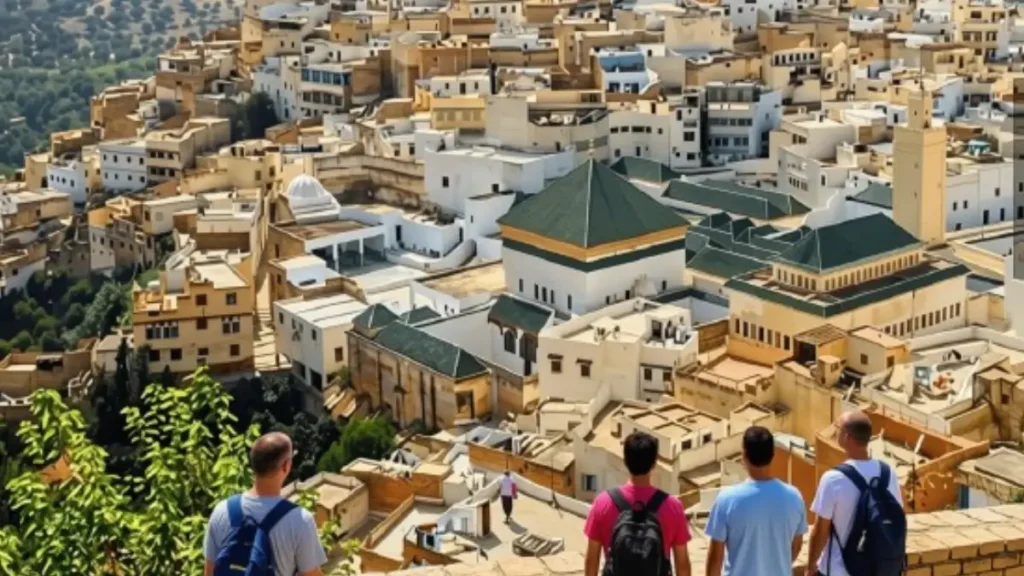
The most practical order for a full day is:
1. Volubilis early in the morning
2. Moulay Idriss for lunch
3. Meknes later in the day
This order has two advantages. First, you explore the exposed ruins before the strongest sun and before larger tour groups arrive. Second, Moulay Idriss is close enough—approximately 3–5 km away—to make a logical stop after Volubilis rather than a separate excursion.
Moulay Idriss and Volubilis are often treated as a pair, but they offer very different experiences. Volubilis is an open archaeological landscape, while Moulay Idriss is a living hill town. Plan transport between them in advance if you are not travelling with a driver.
Meknes works well as the final stop because it gives you a more urban setting after the ruins and lunch. If your itinerary includes several former imperial capitals, the broader guide to Morocco’s imperial cities can help put Meknes in context.
When is the best time to visit Volubilis?
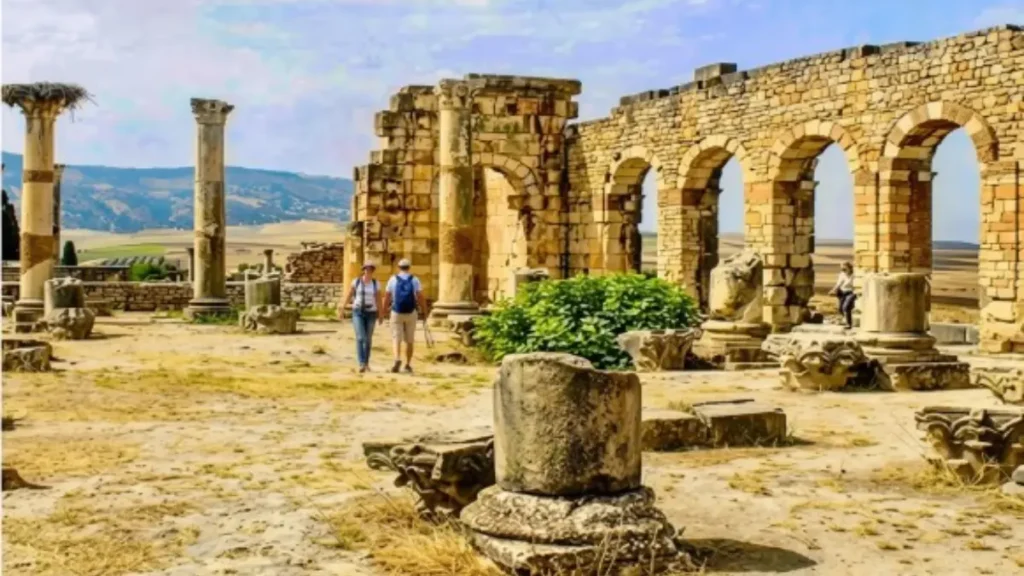
Early morning and late afternoon are the best times of day to visit Volubilis Morocco. There is almost no shade inside the site, and the exposed paths can become uncomfortable under strong sun. These quieter periods can also help you avoid the largest tour groups.
Spring and winter are generally the more comfortable seasons for walking the ruins. The surrounding landscape is greener in these periods, which adds to the setting around the archaeological site.
Summer visits are still possible, but preparation matters. Bring:
- A hat
- Sunscreen
- Plenty of water
- Comfortable walking shoes with grip
- Sunglasses, if bright light bothers you
There is little point in arriving unprepared and then rushing through the ruins because of heat. A slower visit in cooler conditions is much more rewarding, especially if you want to look carefully at the mosaics.
Practical local tips for visiting Volubilis
A few small decisions can make the visit smoother:
- Carry some Moroccan dirhams for local transport, food, and any guide you hire. If you plan to buy your Volubilis ticket at the entrance, confirm the current payment options beforehand.
- Do not plan only 45 minutes for the site; allow at least 1.5 hours.
- Check prices before buying food or drinks around the car park and gate.
- Agree a guide price in advance if you choose to hire one.
- Arrive early or later in the day to reduce sun exposure.
- Take water into the ruins rather than assuming you can easily buy it once inside.
- Build in flexibility if using a shared grand taxi, as it usually leaves only when full.
- Combine Volubilis with Moulay Idriss if you have a full day, rather than making two separate trips.
Make Volubilis part of a better Morocco itinerary
Volubilis is most satisfying when it is treated as more than a quick excursion from Fes or Meknes. Give the ruins enough time, protect yourself from the sun, and plan the transport links before the day begins. Combining Volubilis, Moulay Idriss, and Meknes creates a varied day without needing to cover long distances between every stop.
For wider route ideas and practical preparation beyond the archaeological site, continue with the Morocco travel guide.
FAQ
How much is the entrance fee for Volubilis Morocco?
As of August 2026, admission is 100 MAD for foreign adults and 50 MAD for foreign children aged 7–13. Moroccan residents currently pay 30 MAD for adults and 10 MAD for children aged 7–13. Check the official Ministry of Culture ticket portal before your visit in case prices change.
How long do you need at Volubilis?
Allow around 1.5 to 2 hours inside the ruins. A 45-minute visit is usually too rushed to see the mosaics and explore the wider archaeological site properly.
Can you visit Volubilis from Fes in one day?
Yes. The easiest option is a private driver or organised day trip that combines Volubilis and Meknes. Budget travelers can take the train from Fes to Meknes, then continue by bus or grand taxi.
Is Volubilis close to Moulay Idriss?
Yes. Moulay Idriss is approximately 3–5 km from Volubilis, making it easy to combine the two places in one day with suitable transport arranged between them.
Do you need a guide at Volubilis?
No, a guide is not required, and there are information plaques for independent visitors. However, for a first visit I recommend hiring one of the licensed guides at the entrance. A guide can help you understand the mosaics, private houses, Roman streets, temples, and everyday-life details that are easy to overlook when exploring alone.