
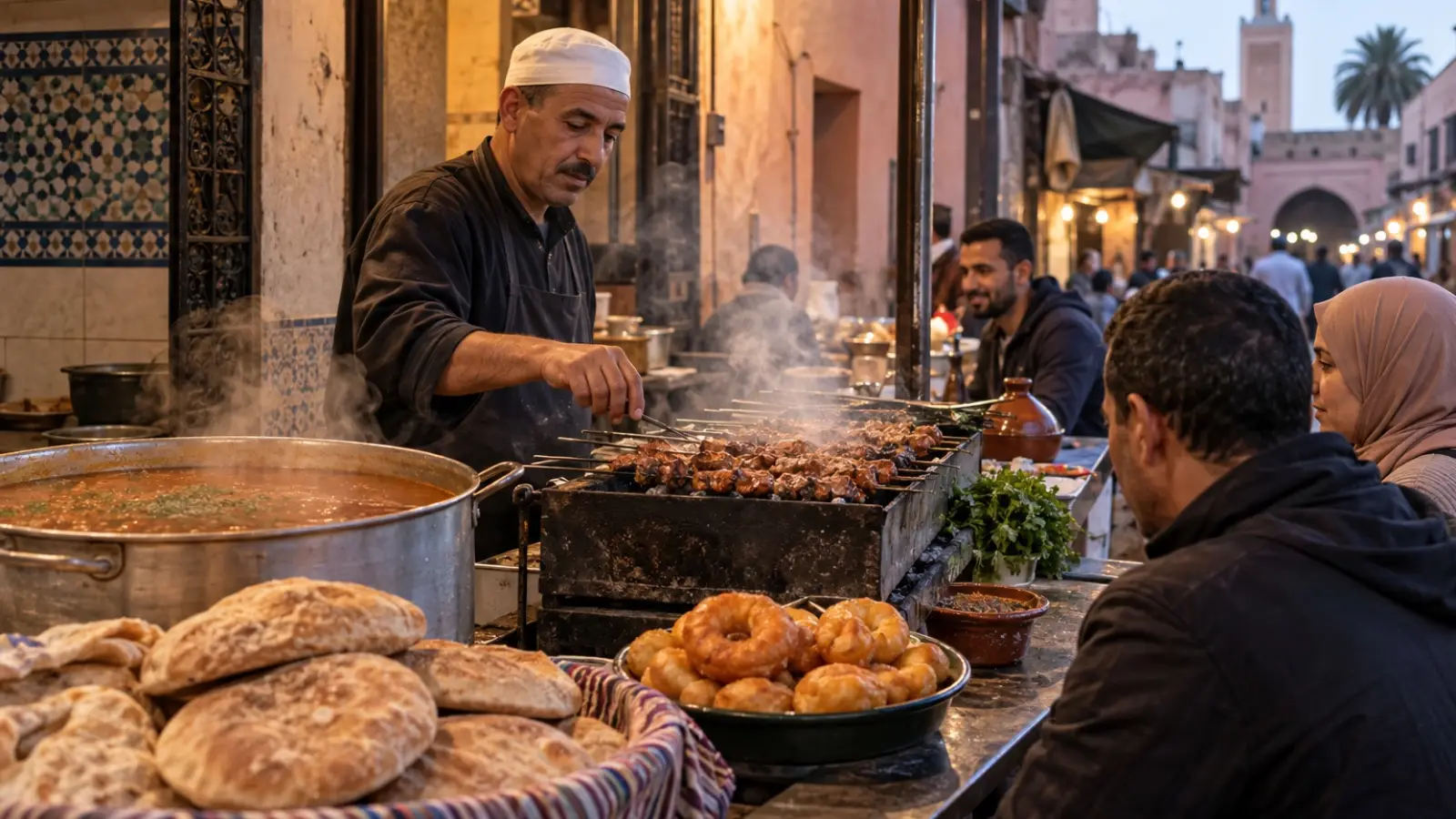
Morocco street food is one of the simplest ways to eat well on a modest budget, but it rewards a little judgment. The best meals are usually at busy counters, market stalls and small neighbourhood shops where food is cooked quickly and locals are eating alongside you.
This guide covers the Moroccan street food worth seeking out, how prices and portions work, what differs between Marrakech, Fes, Tangier and Essaouira, and how to avoid common mistakes around tourist-heavy food stalls.
Table of Contents
Table of Contents
Is Morocco street food worth trying?
Yes—provided you choose busy places with high turnover and order with a little care. Street food in Morocco is not one single category: it can mean a bowl of morning bissara, a flaky msemen bought from a bakery window, skewers grilled over charcoal, snails in aromatic broth, or seafood cooked beside the Atlantic.
The most satisfying approach is to mix inexpensive everyday foods with one or two regional specialties. Do not assume that the busiest tourist square will offer the best version of everything. In Marrakech, for example, Jemaa el-Fna is worth experiencing for its atmosphere, but much of the more interesting food is found around its edges and in nearby streets.
For a broader introduction to dishes served in homes and restaurants as well as on the street, see this guide to traditional Moroccan food.
What to eat: the essential Moroccan street foods
Msemen and meloui: flaky breads for breakfast or an afternoon snack
Msemen is a layered, square-shaped flatbread with a rich, flaky texture. It may be served plain, spread with honey, or stuffed with savoury fillings. It is one of the most useful street-food breakfasts in Morocco, though it also works well as an afternoon snack with mint tea.
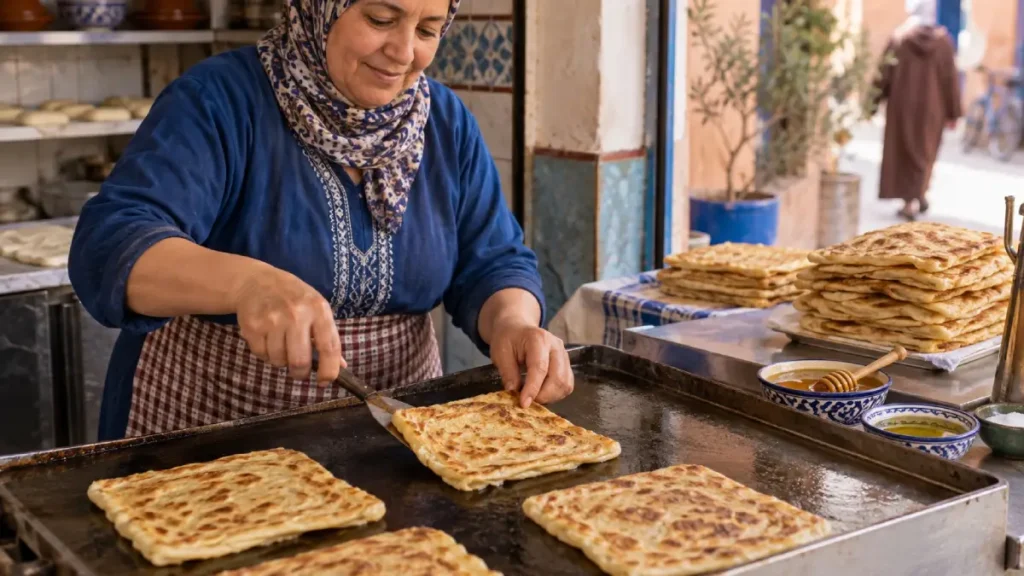
Plain msemen should normally cost less than a filled version. Confirm the price before adding honey, cheese, meat or other fillings, because each addition can change the total.
In Fes, also look for meloui, a related bread rolled into a spiral before cooking. Side streets off Talaa Kebira are good places to find fresh msemen and meloui rather than packaged versions sitting for hours.
Baghrir: the “thousand-hole” pancake
Baghrir is the spongy Moroccan pancake recognisable by its tiny holes, which absorb butter, honey or syrup. It is more commonly a breakfast or tea-time food than a late-night street meal.
It is a good option for vegetarians, although it is still worth asking what has been added on top if you avoid butter or honey.
Harira: Morocco’s comforting tomato-and-lentil soup
Harira is a warming soup made with tomatoes, lentils and herbs. It is filling without being heavy, making it an excellent first course before grilled food. You will find it at counters, bakeries and small cafés, particularly in the evening.
Harira is normally sold by the bowl. Check whether bread, dates or boiled eggs are included or charged separately before ordering a complete meal.
Harira is often associated with Ramadan, but it is available beyond that period. Vegetarians should ask before ordering: many versions contain meat or meat stock.
Bissara: northern Morocco’s fava-bean breakfast
Bissara is a thick fava-bean soup, especially associated with northern Morocco. It is often eaten in the morning with olive oil, cumin and bread. It is inexpensive, satisfying and generally naturally vegetarian.
If you are visiting Tangier or other northern cities, bissara is one of the best street food Morocco experiences to seek out early in the day.
Maakouda: fried potato fritters, often in a sandwich
Maakouda are fried potato fritters, crisp outside and soft inside. They are frequently tucked into sandwiches with sauces or other fillings, making them a practical cheap lunch.
They are vegetarian on their own, but sandwich fillings and sauces vary, so ask if meat, tuna or egg is included.
Brochettes: charcoal-grilled skewers
Brochettes are grilled meat skewers, usually cooked over charcoal and served with bread, salt, cumin and sometimes salad. They are easy to find across Morocco and work best when they are grilled to order.
Brochettes may be priced per skewer or as part of a plate with bread and salad. Ask which system the stall uses before ordering several skewers.
Babbouche: snails in a deeply seasoned broth
Babbouche, or Moroccan snail soup, is a classic street snack. Small snails are served in a fragrant, herbal broth that many people enjoy as much as the snails themselves. It is not for every traveller, but trying one small bowl is a worthwhile local-food experience.
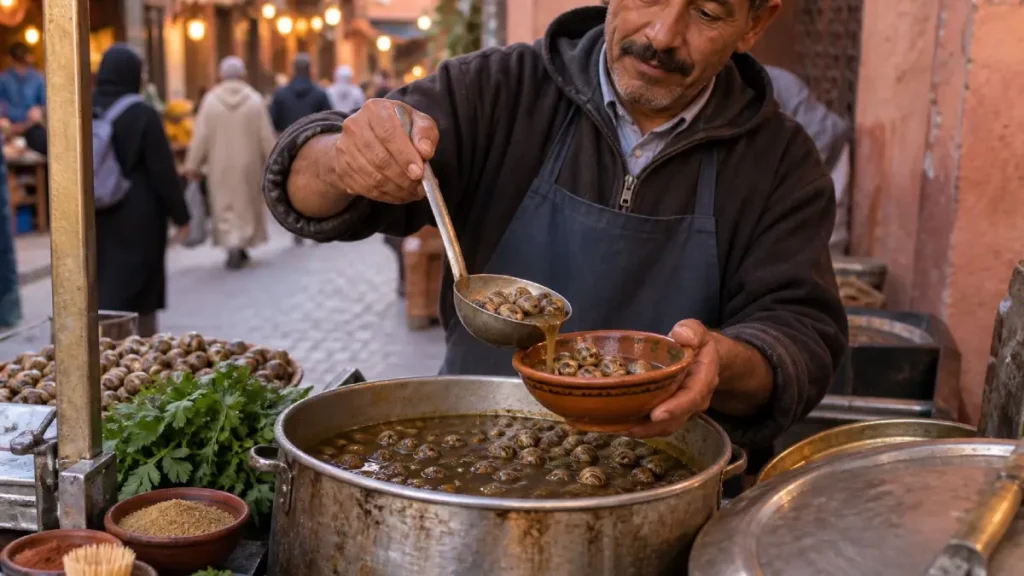
Babbouche is commonly sold in different bowl sizes. In Marrakech, carts may be found around busy medina squares, but locations and operating hours can change.
Sfenj: eat it straight from the fryer
Sfenj is Morocco’s airy, irregular doughnut, fried until golden and usually eaten plain, with sugar, or alongside tea. The key is timing: it is at its best within minutes of frying. A sfenj that has been sitting for a long time loses the contrast between crisp outside and soft centre.
Sfenj is normally sold by the piece. Look for a vendor frying a fresh batch rather than choosing by price alone; freshness makes a much bigger difference than presentation.
Tangia: the Marrakech specialty to order when you have time
Tangia is an essential Marrakech dish, traditionally slow-cooked in an urn-shaped clay vessel. It is a meat dish, usually deeply seasoned and tender from long cooking, and it is different from a tagine despite the similar name.
Tangia is not always a quick, grab-and-go snack. Portions and accompaniments vary, so confirm whether the quoted price covers one person, a shared portion or a complete plate.
Mechoui: slow-roasted lamb by weight
Mechoui is slow-roasted lamb, traditionally served simply with bread, salt and cumin. In Marrakech, the key place to look is Mechoui Alley, just off Jemaa el-Fna.
Mechoui is commonly ordered by weight. Ask for the price per unit, specify how much you want and confirm the estimated total before the meat is cut.
Sheep’s head: for adventurous eaters
When available, particularly around Eid, cooked sheep’s head is one of the more adventurous Moroccan street-food experiences. It is not an everyday recommendation for every traveller, but it is part of the wider local food culture and may appear at specialist stalls.
Ask clearly what is included and how it is priced before ordering.
How Morocco street-food prices work
Morocco street-food prices are not fixed nationally. They change with the city, ingredients, portion size and location, and stalls in heavily visited areas may charge more than neighbourhood counters.
Before ordering, check:
- Whether the price is per piece, skewer, bowl, plate or portion.
- Whether meat or seafood is sold by weight.
- Whether bread, salad, sauces or drinks cost extra.
- The approximate total before food is cut, grilled or served.
- Whether a visible menu and the amount quoted verbally agree.
Simple breads, soups and fried snacks should normally cost less than filled sandwiches, grilled meat or seafood. Carry small dirham notes, keep the order simple and ask politely when the pricing unit is unclear. A busy stall, fast turnover and clearly stated prices are more useful quality signals than either the cheapest or most expensive option.
Where to find the best street food in Morocco
Marrakech: look beyond the centre of Jemaa el-Fna
Marrakech offers a wide range of street-food experiences, from morning breads to slow-roasted lamb and evening snail soup.
Across the medina, you will find counters selling kefta sandwiches, pastries, fresh juice, bocadillos and breakfast breads. Rather than crossing the city for one named stall, choose a place preparing food in front of customers with steady local turnover.
Rahba Kedima is often associated with snail-soup carts, while the lanes north of Jemaa el-Fna are known for mechoui. Vendors and opening patterns change, so treat these as areas to explore rather than guaranteed individual recommendations.
How to eat at Jemaa el-Fna without overpaying
Jemaa el-Fna is one of Morocco’s defining public spaces. UNESCO lists the cultural space of Jemaa el-Fna for its living traditions. The food stalls are part of the experience, but it helps to see the square as a cultural spectacle as well as a place to eat.
The numbered grill stalls in the centre are largely interchangeable and heavily promoted by touts. You may be encouraged to sit before you have decided, and side plates such as bread or salad can sometimes appear on the bill even when you did not knowingly order them.
A more practical approach is to:
- Agree on the price before sitting down.
- Ask whether bread, salad, tea or sauces are included.
- Check the bill before paying.
- Choose the busier counters rather than responding to the loudest invitation.
- Look around the edges of the square for snail carts, fried fish, harira counters and the route towards Mechoui Alley.
If you want a proper sit-down meal rather than a street-food evening, this guide to the best restaurants in Marrakech may be more useful.
Fes: breads, harira and more traditional grilling
In Fes, the lanes around Rcif and Talaa Kebira can be useful places to look for harira, msemen and meloui. Choose busy counters where bread is coming directly from the griddle and soup is being served hot.
Fes also has more specialised options, including grilled sheep brains and Tangia Fassi. The latter is not necessarily an immediate street purchase, so ask ahead if it is something you specifically want to try.
Tangier: bissara, bocadillos and fish-market grills
Tangier’s street food reflects its northern setting and long connection with Spain. Start with a morning bowl of bissara, seasoned with olive oil and cumin, then look for Spanish-influenced montaditos and bocadillos.
Around Grand Socco, you will find juice stalls and bocadillos. Petit Socco is better for café culture and light snacks than for a major street-food crawl.
Tangier’s fish-market grills are important for fresh local seafood. Choose a place where fish is moving quickly and being grilled in front of customers. For a fuller overview of the city, see the Tangier travel guide.
Essaouira: grilled seafood by the port
Essaouira is where Moroccan street food becomes strongly coastal. Sardines, shrimp and calamari are commonly offered around the port and market areas, but stall locations and selling arrangements can change.
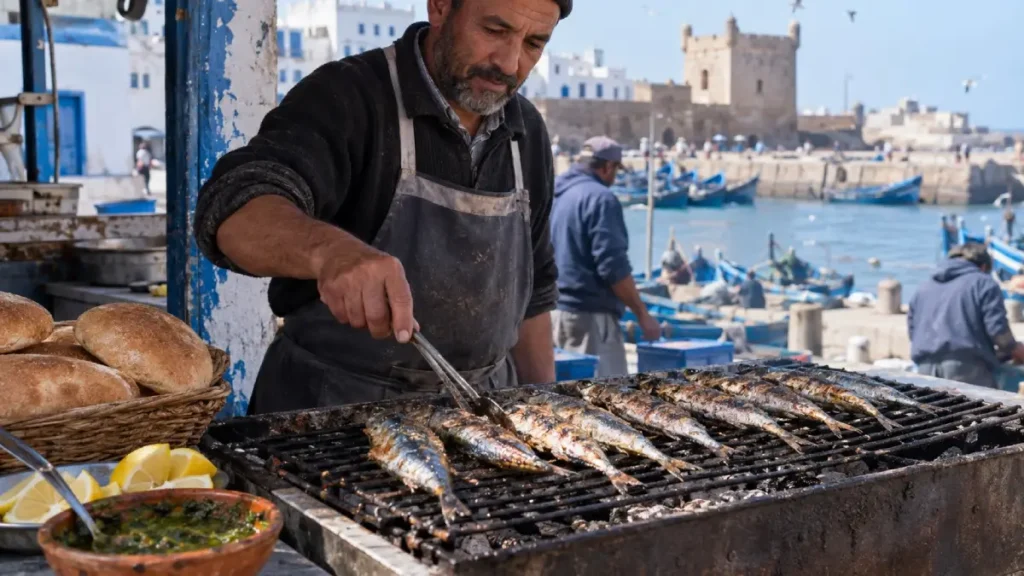
A freshly grilled sardine sandwich can be a simple coastal meal. With any seafood stall, prioritise freshness, fast turnover and food cooked thoroughly in front of you.
Vegetarian street food in Morocco
Vegetarian travellers have more options than first impressions suggest, especially at breakfast and snack time. Good choices include:
- Msemen
- Baghrir
- Harcha
- Maakouda
- Bissara
- Boiled chickpeas with cumin
- Roasted corn
- Zaalouk, the cooked aubergine-and-tomato salad
The main issue is not a lack of vegetarian foods; it is assumptions. Harira may contain meat, while sandwiches can come with unexpected tuna, egg or meat fillings. Ask before ordering, especially if you follow a strict vegetarian or vegan diet.
Raw salads deserve extra caution. The ingredients may have been washed with water that does not agree with every traveller, so cooked vegetables are often the safer choice when you are adjusting to local food.
How to choose safer street food
There is no guaranteed risk-free street stall anywhere, but a few simple choices make a real difference in Morocco.
The most useful rule is high turnover. A busy stall used by local customers is more likely to be serving food that has been prepared recently rather than held for hours.
Choose food that is:
- Cooked to order in front of you.
- Served properly hot.
- Being replenished frequently.
- Stored away from direct sun where possible.
Be more cautious with:
- Premade food sitting in direct sunlight.
- Meat or fish that looks dry, exposed or as if it has been sitting for a long time.
- Sauces that appear old or have been left out for hours.
- Raw salads, herbs and other uncooked ingredients that may have been washed in water your stomach is not used to.
For general context, Morocco’s national food-safety authority publishes information through ONSSA. The World Health Organization’s safer-food guidance emphasizes cleanliness, separating raw and cooked food, thorough cooking, safe temperatures and safe water. For travelers choosing a stall, the clearest visible signals remain cleanliness, thorough cooking, proper handling and fast turnover.
A first Morocco street-food evening: what to order and in what order
If you have only one evening for Moroccan street food, do not try to eat everything at once. Build the meal gradually and prioritise foods that are at their best hot.
- Start with harira from a busy counter. It is a gentle, filling introduction and helps avoid arriving at grilled food overly hungry.
- Order mechoui by weight with bread, cumin and salt. This is especially worthwhile in Marrakech, where Mechoui Alley is the natural place to try it.
- Add grilled sardines if you are on or near the coast. In Tangier or Essaouira, fresh seafood can be a better choice than trying to recreate a Marrakech-style meal.
- Try a hot msemen if you find one fresh from the griddle. It is more naturally a morning or afternoon food, but a good fresh example is always worth stopping for.
- Finish with babbouche and its herbal broth. Even if you are unsure about snails, one small bowl is an easy way to try a very traditional street-food ritual.
The best street food Morocco has to offer is rarely about finding one famous stall. It is about choosing the right food for the city, eating it fresh, and keeping your order simple enough that you know exactly what you are paying for.
FAQ
What is the most popular street food in Morocco?
Msemen, harira, brochettes, maakouda, sfenj and bocadillo sandwiches are among the most common everyday options. Regional specialties matter too: bissara is particularly associated with northern Morocco, tangia with Marrakech, and grilled sardines with the coast.
How much does street food cost in Morocco?
Street-food prices vary by city, portion and location. Simple breads, soups and fried snacks normally cost less than filled sandwiches, grilled meat or seafood. Ask whether the amount is per piece, plate or weight and confirm the approximate total before ordering.
Is Jemaa el-Fna good for street food?
It is worth visiting for the atmosphere, but treat the square as a cultural experience as well as a place to eat. Compare menus, confirm extras before ordering and do not feel pressured to sit at the first stall that approaches you.
What Moroccan street food is suitable for vegetarians?
Msemen, baghrir, harcha, maakouda, bissara, boiled chickpeas, roasted corn and zaalouk are useful vegetarian choices. Ask about harira, sandwich fillings and sauces, as these may include meat or other animal products.
How can I avoid getting sick from street food in Morocco?
Choose busy stalls with high turnover, order food cooked in front of you and make sure hot dishes arrive hot. Be cautious with exposed meat or seafood, sauces held without temperature control and uncooked ingredients when their handling is unclear.