
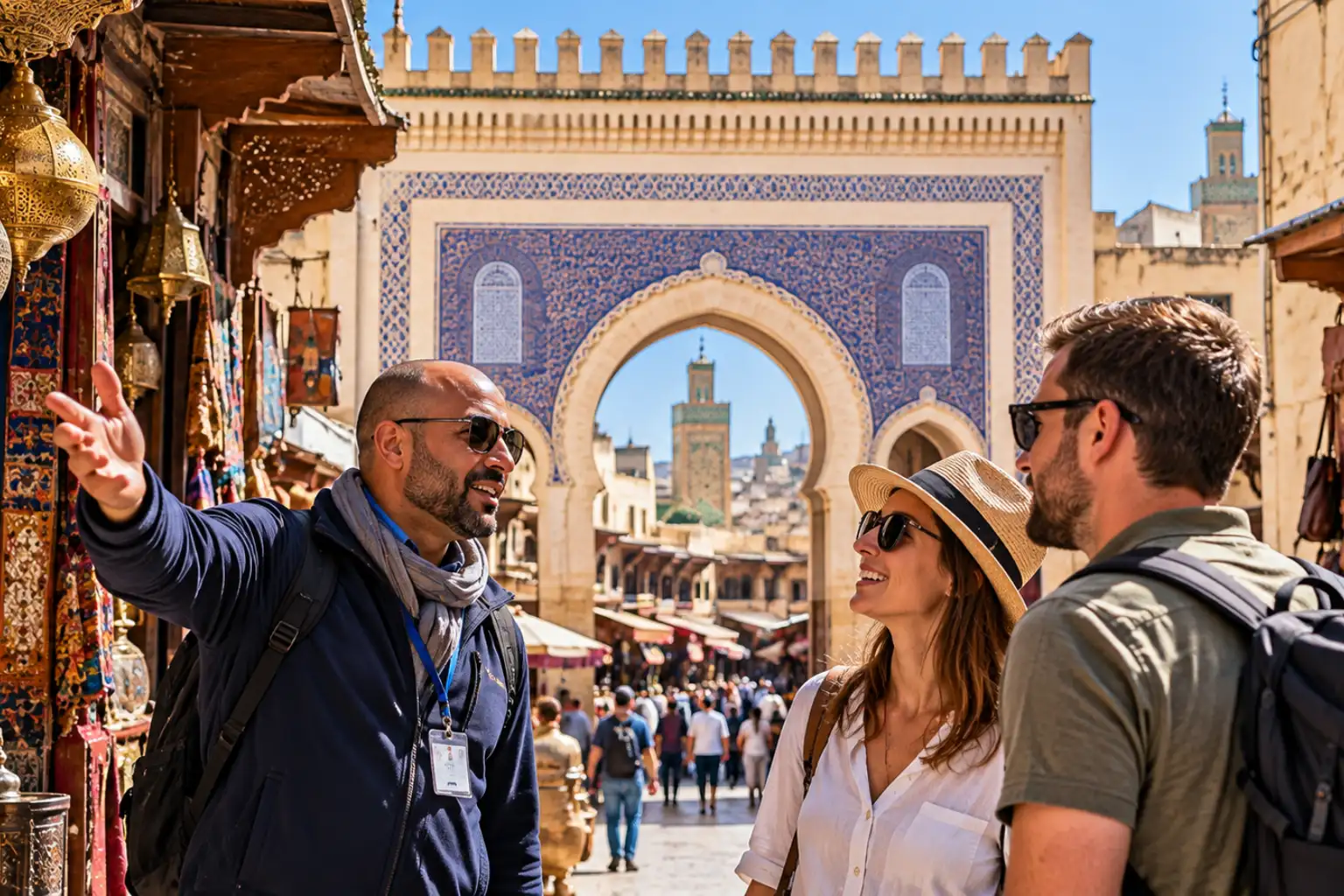
A Fes walking tour is the most practical way to understand Fes el-Bali on a first visit. The Medina is largely pedestrian, with narrow lanes, changing levels and few obvious landmarks once you are inside. A licensed guide helps you follow a sensible route, understand what you are seeing and avoid losing valuable time on detours or unwanted shopping stops.
For most visitors, a private half-day walk of around three to four hours is enough to cover the core Medina highlights. A longer five- to six-hour tour works better if you also want to include Fes el-Jdid, the Mellah, gardens or a panoramic viewpoint outside the old city.
Table of Contents
Table of Contents
Is a private Fes walking tour worth booking?
For a first visit, yes—particularly if you want more than a quick look at the famous tannery and a few souks.
Fes el-Bali is not a place where every visitor needs a rigid itinerary, but it is easy to become disoriented. Streets often narrow into covered passages, routes change level quickly, and taxis cannot enter most of the historic center. A good Fes private guide makes the Medina more manageable without turning the day into a rushed checklist.
The best guided tours balance three things:
- Navigation: choosing a route that flows naturally rather than repeatedly doubling back.
- Context: explaining the Medina’s religious, commercial and craft areas in a clear, relevant way.
- Pacing: allowing time for photographs, monument visits, breaks and questions without making the walk exhausting.
A guide is especially useful for travelers with limited time, first-time visitors to Morocco, families, older travelers and anyone who would rather not negotiate the Medina’s maze alone. Independent visitors can certainly explore Fes, but a guided walk usually gives a stronger first introduction.
For a broader overview of where to stay, how to arrive and how to organize your visit, see this Fes travel guide.
The best starting point for a Fes Medina tour
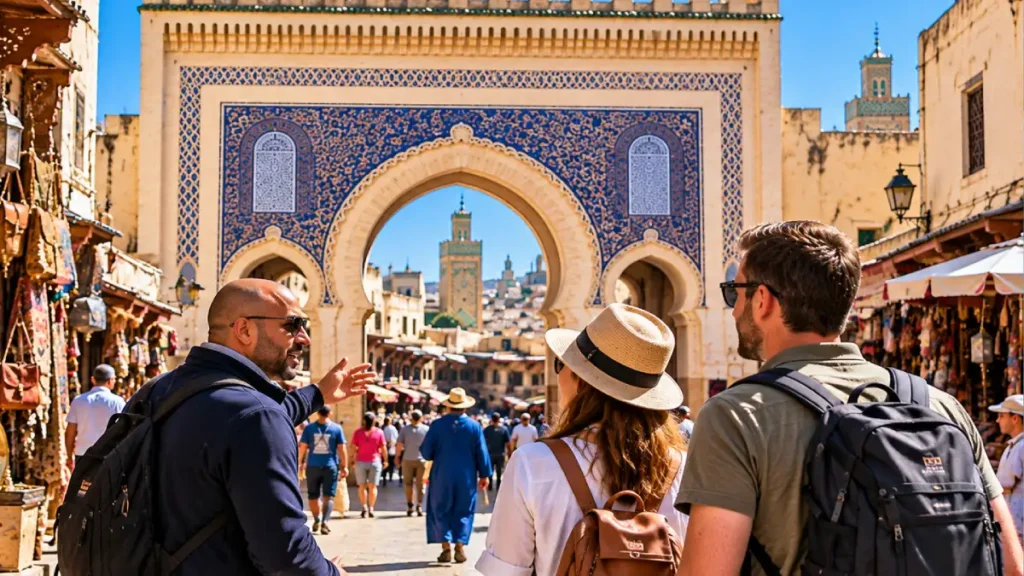
For a first-time Fes guided tour, Bab Bou Jeloud is an excellent meeting point. Starting here creates a natural downhill route through the heart of Fes el-Bali, rather than beginning deep inside the maze and spending the first part of the tour finding your bearings.
Bab Bou Jeloud is also practical because it is a clear landmark at the Medina edge. Since cars and taxis can only reach perimeter access points, an agreed meeting place matters. If you are staying in a riad within the old city, confirm in advance whether the guide will meet you at the nearest accessible gate, at your riad, or at another landmark.
If you are arriving with luggage, have mobility concerns or need a transfer from outside the Medina, arrange this before the tour. Vehicle access and walking distance to your accommodation can make a significant difference to the day.
Prefer hotel or riad pickup instead of meeting at Bab Bou Jeloud?
Compare guided Fes tours that include pickup or a clearly arranged meeting point.
A practical 3–4 hour Fes walking tour route
A half-day walk should focus on the Medina’s essential places rather than trying to cover every lane, market and monument. A sensible route from Bab Bou Jeloud can follow Talaa Kebira through the central spine of the old city before continuing toward the craft and religious quarters.
Bab Bou Jeloud, Talaa Kebira and Bou Inania Madrasa
From Bab Bou Jeloud, Talaa Kebira provides one of the clearest introductions to the busy commercial life of Fes el-Bali. The street leads past shops, small food stalls and traditional businesses, but it is also a useful route because it connects several major sights.
Bou Inania Madrasa is one of the core stops on a first Medina tour. Nearby is the historic Dar al-Magana water clock, which is worth pointing out even if time does not allow for a long stop. Both work well early in the walk, while the group is still fresh and before the route becomes more crowded and intricate.
Place Nejjarine and the woodworking quarter
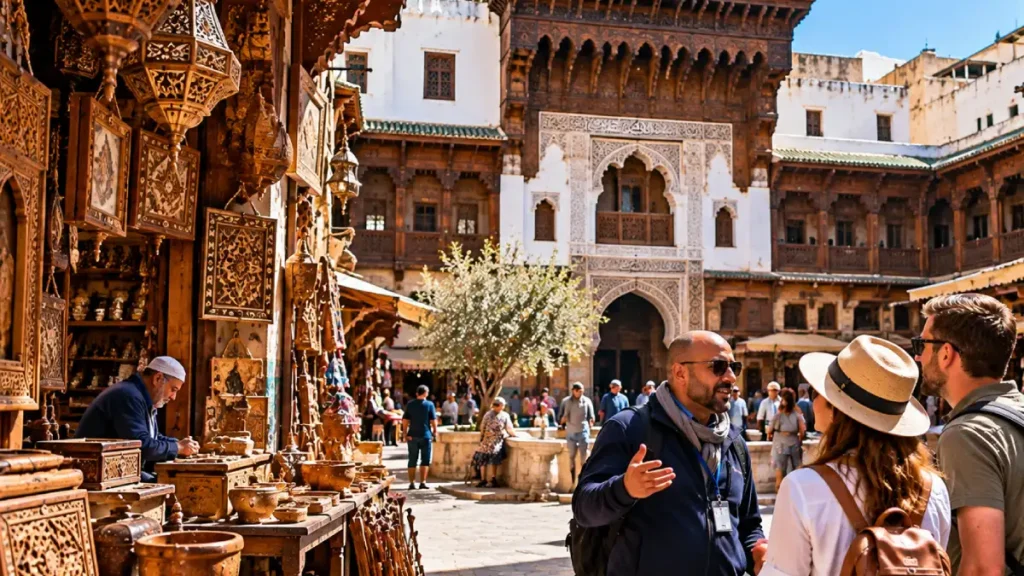
Continuing through the Medina, Place Nejjarine and its surrounding traditional woodworking area offer a different character from the busier main streets. This is a useful part of the route for understanding how Fes has long organized crafts and trade by neighborhood.
Place Nejjarine is one of the key highlights to prioritize on a first visit. It also gives the guide a natural opportunity to slow the pace before continuing into the denser lanes toward the central religious and market areas.
Henna Souk and the Moulay Idriss II area
The Henna Souk and the area around the Moulay Idriss II sanctuary are usually included as the route moves deeper into Fes el-Bali. These are atmospheric parts of the Medina, but they are secondary to the main monuments if your time is limited.
This is where a guide can be particularly helpful. The lanes are more confusing than they appear on a map, and a visitor walking independently can easily miss the significance of the area or spend too long trying to locate the next major sight.
Al-Attarine Madrasa and the Al-Qarawiyyin area
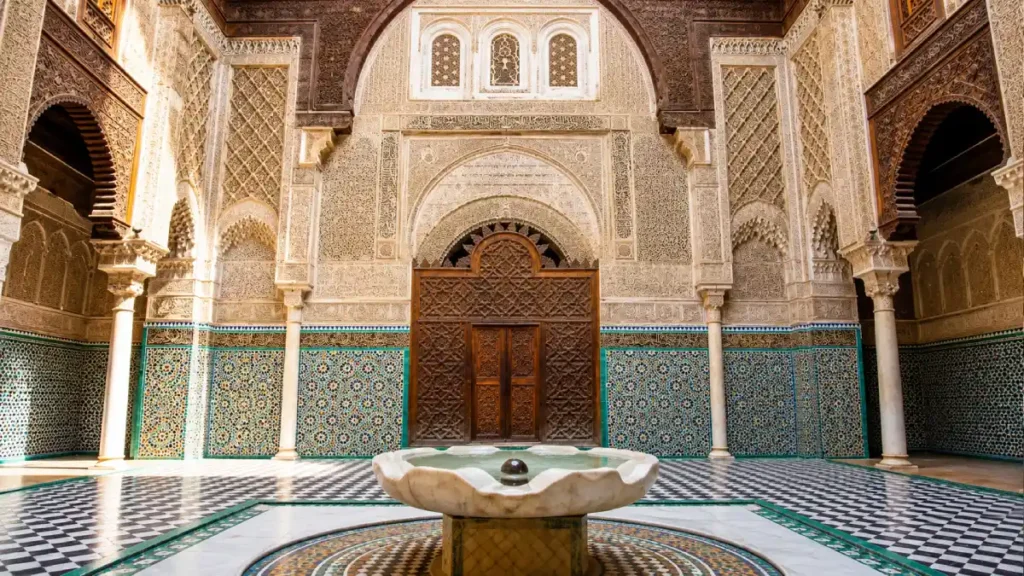
Al-Attarine Madrasa and the Al-Qarawiyyin area are among the essential stops on a well-planned Fes Medina tour. They are close enough to combine naturally, and they show the central role that religious learning, scholarship and commerce have played in this part of the old city.
Access arrangements and entrance charges for monuments can change, so confirm what is included when booking your tour. A licensed guide should make clear whether monument admission is separate from the guiding fee.
Monument access and admission arrangements can change. When booking, confirm whether Bou Inania Madrasa, Al-Attarine Madrasa and any other paid sites are included in the tour price or paid separately on the day. I prefer not to treat old entrance fees as fixed because ticketing can change.
Place Seffarine and the metalworking area
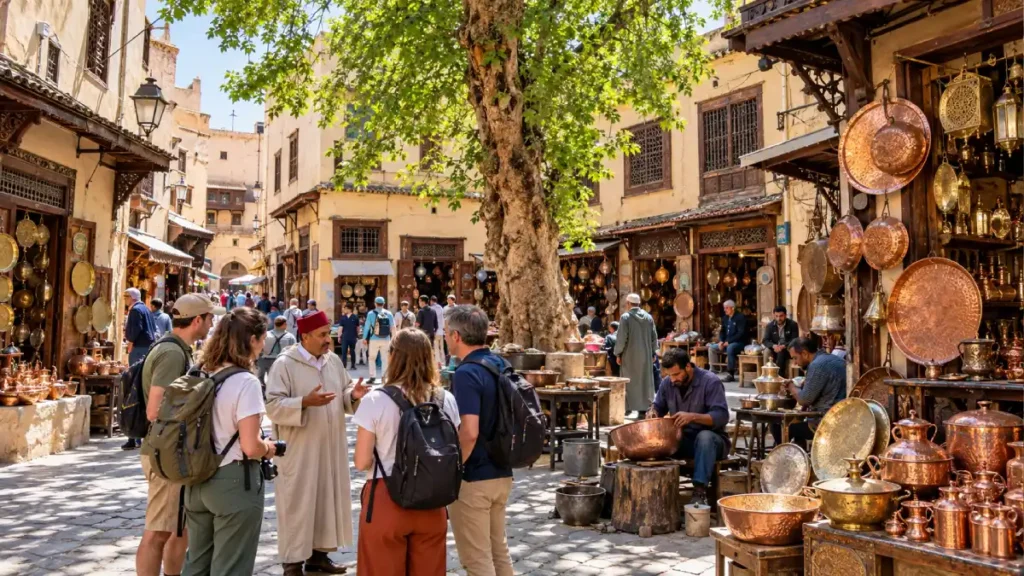
Place Seffarine is another core highlight. Its traditional metalworking character provides a useful contrast with the woodworking quarter around Place Nejjarine and the commercial streets closer to Bab Bou Jeloud.
The square is a good example of why a walking route matters. Reaching it on foot as part of a connected Medina itinerary is far more practical than treating it as an Realistic travel image of Place Nejjarine in Fes showing traditional carved wood crafts, historic buildings, a private guide and travelers exploring the woodworking quarter during a Medina walking tour. stop.
Chouara Tannery: what the visit is really like
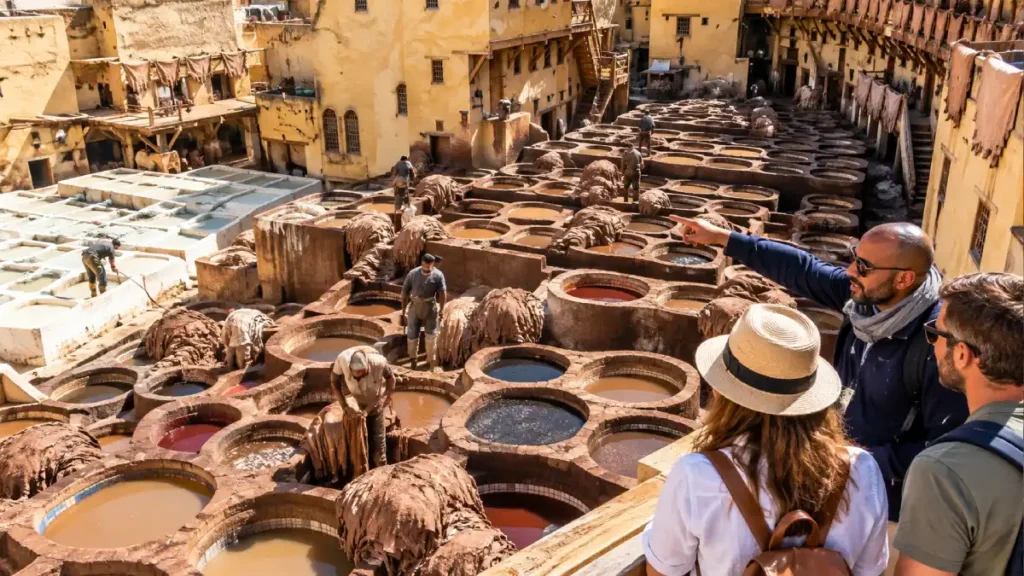
Chouara Tannery is one of the best-known stops on a guided tour of Fes, but visitors should arrive with realistic expectations.
The usual experience is viewing the dye vats from terraces in surrounding leather shops. The smell can be strong, and visitors may be offered mint to hold nearby. You are not obliged to buy leather simply because you have been shown to a viewpoint.
Before entering a terrace or agreeing to go closer to the vats, clarify whether there is any access fee, tip expectation or other payment. This is especially important if someone has approached you in the street and offered to take you there.
A good guide should help you visit without pressure and should not turn the tannery into a compulsory shopping stop.
Returning by Talaa Seghira or a parallel Medina lane
Depending on the group’s pace, energy and interests, the return can follow Talaa Seghira or another parallel route. This avoids simply retracing the same path and shows a different side of the Medina.
It is also the point where flexibility matters. A fast-moving group may have time for a longer return route; families with children, older travelers or anyone visiting during a busy period may prefer a direct finish at a convenient exit point.
For more detail on navigating the old city independently, read the Fes Medina guide.
Looking for a half-day Fes Medina tour?
Compare guided walks covering Bab Bou Jeloud, Bou Inania, Nejjarine, Seffarine and the tannery.
- Check Half-Day Fes Walking Tours.
What a longer full-day Fes tour can add
A five- to six-hour walk, or a full-day private tour with transport between areas, gives you more room to move beyond the central Medina route. This is the better choice if Fes is a major stop on your itinerary and you want to combine the old city with Fes el-Jdid and a few locations outside the pedestrian core.
Possible additions include:
- Fes el-Jdid, the later historic quarter adjoining the old Medina.
- The Mellah, Fes’s historic Jewish quarter.
- The Royal Palace gates, best viewed from outside.
- Jnan Sbil Gardens, which can provide a quieter break from the Medina.
- Jewish heritage sites, depending on your interests and access arrangements.
- Dar Batha, if it fits the day’s route and current visitor arrangements.
- A pottery workshop area, for travelers particularly interested in Moroccan crafts.
- A panoramic stop around Borj Nord or the Marinid Tombs.
A full day should include a proper lunch break. The Medina can be physically demanding, especially in warm weather or when the itinerary includes several monuments and long stretches of walking. A quiet traditional restaurant or riad-style setting is generally a better choice than trying to eat quickly while moving between stops.
Not every full-day tour needs every addition. A good private itinerary should be shaped around your interests: history, architecture, crafts, Jewish heritage, photography, food or simply a slower pace.
Want more than the core Medina route?
Compare full-day Fes tours that may include Fes el-Jdid, the Mellah, panoramic viewpoints and additional artisan quarters.
- See Full-Day Fes Tours.
Licensed guide or unofficial helper: the difference matters
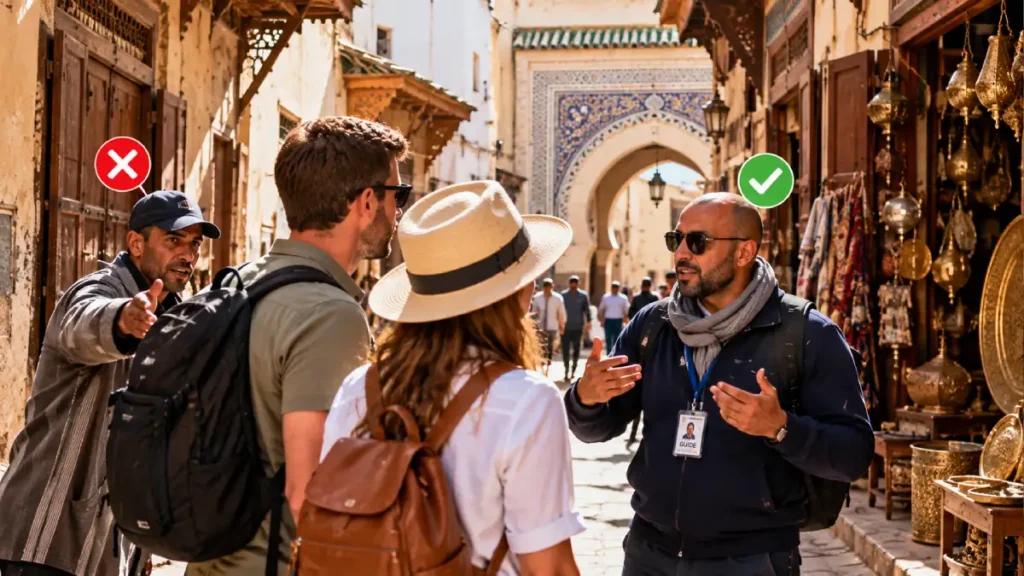
Fes has many people who may offer directions, a shortcut or help finding a tannery. Some are friendly, but visitors should be cautious about accepting unsolicited guiding services.
For a proper Fes tour guide, book an official licensed guide through a reputable agency, your hotel or riad, or an established tour provider. This gives you a clearer agreement on the meeting point, duration, itinerary and payment.
The main problem with unofficial helpers is not only that they may be unreliable. Some redirect visitors by saying that a street, monument or tannery is closed, then lead them toward high-commission carpet, leather, spice or herbal shops.
Be particularly cautious if someone:
- Approaches you without being asked and insists you need help.
- Says your intended route is closed but cannot explain an alternative clearly.
- Promises a “free” tannery visit or workshop visit.
- Pressures you to enter a shop after showing you a viewpoint.
- Becomes impatient when you say you do not want to buy anything.
A professional guide can introduce crafts and workshops if you are interested, but the day should not revolve around forced shopping. Navigation, history and pacing should remain the priority.
Fes private guide prices: what should be included?
The cost of a Fes private guide depends on the duration of the tour, the size of your group, the languages required, whether transport is needed outside the Medina and whether you are booking a half-day or full-day experience.
Rather than choosing purely by the lowest quote, ask what the quoted price covers. A clear booking should state:
- Tour duration.
- Whether the guide is licensed.
- Private or shared format.
- Meeting point and finish point.
- Whether hotel or riad pickup is possible.
- Whether monument entrance fees are included or paid separately.
- Whether transport or a driver is included for Fes el-Jdid, viewpoints or other locations outside the walking route.
- Whether lunch is included on a full-day itinerary.
- Whether the itinerary includes shopping stops and whether these are optional.
As a current marketplace reference, many private three- to four-hour Fes Medina walking tours are listed at roughly US$25–40 per person, while five- to six-hour private or full-day options commonly start around US$55–80+ per person. These are market examples rather than an official tariff: the final price depends on group size, language, pickup, whether a driver or vehicle is included, monument tickets, lunch and the exact itinerary.
Be careful with vague offers that advertise a “cheap Fes tour” but do not specify how long the guide will stay with you or where the route will go. A lower price can make sense for a short orientation walk, but it is not comparable with a private half-day or full-day licensed service.
Through Morkosh Tours, I can arrange a licensed Fes guide, with transfers or a private driver coordinated when needed. This is particularly useful for travelers staying outside the Medina, arriving by vehicle, or adding Fes el-Jdid and panoramic stops to the day.
For travelers building a wider itinerary, these private tours in Morocco can also be tailored around Fes and onward travel.
How difficult is a walking tour of Fes Medina?
Fes el-Bali is largely pedestrian, but it is not flat or fully accessible. Expect steep sections, uneven paving, narrow lanes, steps and occasional crowding. The walk can be tiring even for active travelers if it is rushed.
Comfortable walking shoes are essential. Shoes with reliable grip are more useful than sandals or smooth-soled footwear, especially on uneven surfaces.
A Fes walking tour can still work well for older travelers and families, but the route should be adapted:
- Choose a slower pace and allow regular pauses.
- Focus on fewer core highlights rather than trying to cover the whole Medina.
- Avoid adding distant outer monuments unless the group is comfortable walking longer.
- Plan vehicle transfers where possible for locations outside Fes el-Bali.
- Confirm the meeting and finishing points in advance, since taxis cannot reach every riad door.
For travelers with significant mobility limitations, discuss requirements honestly before booking. A guide can reduce unnecessary walking, but cannot remove the physical realities of the Medina’s terrain and limited vehicle access.
What to agree before your guided tour of Fes
A few clear questions before booking prevent most misunderstandings on the day.
Confirm:
- The exact meeting point. Bab Bou Jeloud is often practical, but your riad location may require another arrangement.
- The planned duration. A three- to four-hour tour and a full-day tour are very different experiences.
- Your priorities. Tell the guide whether you care most about monuments, crafts, photography, Jewish heritage, food or a general introduction.
- The walking level. Mention children, older travelers, injuries or limited mobility.
- What costs are separate. This may include monument admission, terrace access at the tannery, lunch, transport and optional tips.
- Your shopping preference. If you do not want shop visits, say so before the tour begins.
The official Visit Morocco website can be useful for broader destination inspiration, but practical Medina arrangements are best confirmed directly with your accommodation or tour provider before arrival.
Choosing the right Fes Medina tour for your trip
For most first-time visitors, choose a private half-day walk beginning at Bab Bou Jeloud and covering Bou Inania Madrasa, Place Nejjarine, the Al-Qarawiyyin area, Al-Attarine Madrasa, Place Seffarine and Chouara Tannery. It gives you the essential Fes experience without making the day unnecessarily long.
Choose a full-day tour if you want to add Fes el-Jdid, the Mellah, gardens, a viewpoint or a craft-focused visit—and if you are comfortable with more walking and a slower day with a proper lunch break.
The key is not to see every corner of Fes el-Bali. It is to follow a route that makes sense, leave room for the unexpected, and work with a licensed guide who helps you understand the Medina without steering the visit toward unwanted purchases.
Ready to choose your Fes walking tour?
Compare current availability, traveler reviews and prices before booking.
- See Available Fes Walking Tours.
Affiliate disclosure: If you book through one of these links, I may earn a small commission at no extra cost to you.
FAQ
How long should a Fes walking tour last?
For most first-time visitors, a private half-day tour of around three to four hours is enough for the central Medina highlights. Choose five to six hours or a full day if you also want to include Fes el-Jdid, the Mellah, gardens or a panoramic stop.
Where should I start a Fes Medina tour?
Bab Bou Jeloud is a practical starting point for a first visit. It provides a natural downhill route through Fes el-Bali and is easier to use as a meeting point than many locations deep inside the Medina.
Do I need a licensed guide in Fes?
You do not have to hire one, but a licensed guide is strongly recommended for a first visit. The Medina is easy to get lost in, and booking through a reputable agency, hotel or riad helps you avoid unofficial helpers and unwanted shopping detours.
Is Chouara Tannery free to visit?
The usual experience is viewing the tannery from terraces in surrounding leather shops. Any access fee, tip or payment expectation should be agreed clearly before entering a terrace or going closer to the vats. You should not feel obliged to buy leather.
Is Fes Medina suitable for travelers with limited mobility?
It can be challenging. Fes el-Bali has steep, uneven and narrow pedestrian lanes, and vehicles can only reach perimeter access points. A slower, shorter route may work for some travelers, but discuss mobility requirements in advance and keep expectations realistic.