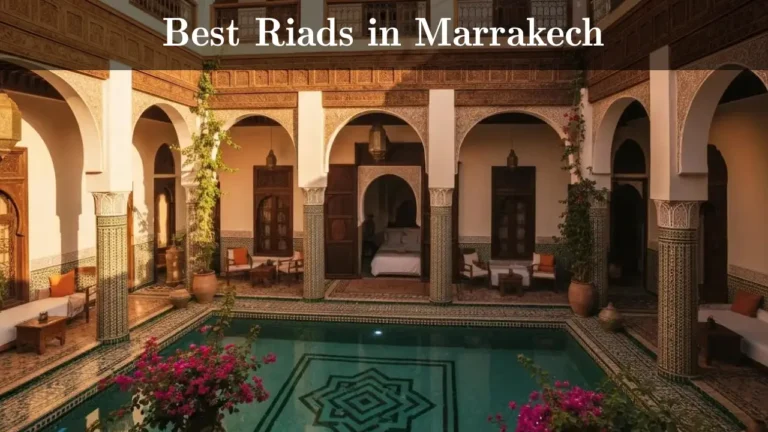

Morocco in October is an excellent choice for travelers who want warm days without summer’s punishing heat. It is one of the most flexible months for combining Marrakech, Fes, the Atlas Mountains, the Sahara and the Atlantic coast in one trip, with a real difference between warm afternoons and cooler mornings and nights.
For a first visit, October is one of the strongest times to come. You can spend a full day exploring medinas, take a road trip through the valleys, walk in the mountains and sleep in the desert without having to plan every activity around extreme temperatures. The main considerations are booking ahead during busy school-holiday weeks and packing layers rather than relying on summer clothing alone.
Table of Contents
Table of Contents
Is October a good time to visit Morocco?
Yes. October is a particularly good time to visit Morocco for first-time visitors, families, photographers, hikers and travelers planning a varied itinerary.
The month sits between the intense heat of summer and the colder, wetter conditions that become more established later in autumn and winter. Marrakech is still warm, the Sahara is far more comfortable than in July or August, and the Atlas Mountains are well suited to trekking. It is also date-harvest season in southeastern oasis regions, adding a distinctly autumnal side to a Morocco trip.
October is especially practical if your route includes several climates. A week or two might include warm city days in Marrakech, crisp evenings in the desert, cool mountain mornings around Imlil and beach weather in Agadir.
Compared with November, October generally offers warmer daytime conditions, more reliably comfortable Sahara travel and greater flexibility across the country before northern rain and colder nights become more common.
There are trade-offs. October is popular with international visitors, particularly during European school holidays. Well-located riads in Marrakech and Fes, plus good Sahara desert camps, can book up well ahead. Travelers whose main goal is spring greenery or rose season may prefer April or May, while those focused strictly on lower accommodation costs may find better value during parts of winter.
For broader seasonal comparisons, see this guide to the best time to visit Morocco.
Morocco weather in October: expect warm days and cool nights
Morocco October weather varies considerably by region. That is one reason the month works so well for an itinerary that mixes cities, mountains, coast and desert—but it is also why a single-weather packing strategy does not work.
The most important pattern is the day-to-night temperature shift. Warm afternoons can feel like summer in Marrakech or the Sahara, while early mornings and evenings may require a fleece, sweater or light jacket.
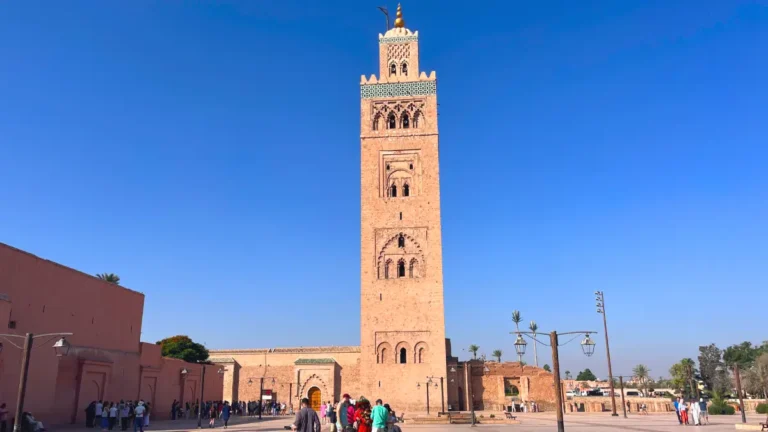
Marrakech in October: warm enough for full days outdoors
Marrakech in October is usually warm and pleasant rather than overwhelmingly hot. Daytime highs are typically around 27–30°C at the beginning of the month, gradually falling towards roughly 24°C by late October. Mornings and evenings are much cooler, commonly around 14–20°C.
This makes a practical difference to sightseeing. Unlike July and August, October normally allows genuine full-day exploration: walking through the medina, visiting gardens and museums, eating on a rooftop terrace or spending time in Jemaa el-Fna without needing to retreat indoors for the hottest middle hours.
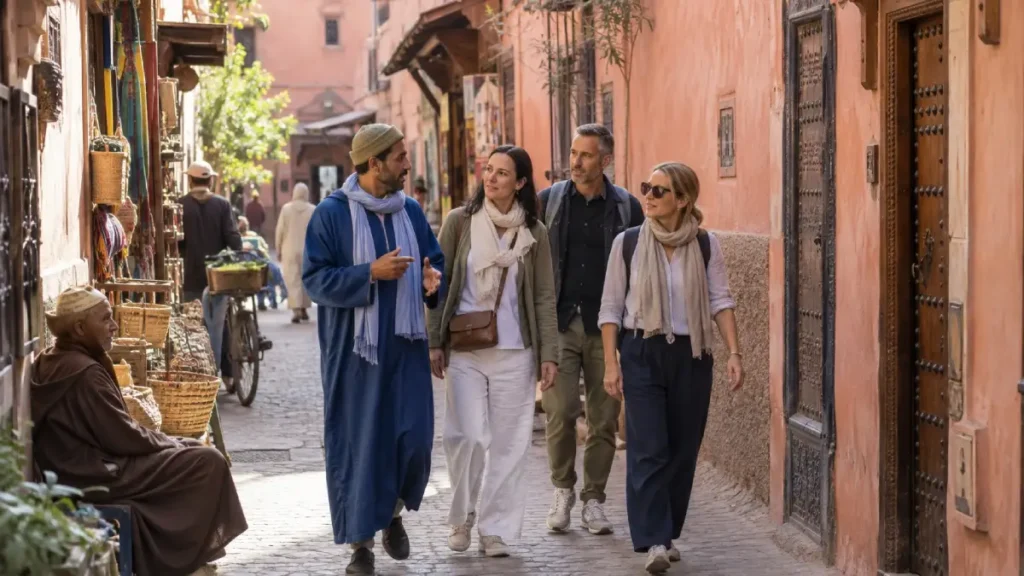
It is still sensible to start outdoor walks earlier in the day, wear sun protection and carry water. But October gives you far more freedom with your schedule than peak summer.
For neighborhood advice and sights to build into your stay, use the Marrakech travel guide.
Fes and Meknes: ideal weather for long medina walks
Fes and Meknes are also very good in October. Daytime temperatures are generally in the low 20s, while nights can fall to around 12–14°C.
These cooler conditions are particularly helpful in Fes el-Bali, where exploring often means several hours on foot through narrow lanes, souks and steep sections of the old city. In summer, the heat can make long walks tiring quickly. October is much more manageable, although comfortable shoes remain essential.
Bring a light outer layer for dinner and for early starts, especially if you are staying in an older riad where indoor spaces can feel cool in the morning.
Chefchaouen, Tangier and Rabat: carry a rain layer
Northern Morocco begins to feel more autumnal in October. Chefchaouen, Tangier and Rabat can still have many dry days, but cloud cover and the chance of rain generally increase toward the second half of the month.
Do not assume every day will be sunny simply because Marrakech is warm. A lightweight waterproof layer is a worthwhile addition if your route includes the north, particularly later in October. Rain is not necessarily a reason to avoid these destinations; it simply means you should plan with more flexibility than you would in the south.
Agadir and Essaouira: two different Atlantic experiences
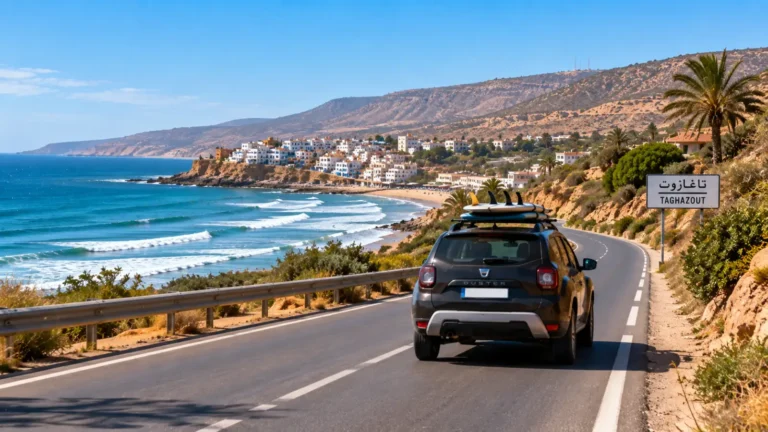
Agadir is one of Morocco’s strongest October beach destinations. Daytime temperatures can reach around 28°C, and Atlantic water may be around 21°C, making swimming realistic for many travelers.
Essaouira is cooler and noticeably windier, with daytime temperatures generally in the low 20s and sea temperatures around 19°C. It is a better choice for travelers who enjoy a breezy coastal atmosphere, surfing or kiteboarding than those hoping for consistently hot sunbathing weather.
Daily wind and swell conditions matter on this coast, so check locally if surfing, kitesurfing or beach swimming is central to your plans.
The Sahara in October: comfortable days and crisp camp evenings
October is one of the best months for a Sahara excursion. Typical daytime temperatures can range roughly from 25–32°C, while nights cool to around 10–18°C. This is far more comfortable for camel rides, dune walks and long drives than the desert heat of midsummer.
The desert is not cold in the same way it can feel in midwinter, but sunset changes the temperature quickly. A warm afternoon outfit is not enough once you are sitting outside after dinner or waking before sunrise.
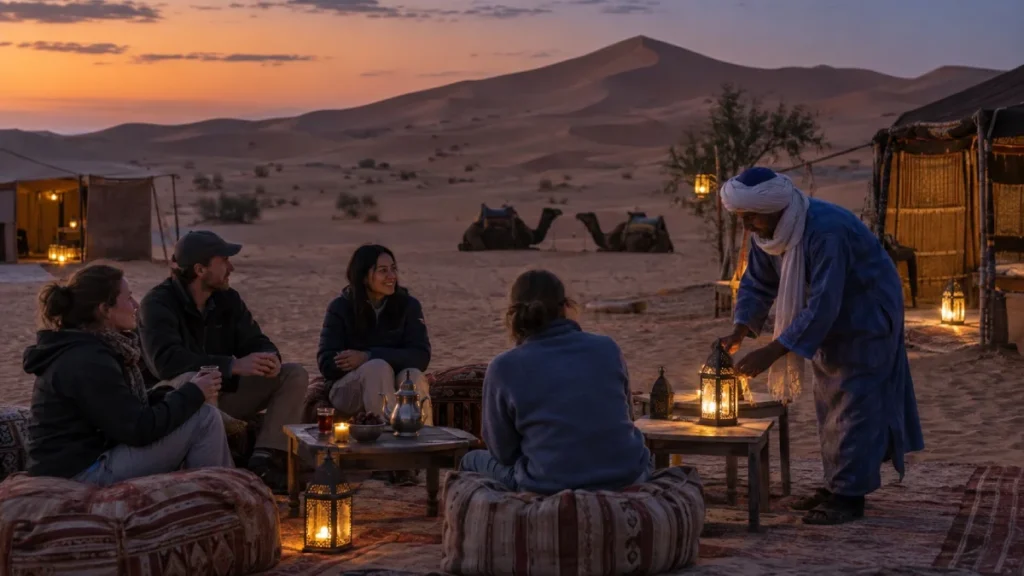
Most desert camps are comfortable in October, and many provide warm bedding. However, camp standards vary greatly. Do not assume that every camp has heating, heavy blankets, private bathrooms or the same level of insulation. Confirm the facilities of your specific camp before booking.
For travelers leaving from Marrakech, this guide to Sahara desert tours from Marrakech can help you understand the different trip formats.
Why October suits desert activities
The biggest advantage is not only the daytime temperature. October also makes the usual desert experiences more enjoyable:
- Camel rides are less physically demanding than in peak summer heat.
- Walking on dunes around sunrise or sunset is more comfortable.
- Long road journeys through the southern valleys feel easier.
- Sleeping outdoors or relaxing around camp after dark is pleasant with proper layers.
- Photography is easier when you are not trying to avoid extreme midday heat.
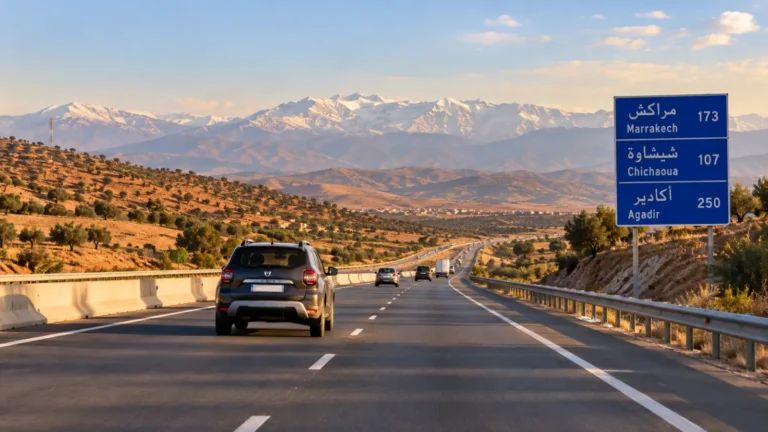
If you are combining Marrakech with the Sahara, allow for the reality of driving distances. The journey is part of the experience, with mountain roads, valleys and stops along the way, rather than a quick transfer to the dunes.
Atlas trekking in October: one of the best hiking windows
October is an excellent time for Atlas trekking, especially around Imlil. Typical daytime temperatures can range from roughly 15–25°C, while nights may fall to around 5–10°C.
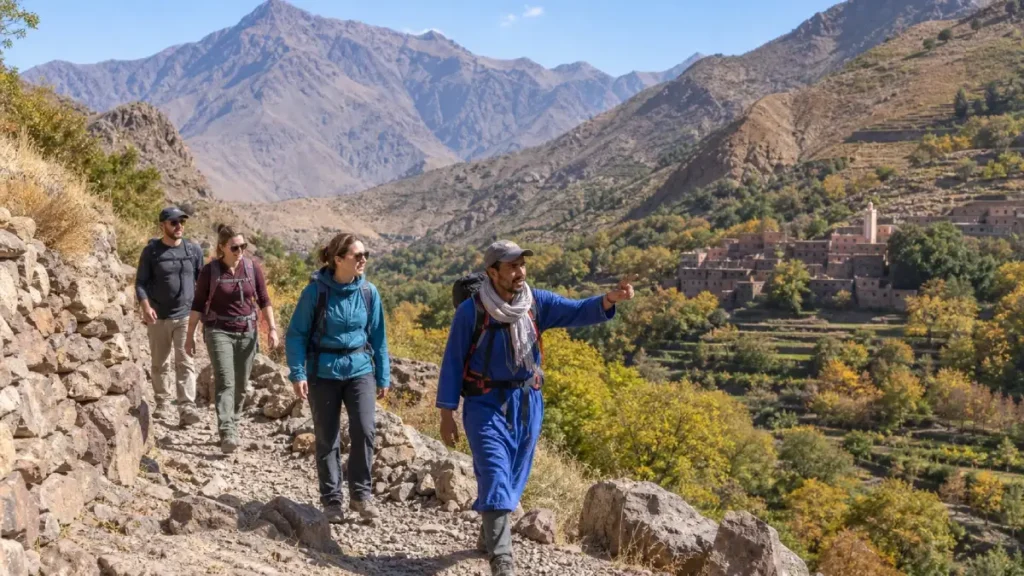
For day walks, the weather is often comfortable enough for sustained uphill hiking without the intense heat of summer. Trails and passes are frequently clear and dry, although conditions always depend on the exact route, altitude and recent weather.
The key mistake is packing for Marrakech rather than for the mountains. Even if the city is warm, Imlil and higher trails can feel significantly colder in the morning, evening and shade.
Higher routes need mountain-specific preparation
The highest peaks, including Toubkal, can occasionally receive their first light snow toward late October. That does not mean every October trek involves snow, but it does mean travelers heading to altitude should check current mountain conditions before setting out.
Pack warmer layers than city temperatures suggest, including:
- A fleece or insulated mid-layer
- A light windproof or waterproof shell
- Proper walking shoes with grip
- Warm socks for early starts
- Sun protection, even on cool days
- A small daypack with water and snacks
For route planning and practical preparation, see the Atlas Mountains trekking guide.
Autumn rain can affect mountain roads and river crossings. Rain is often short-lived, but never assume that a normally dry crossing or road remains safe after heavy weather. Check current local conditions when significant rain is forecast.
October road trips through the Dades, Skoura and Draa Valley
October is also an excellent month for southern road trips through Dades, Skoura and the Draa Valley. Cooler temperatures make roadside stops, walks around palm groves and visits to kasbah areas much easier than during the hottest months.
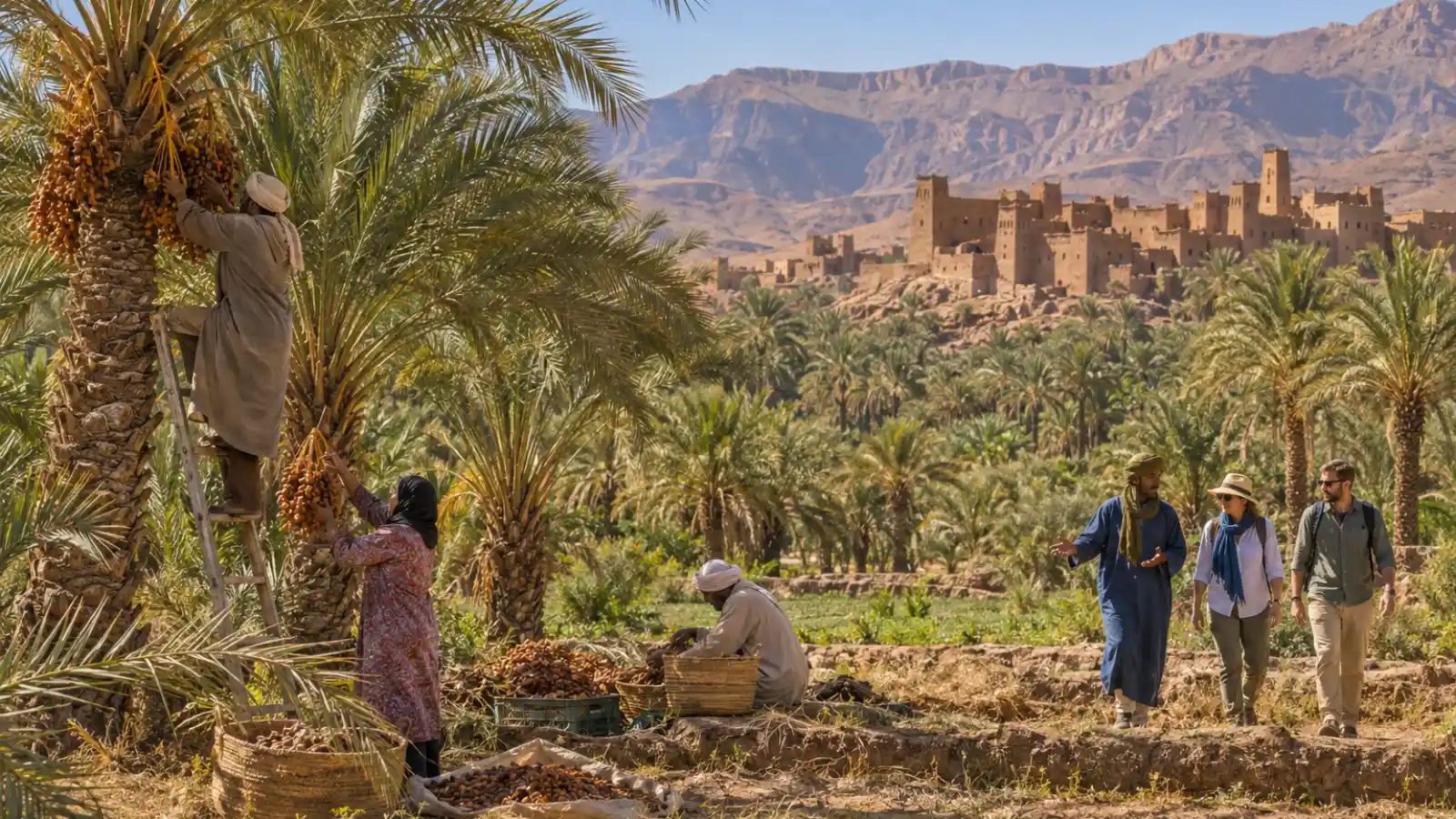
These valleys have a different rhythm in autumn. Agricultural activity becomes more visible, especially around the date harvest, and the contrast between palm groves, dry landscapes and mountain scenery is particularly rewarding on a multi-day route to or from the Sahara.
Road conditions are generally favorable in October, but weather still matters. Rain becomes more likely in northern and mountainous areas, and heavy weather can change driving conditions quickly. Build some flexibility into a self-drive route rather than treating mountain travel as fixed to the minute.
Date harvest season in southeastern Morocco
One of the most distinctive reasons for visiting Morocco in October is the date harvest. Around Erfoud, Rissani and parts of the Draa Valley, palm groves become active and local markets carry fresh dates.
This is a good time to try dates from the regions where they are grown rather than viewing them only as a packaged souvenir. You may see prized varieties such as Medjool, but harvest timing and varieties vary by area, so do not expect every type of date in every market or oasis.
Erfoud and the annual date festival
Erfoud is associated with an annual date festival celebrating the harvest through local products, music and cultural activities. It can be a worthwhile addition to a southeastern Morocco itinerary if your travel dates align, but the programme and timing vary.
If you plan around the festival, book accommodation and transport earlier than usual. Festival periods can bring additional domestic visitors as well as international travelers.
Autumn cultural festivals may affect your route
Autumn can also bring cultural events elsewhere in Morocco. Essaouira may host the MOGA Festival during this period, while M’Hamid El Ghizlane is associated with the Taragalte Festival, focused on Saharan and nomadic culture through music, poetry and cultural gatherings.
Treat these events as possible itinerary additions rather than fixed travel assumptions until the 2027 dates are confirmed.
Ouzoud Waterfalls and Ourika Valley in October
October is a comfortable time for day trips from Marrakech to Ouzoud Waterfalls and the Ourika Valley. Cooler temperatures make walking easier, and the large domestic summer crowds have disappeared.
That does not mean these places are empty. Weekends and organized day-trip periods can still be busy, especially when Marrakech has high visitor numbers. Start early if you want a quieter walk and more time before returning to the city.
The waterfall flow can vary with recent weather and seasonal conditions, so it is better not to plan around a guaranteed water level. The main October advantage is the walking weather rather than a promise of a particular flow.
For practical route advice, see this Marrakech to Ouzoud Falls day-trip guide.
Crowds and booking advice for visiting Morocco in October
October is popular, and the most in-demand places can feel busy. Marrakech, Fes, the Sahara and attractive riads are particularly affected, especially around European school holidays.
Book ahead if any of these are important to your trip:
- A specific riad in Marrakech or Fes
- A higher-quality desert camp
- A private driver for a multi-day southern route
- A guided Atlas trek
- Accommodation in a small coastal property
- Travel dates that overlap with a confirmed festival
Some properties may be less expensive than during certain spring peak periods, but rates vary substantially by city, property type and exact week. It is not safe to expect a standard October discount.
The practical approach is simple: choose your route first, reserve the experiences with limited capacity, then leave a little flexibility for restaurants, city wandering and weather-dependent activities.
What to pack for Morocco in October
The biggest October packing mistake is assuming warm afternoons mean warm nights. Morocco in October requires layers, especially if you plan to visit more than one region.
For most itineraries, pack lightweight clothing for daytime alongside a fleece, sweater or light jacket for mornings and evenings. Desert and mountain travelers need warmer layers because temperatures fall quickly after sunset.
A useful October packing list includes:
- T-shirts or lightweight long-sleeved tops for warm afternoons
- Trousers, loose long skirts or other comfortable walking clothes
- A fleece, sweater or light jacket
- A lightweight waterproof layer for northern Morocco and mountain travel
- Comfortable walking shoes for medinas, valleys and uneven paths
- Sandals for warm city or beach days
- Sun protection: hat, sunglasses and sunscreen
- A scarf or light layer for cool evenings, dusty roads or conservative settings
- A warmer layer for the Sahara and Atlas Mountains
- Swimwear if Agadir or a hotel pool is part of your itinerary
For a more detailed, trip-wide checklist, use this Morocco packing list.
Who should choose Morocco in October?
October is particularly well suited to travelers who want to see several sides of the country in one trip. It is a strong month if you want city exploration, mountain walking, desert travel and a few beach days without facing severe seasonal extremes in each place.
Choose October if you are:
- Visiting Morocco for the first time
- Combining Marrakech, Fes, the Atlas and Sahara
- Traveling as a family and want manageable daytime conditions
- Interested in hiking around Imlil
- Planning a road trip through the oasis valleys
- Looking for comfortable desert camp nights rather than summer heat
- Interested in date harvest activity around Erfoud, Rissani or the Draa Valley
- Considering Agadir for warm Atlantic beach weather
It may be less ideal if your only priority is lush spring scenery or the lowest possible hotel prices. But for an all-round Moroccan itinerary, October offers one of the best balances of weather, seasonal interest and travel flexibility.
FAQ
Is October a good time to visit Morocco?
Yes. October is one of the best all-round months for Morocco, with warm but more manageable city temperatures, comfortable Sahara conditions and strong trekking weather in the Atlas Mountains. Expect cooler mornings and nights, especially in the desert and at altitude.
How hot is Marrakech in October?
Marrakech typically has daytime highs around 27–30°C in early October, falling toward roughly 24°C later in the month. Mornings and evenings are commonly cooler, around 14–20°C.
Can you swim in Morocco in October?
Agadir is one of the better choices for October swimming, with daytime temperatures that can reach around 28°C and Atlantic water that may be around 21°C. Essaouira is cooler, windier and generally better suited to surfing and kiteboarding.
Is the Sahara cold at night in October?
Desert nights are cooler than the daytime but are usually crisp rather than severely cold. Typical night temperatures can range around 10–18°C. Bring a fleece or light jacket, and confirm what bedding and facilities your specific desert camp provides.
What should I wear in Morocco in October?
Bring lightweight clothes for warm afternoons, plus a fleece, sweater or light jacket for mornings and evenings. Add a lightweight waterproof layer if visiting northern Morocco, and pack warmer layers for the Sahara or Atlas Mountains.