
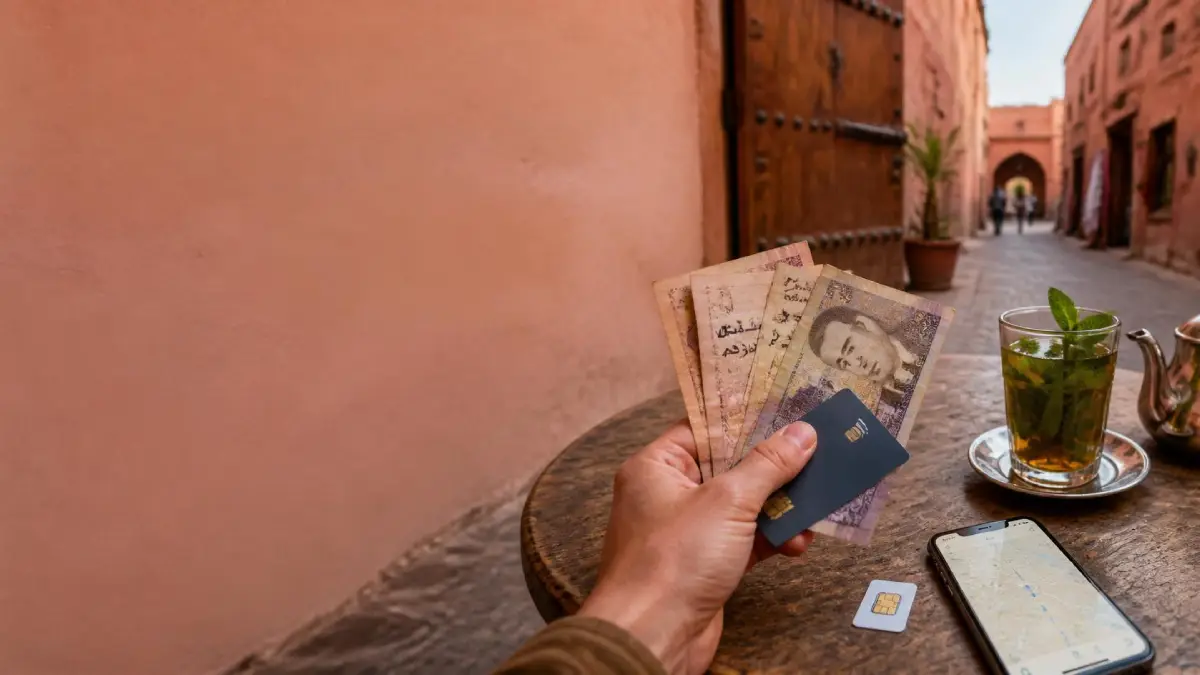
The official Morocco currency is the Moroccan dirham, identified internationally by the code MAD.
For most travelers, the best way to handle money in Morocco is to use a combination of cash and cards. Cards are increasingly useful at hotels, supermarkets, modern restaurants and larger businesses, but Moroccan dirhams remain essential for taxis, souks, small cafés, tips and purchases in rural areas.
I’m Youness Labchir, a licensed Moroccan guide since 2004. After more than twenty years helping travelers around Marrakech, Fes, the Atlas Mountains and Sahara, I have seen the same money problems repeatedly:
- Arriving without cash for the first taxi
- Depending on one card
- Accepting an expensive ATM conversion
- Receiving only 200-dirham notes for small purchases
- Reaching the mountains or desert before withdrawing enough money
- Assuming that an online reservation means the balance has already been paid
This guide explains what currency Morocco uses, whether you should bring cash or cards, which ATMs currently work best for foreign visitors, where to exchange money and how much cash to carry.
Table of Contents
Table of Contents
Morocco Currency: Quick Answer
| Question | Practical answer |
|---|---|
| What currency does Morocco use? | The Moroccan dirham, abbreviated as MAD |
| Can I pay in euros or US dollars? | Some tourism businesses may accept them, but daily purchases should normally be paid in dirhams |
| Should I buy Moroccan dirhams before traveling? | Usually not. It is normally easier to withdraw or exchange money after arriving |
| Is Morocco cash-only? | No, but cash is still necessary for many everyday payments |
| Are cards accepted in Morocco? | Commonly at hotels, supermarkets and larger businesses, but acceptance varies |
| Are there ATMs in Morocco? | Yes, particularly in cities, airports and larger towns |
| What is the best ATM in Morocco for foreigners? | BMCI is my first choice for larger withdrawals; Attijariwafa is my nationwide backup |
| How much is the local ATM fee? | Around 35 MAD is now common, although the fee can vary |
| How much cash should I obtain after landing? | For most visitors, 500–1,000 MAD is enough for the first stage of the trip |
| Should I accept the ATM’s home-currency conversion? | No. Complete the withdrawal in MAD |
| Do I need cash for the Sahara or Atlas Mountains? | Yes. Withdraw before leaving a major city or regional center |
| How many cards should I bring? | Ideally two cards stored separately |
What Currency Is Used in Morocco?
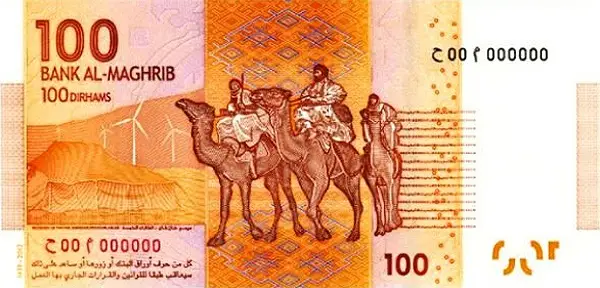
Morocco uses the Moroccan dirham as its official currency.
Its international currency code is:
MAD
Prices may also be written as:
- DH
- Dhs
- DHS
- د.م.
- Dirham
One dirham is divided into 100 santimat, although visitors mostly deal with whole-dirham prices.
The main banknotes in circulation are:
- 20 MAD
- 50 MAD
- 100 MAD
- 200 MAD
Common coins include:
- 1 MAD
- 2 MAD
- 5 MAD
- 10 MAD
Smaller centime coins also exist, but travelers will normally use dirham coins and notes for ordinary purchases.
Carry Smaller Dirham Notes
A 200-dirham banknote is useful for hotels, restaurants and larger purchases, but it can be difficult to change when paying for:
- A short taxi journey
- A bottle of water
- A café bill
- A small market purchase
- Luggage assistance
- A public toilet
- A tip
- A village shop
After withdrawing money, try to break one larger note at a supermarket, established restaurant, hotel or larger shop.
A useful everyday mix is:
- A few 20-dirham notes
- Several 50-dirham notes
- One or two 100-dirham notes
- Coins for very small expenses
Do not expect a taxi driver or small vendor to have change for 200 MAD, particularly early in the morning.
Is the Moroccan Dirham a Closed Currency?
The Moroccan dirham is often described as a closed currency. A more precise description is that it is a regulated currency whose import and export are restricted.
Travelers may carry no more than 2,000 MAD in Moroccan banknotes into or out of Morocco.
The practical consequences are:
- Do not bring a large supply of dirhams from abroad
- Obtain most of your Moroccan currency after arrival
- Do not plan to take a large amount of unused MAD home
- Spend or exchange excess dirhams before departure
- Keep important ATM and exchange receipts
Some banks and travel-money companies outside Morocco may sell dirhams. However, availability can be limited, and the exchange rate may be less favorable than obtaining MAD after arrival.
My Recommended Morocco Money Setup
For most travelers, I recommend arriving with:
- A primary Visa or Mastercard
- A backup card stored separately
- A modest amount of euros, pounds or US dollars for emergencies
- Enough accessible money for the first day
- Your bank’s emergency number saved offline
- Card-transaction notifications enabled
- Your first accommodation and transfer details saved offline
- A secure place for emergency money separate from your normal wallet
After arriving, obtain approximately 500–1,000 MAD when needed.
That should normally cover:
- Your airport transfer or taxi
- A first meal
- Water and snacks
- Luggage assistance
- Small tips
- Medina purchases
- A SIM card or other arrival expense
- A business whose card terminal is unavailable
Your first airport withdrawal or exchange does not need to be the cheapest transaction of your trip. It only needs to make your arrival straightforward.
You can compare larger ATM withdrawals or exchange-office rates after reaching the city.
For transport choices and current arrival procedures, read my Marrakech Airport to the Medina guide.
Do Not Carry the Complete Trip Budget in Cash
You do not need to arrive with an envelope containing all the money for your holiday.
A safer approach is to:
- Obtain money in stages
- Keep one day’s spending accessible
- Store emergency cash separately
- Use cards for suitable larger expenses
- Withdraw before entering areas with unreliable banking services
- Keep the backup card away from the primary card
If one wallet is lost, you should still have access to another card and some emergency money.
Cash or Card in Morocco?
The safest answer to cash or card in Morocco is to bring both.
Morocco is not completely cash-only, but cash remains important for many ordinary transactions.
Where Cash Is Usually Necessary
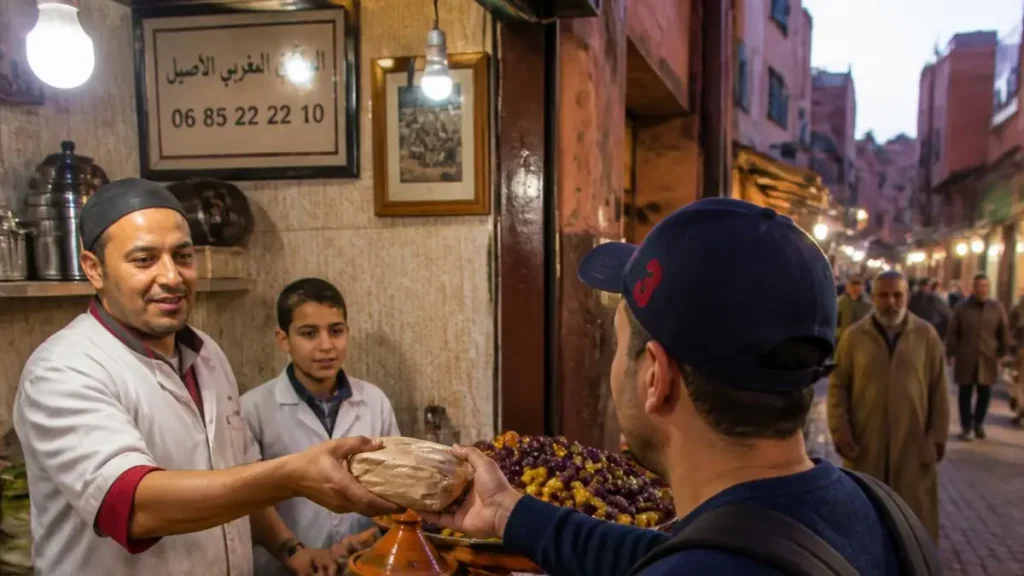
Expect to pay in Moroccan dirhams for:
- Petit taxis
- Souks and traditional markets
- Small cafés
- Street-food stalls
- Local grocery shops
- Public toilets
- Tips
- Luggage assistance
- Smaller Medina businesses
- Rural shops
- Mountain villages
- Desert-camp extras
- Independent guides or drivers who do not have card facilities
On a Medina-focused day, many of my guests still pay roughly 70–80% of their smaller expenses in cash.
Where Cards Commonly Work
Visa and Mastercard are increasingly accepted at:
- Larger hotels
- Many mid-range and luxury riads
- Modern restaurants
- Supermarkets such as Marjane and Carrefour
- Shopping centers
- International retail brands
- Established tour companies
- Train or airline websites
- Larger purchases
- Modern businesses in areas such as Gueliz in Marrakech or Maarif in Casablanca
However, a card logo on the door does not guarantee that the terminal will work.
Card payments can fail because of:
- A weak internet connection
- A terminal problem
- A power interruption
- A bank-security block
- An unsupported card
- A daily spending limit
- A temporary payment-network failure
Always keep enough cash to complete the purchase or reach your accommodation.
Contactless Payments and Mobile Wallets
Some modern businesses accept contactless cards, Apple Pay or Google Pay.
Treat these as conveniences, not as your only payment method.
Bring the physical card because:
- The terminal may require a PIN
- Your phone battery may run out
- The merchant may not accept mobile-wallet payments
- Your card issuer may request additional verification
- The terminal may accept the card but not the phone
Cash and a physical backup card remain essential.
Using Wise or Revolut in Morocco
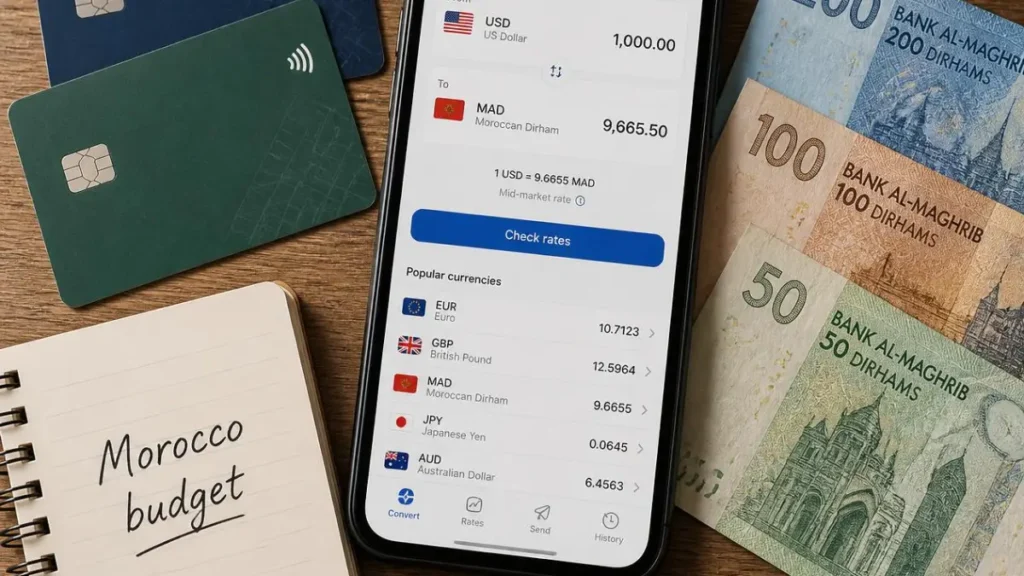
Wise and Revolut cards can both be useful in Morocco where their Visa or Mastercard network is accepted.
They can help travelers:
- Manage currency conversion
- Freeze a missing card quickly
- Receive transaction notifications
- Separate travel money from the main bank account
- Check spending through an application
However, neither card removes the need for cash or a backup payment method.
Before traveling, check:
- Your current ATM allowance
- Withdrawal fees after the allowance
- Currency-conversion fees
- Weekend or fair-usage charges
- Whether your account permits international cash withdrawals
A Moroccan ATM may add its own fee even when the card provider describes the withdrawal as fee-free.
Do not rely on a particular brand being automatically cheaper. Fees and account terms can change.
How Much Cash Should You Take to Morocco?
You should distinguish between:
- Your total trip budget
- The amount you keep in cash
- The amount already paid online
- The amount still due locally
Most travelers do not need to carry their entire budget in physical money.
Rough Daily Spending Ranges
Excluding flights, rough planning ranges are:
- Budget traveler: approximately 300–450 MAD per day
- Mid-range traveler: approximately 500–900 MAD per day
- Comfort or upscale traveler: approximately 1,000–1,800 MAD or more per day
These are broad total-spending ranges, not instructions to carry that complete amount in your wallet.
Accommodation, private transport, tours and higher-end restaurants can change the total considerably. For a full breakdown, read my Morocco travel cost guide.
How Much Cash Should You Carry Each Day?
Carry enough Moroccan dirhams for:
- Planned cash-only purchases
- Taxis
- Food and drinks
- Tips
- Small shopping
- A failed card transaction
- An emergency journey back to the hotel
Keep the rest in a secure place or withdraw it later.
A traveler spending the day at a resort or modern hotel may use little cash. Someone exploring a Medina, taking taxis and shopping in souks will need more.
How Much Cash Should You Get After Landing?
For most visitors, 500–1,000 MAD is a sensible first amount.
Increase it when:
- Your transfer has not been prepaid
- You are arriving late
- You are traveling directly outside the city
- Your accommodation requires a cash balance
- You are traveling with a family
- You have several cash-only expenses on the first day
Reduce it when your airport transfer, accommodation and first activities have already been paid.
Families and Groups
Families should carry a larger emergency reserve, but not in one wallet.
Divide the money between responsible adults and keep the backup card separately.
Before leaving a city, calculate:
- Meals for the group
- Taxis or private transport
- Unpaid accommodation
- Activities
- Tips
- Snacks and drinks
- A reasonable emergency reserve
ATMs in Morocco: Fees, Limits and the Best Banks
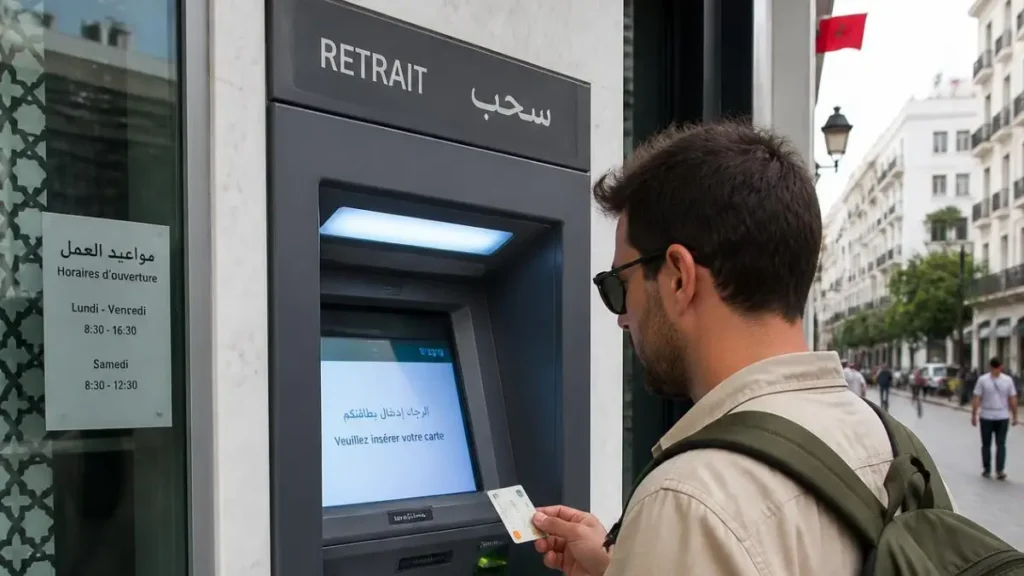
Are there ATMs in Morocco? Yes.
You will find them at airports and throughout cities such as Marrakech, Casablanca, Fes, Rabat, Tangier and Agadir, as well as in most larger regional towns.
The problem is not finding an ATM in a city. The problem is avoiding repeated fees and withdrawing enough before entering a remote area.
ATM Fees in Morocco in 2026
As of August 2026, I no longer advise travelers to plan around finding a dependable fee-free ATM.
A local fee of around 35 MAD per withdrawal is now common for foreign cards, although the exact charge can vary according to:
- The bank
- The individual ATM
- Your card network
- Your home bank
- Your account type
- The amount requested
Your own bank or card provider may separately add:
- An international ATM fee
- A foreign-transaction fee
- A currency-conversion fee
- A cash-advance charge when using a credit card
The ATM should display its own local fee before you approve the withdrawal.
Best ATM in Morocco for Foreigners: BMCI
From what I am currently seeing while guiding travelers, BMCI is my first ATM choice.
Many BMCI machines allow foreign visitors to withdraw approximately 4,000–8,000 MAD in one transaction.
This matters because the Moroccan ATM fee is normally charged per transaction.
A traveler who needs 8,000 MAD may be able to pay the local fee once at BMCI instead of making several 2,000-MAD withdrawals and paying it repeatedly.
The exact amount available still depends on:
- The specific ATM
- The cash available inside the machine
- Your bank’s daily withdrawal limit
- Your card provider
- Your account balance
- Temporary technical restrictions
If 8,000 MAD is declined, try 6,000 or 4,000 MAD before assuming the card does not work.
Attijariwafa Bank: Best Nationwide Backup
Attijariwafa Bank is my second recommendation.
Its main advantage is its large national network. Its ATMs are easy to find in major cities and many regional towns, making it a useful backup while moving between destinations.
Other useful alternatives include:
- Bank of Africa
- Banque Populaire
- CIH Bank
One bank may reject a foreign card while another accepts it immediately. A rejection does not always mean there is a problem with the card.
Al Barid Bank Is No Longer the Fee-Free Favorite
Al Barid Bank was frequently recommended in older Morocco travel articles because foreign visitors could often withdraw money without a local ATM fee.
That advice is now outdated.
In 2026, Al Barid Bank machines commonly display a fee of approximately 35 MAD for foreign-card withdrawals.
Its branches are still useful and widespread, but it is no longer the special fee-free option described in many older guides.
Always Withdraw in Moroccan Dirhams
A Moroccan ATM may offer to convert the transaction into your home currency.
For example, it may offer to charge your account in:
- Euros
- British pounds
- US dollars
- Canadian dollars
- Australian dollars
This is called Dynamic Currency Conversion, or DCC.
Normally, choose:
- Continue in MAD
- Decline conversion
- Charge in Moroccan dirhams
- Use my bank’s exchange rate
Declining conversion does not cancel your withdrawal. It allows your card issuer to handle the conversion instead of accepting the ATM operator’s offered exchange rate.
Always read the screen carefully because ATM wording varies.
Use an ATM Attached to a Bank Branch
Whenever possible, use an ATM:
- Attached to an open bank
- During daytime
- In a busy, well-lit location
- Before leaving a major town
If the ATM retains your card, it is easier to request help when the branch is open.
Carry your passport or a secure copy of your identification when making an important withdrawal, but do not leave your passport with anyone as a payment guarantee.
Carry Two Cards
Bring a primary card and a backup card from another account or card network when possible.
Store them separately.
A card can be:
- Declined
- Lost
- Stolen
- Temporarily blocked
- Retained by an ATM
- Incompatible with a terminal
- Limited by a daily withdrawal ceiling
Keeping both cards in the same wallet removes the benefit of having a backup.
Morocco Currency Exchange: Where to Change Money
You can exchange eligible foreign banknotes through:
- Moroccan banks
- Authorized currency-exchange offices
- Airport exchange counters
- Approved exchange counters at ports
- Certain authorized hotels
Look for an established provider displaying:
- Its business name
- Current buying and selling rates
- Official exchange signage
- A staffed counter
- A receipt or exchange slip
Do not exchange money with strangers on the street or through an unidentified shop.
An unusually generous unofficial rate is not worth the risk of receiving counterfeit money, the wrong amount or no record of the transaction.
What Is the Best Currency to Bring to Morocco?
The easiest foreign currencies to exchange are generally:
- Euros
- British pounds
- US dollars
Bring clean, undamaged banknotes.
An exchange provider may reject notes that are:
- Torn
- Heavily marked
- Extremely worn
- Missing part of the design
- Difficult to authenticate
Foreign cash should be an emergency or exchange reserve, not your main daily payment method.
Airport Exchange or City Exchange?
Airport exchange counters are useful for obtaining enough money for:
- A first taxi
- Food and water
- Tips
- Luggage assistance
- Small arrival expenses
Exchange a modest amount at the airport unless the displayed rate is acceptable and convenience is more important to you.
After reaching the city, compare the total amount of dirhams you will receive.
City exchange offices can be competitive in areas with several providers, including parts of:
- Gueliz in Marrakech
- Central Casablanca
- Maarif in Casablanca
- Central Rabat
- Major tourist and business districts
Do not assume that every airport rate is automatically terrible or that every city office is better. Rates and commissions vary.
Ask:
How many Moroccan dirhams will I receive after every commission and charge?
Compare the final amount, not only the large rate displayed outside.
Keep Your Exchange Receipts
Keep receipts from:
- Currency exchanges
- Large ATM withdrawals
- Important card payments
- Tour balances
- Hotel payments
An exchange receipt may be useful when converting unused dirhams back into foreign currency before departure.
For a current reference rate, use the official Bank Al-Maghrib foreign-banknote exchange-rate page. Remember that a central-bank reference does not guarantee the exact rate offered by a cash exchange office or card provider.
Can You Use Euros in Morocco?
Some hotels, tour companies, desert camps and tourism-oriented businesses may accept euros.
However, the euro is not Morocco’s normal daily currency.
Taxis, cafés, souks, small restaurants and local shops generally expect Moroccan dirhams.
When a business accepts euros directly, ask:
- What is the price in MAD?
- Which exchange rate are you using?
- Will change be returned in euros or dirhams?
- Can I pay by card in MAD instead?
A business may use its own conversion rate, which can be less favorable than exchanging money formally or paying in dirhams.
Use euros mainly as emergency exchange money rather than for normal daily spending.
The same applies to US dollars and British pounds. They are useful for exchange, but you should not expect a taxi driver, café or small Medina shop to accept them.
Money in Remote Morocco: Atlas Mountains and Sahara
Do not wait until reaching a mountain village or desert camp before deciding how much cash you need.
ATM access becomes less predictable outside major cities and regional centers. Machines may be:
- Out of service
- Out of cash
- Unable to accept a foreign card
- Closed inside a branch
- A long distance from your accommodation
An ATM shown on a map is not a guarantee that it will work.
Before Traveling to Imlil and the High Atlas
Complete important withdrawals in Marrakech before traveling toward Imlil, Toubkal or smaller mountain villages.
Prepare cash for:
- Unpaid accommodation
- Meals
- Local guides
- Mule or luggage support
- Transport
- Tips
- Snacks and water
- Emergency itinerary changes
Carry smaller notes. A village shop, driver or porter may not be able to change a 200-dirham banknote.
Before Traveling to Merzouga and Erg Chebbi
Withdraw money before depending on ATM access in Merzouga or near the dunes.
Useful regional withdrawal points can include:
- Errachidia
- Erfoud
- Rissani
- Ouarzazate
Before leaving the last larger town, confirm whether the following have been paid:
- Hotel or guesthouse
- Desert camp
- Camel transfer
- Four-wheel-drive transfer
- Meals
- Private driver
- Return transport
- Activities
Even when the main package is prepaid, cash may still be needed for:
- Drinks
- Lunches
- Tips
- Souvenirs
- Optional activities
- Local transfers
- Emergency expenses
Do not assume a desert camp will have a reliable card terminal.
For planning and comparing routes, read my Best Sahara Desert Tours from Marrakech guide.
Before Traveling to Zagora, M’Hamid or Erg Chigaga
Ouarzazate and Agdz are useful places to complete important withdrawals before continuing into the Draa Valley.
Erg Chigaga involves more remote logistics than many Erg Chebbi trips. After the off-road journey begins, banking and payment problems become much harder to solve.
Confirm in writing:
- Total price
- Deposit paid
- Remaining balance
- Payment currency
- Included meals
- Included activities
- Optional expenses
- Return transport
- Whether any real card-payment option exists
Carry enough Moroccan dirhams for the complete remote stage plus an emergency reserve.
Common Money Mistakes to Avoid
Accepting an ATM’s Home-Currency Conversion
Complete ATM withdrawals and card payments in MAD unless you have carefully compared the offered conversion.
Depending on One Card
Carry a backup card and store it separately.
Waiting Until the Sahara to Withdraw Money
Withdraw in the city or regional center before entering remote areas.
Carrying Only 200-Dirham Notes
Break larger notes before taking taxis, visiting a market or entering a rural area.
Assuming Card Payment Will Work
Ask the hotel, riad, restaurant, guide or camp how payment must be made.
Confirm whether an online booking collected the full price or only reserved the room.
Not Confirming the Currency
When someone quotes “twenty,” “fifty” or “one hundred,” confirm that the price is in Moroccan dirhams.
Allowing Someone Else to Select the Terminal Currency
Check the amount and currency before entering your PIN.
Accepting Unrequested ATM Help
Do not share:
- Your PIN
- A banking code
- Your card
- A verification message
- Your telephone screen
Cancel the transaction and move to another ATM when someone makes you uncomfortable.
Carrying All Your Money Together
Divide cash and cards between secure locations.
Do not display a large amount of money while paying for a small purchase.
Exchanging Money Informally
Use banks or authorized exchange offices and request a receipt.
Tipping and Small Payments
Carry small notes for tips and minor services.
Tipping is customary in many situations, but the appropriate amount depends on the service, group size and circumstances.
Before tipping:
- Check whether service is included
- Confirm whether a tour team pools tips
- Use Moroccan dirhams where possible
- Do not feel forced to reward unwanted assistance
- Give larger tips discreetly
For suggested amounts for restaurants, guides, drivers, riads and desert camps, read my dedicated Tipping in Morocco 2026 guide.
SIM Cards and Internet After Arrival
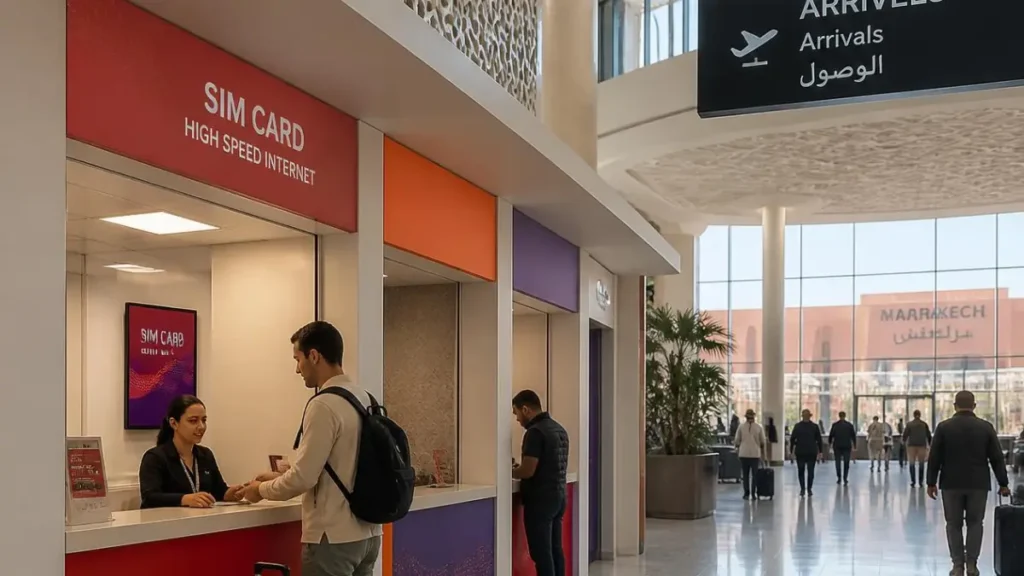
Reliable data makes it easier to:
- Contact your driver
- Find your riad
- Receive banking notifications
- Freeze a missing card
- Use maps
- contact an accommodation during a payment problem
This currency guide should not repeat the full connectivity information.
For Moroccan operators, airport packages and physical SIMs, read my Best SIM Card Morocco 2026 guide.
For international travel eSIMs, installation and data planning, read my eSIM Morocco 2026 guide.
FAQ: Morocco Currency and Travel Money
What Currency Does Morocco Use?
Morocco uses the Moroccan dirham.
Its international currency code is MAD, and prices may also be written as DH or Dhs.
One dirham is divided into 100 santimat.
Should I Bring Cash or Use a Card in Morocco?
Bring both.
Cards work at many hotels, supermarkets, modern restaurants and larger businesses. Cash is still necessary for taxis, souks, small cafés, tips and rural purchases.
Are Euros Accepted in Morocco?
Some tourism businesses accept euros, but the conversion rate may be unfavorable.
Use Moroccan dirhams for daily expenses and keep euros as emergency exchange money.
Should I Buy Moroccan Dirhams Before Traveling?
Most visitors do not need to buy a large amount before departure.
Bring working cards and some emergency foreign cash, then obtain MAD from a bank-owned ATM or authorized exchange provider after arrival.
How Much Cash Do I Need for a Morocco Trip?
Obtain approximately 500–1,000 MAD for your first expenses when needed.
After that, carry enough for the day and the next destination rather than keeping the complete trip budget in one wallet.
What Is the Best ATM in Morocco for Foreigners?
Based on what I am seeing with travelers in 2026, BMCI is my first choice because many of its machines permit withdrawals of approximately 4,000–8,000 MAD.
Attijariwafa Bank is my preferred nationwide backup because of its large network.
Limits still vary by ATM, card and account.
How Much Are ATM Fees in Morocco?
A local ATM fee of approximately 35 MAD is now common for foreign-card withdrawals.
Your own bank may add separate fees.
Check the complete cost shown before confirming.
Are There Any Fee-Free ATMs in Morocco?
Do not build your money strategy around finding one.
Al Barid Bank was formerly known as a fee-free option but now commonly displays a charge of approximately 35 MAD for foreign cards.
Fees can still vary by machine and card.
Should I Choose MAD or My Home Currency at an ATM?
Choose MAD.
This normally allows your card provider to perform the currency conversion rather than accepting the ATM operator’s Dynamic Currency Conversion offer.
Can I Take Moroccan Dirhams Home?
Travelers may carry no more than 2,000 MAD in Moroccan banknotes into or out of Morocco.
Spend or formally exchange a larger unused balance before departure and keep your receipts.
Can I Use Wise or Revolut in Morocco?
Both can work where their card network is accepted.
Check current fees and withdrawal allowances before traveling. Carry another card and Moroccan dirham cash because no travel card is accepted everywhere.
Do I Need Cash in the Marrakech Medina?
Yes.
Some riads, restaurants and polished boutiques accept cards, but cash remains easier for souk purchases, taxis, snacks, tips and small services.
Do I Need Cash for the Sahara Desert?
Yes.
Confirm which tour, camp, accommodation and transport costs are prepaid, then carry enough dirhams for outstanding balances, drinks, lunches, tips, optional activities and emergencies.
Do not depend on finding a convenient working ATM immediately before entering the dunes.
Final Verdict: The Best Way to Handle Morocco Currency
The safest way to manage money in Morocco is to combine Moroccan dirham cash with more than one card.
For most travelers, I recommend:
- Bring a primary Visa or Mastercard.
- Store a backup card separately.
- Carry a modest amount of euros, pounds or US dollars for emergencies.
- Obtain approximately 500–1,000 MAD after arrival when needed.
- Use BMCI for a larger withdrawal when available.
- Use Attijariwafa as a nationwide backup.
- Expect a local ATM charge of around 35 MAD.
- Complete withdrawals and card payments in MAD.
- Keep smaller notes for taxis, cafés, tips and markets.
- Withdraw before traveling into the Atlas Mountains or Sahara.
- Confirm every unpaid accommodation, camp and tour balance.
- Keep receipts from important exchanges, withdrawals and payments.
Moroccan dirhams should cover everyday expenses. Your primary card should handle appropriate larger payments. A separately stored backup card and modest foreign-currency reserve should remain available when the first option fails.
With that preparation, paying for taxis, meals, accommodation, shopping and travel services in Morocco is normally straightforward.