The Ultimate Morocco Culture & Etiquette Guide 2026: Everything You Need to Know Before You Go
If you pack only one thing for Morocco in 2026, make it cultural awareness. Clothes, cameras and chargers you can buy here; knowing how to behave in a new culture is what really opens doors – into family homes, desert tents and little medina workshops you’d never find alone.
I’m Youness, a licensed Moroccan guide based in Marrakech. I’ve been guiding private Morocco tours since my university days – more than 20 years on the road between the Atlantic, the Atlas and the Sahara. This Morocco Culture and Etiquette Guide 2026 is the version I wish every guest read before they land.
Morocco is changing fast – new highways, digital nomads in surf towns, boutique riads where there used to be family houses (you see this clearly in Fez and Marrakech, as described in the Lonely Planet summary & official Visit Morocco tourism site ). But under all that, one idea remains constant: hshuma.
Hshuma (Darija for “shame/embarrassment”) is the social engine here. It’s about not embarrassing yourself or the other person, and protecting everyone’s dignity. If you understand hshuma, almost all Moroccan etiquette starts to make sense.
Think of this as your 30‑second Morocco etiquette for tourists cheat sheet.
| Situation | What To Do | Why It Matters |
|---|---|---|
| Eating, shaking hands, paying | Use your right hand | The left hand is traditionally “unclean”. Using it for food, money or greetings feels disrespectful. |
| Bread | Treat bread as sacred | We never put bread in the trash or on the floor. If you drop it, we usually pick it up and place it somewhere “clean”. |
| Public affection | Keep it subtle | Kissing, hugging or intense flirting in public is considered hshuma. Hand‑holding is usually fine in cities. |
| Religion, politics | Avoid criticising God, the King or the Sahara | This “sacred trinity” is not a joke topic. Complaints about prices? Sure. Big political debates? Not the place. |
| Invitations | Say yes if you can | Turning down tea or snacks repeatedly can be read as cold or unfriendly. Hospitality is our pride. |
| Photos of people | Always ask first – “Mumkin taswira?” | Some people really dislike being photographed; others expect a small tip. Asking saves tension. |
Memorise this and you’re 80% of the way to good Moroccan etiquette.
`Dress Code in Morocco 2026: “Modest Intention”`
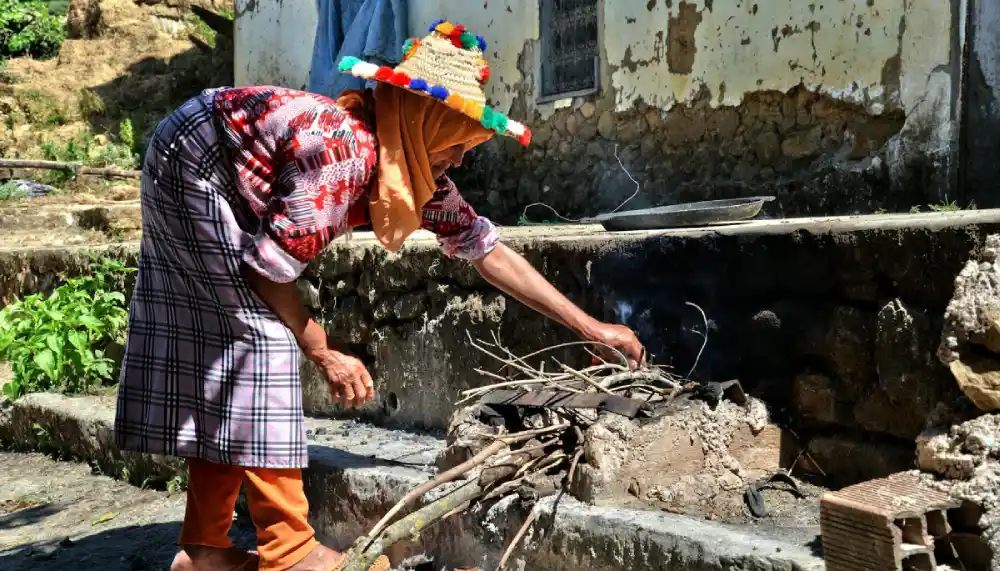
Many people ask me “What to wear in Morocco?” before they even book flights. Good question – and the answer is about intention as much as fabric.
General Rule: Shoulders & Knees Covered
Morocco is more relaxed than some neighbours, but still conservative compared to Europe or North America. If you generally cover shoulders and knees, Moroccans read it as respect, not as you becoming “less free”.
Think of it like this:
Fine almost everywhere
T‑shirts (not spaghetti straps).
Loose trousers, long skirts, midi dresses.
Light scarf you can throw on if needed.
Problems start when
Very short shorts.
Backless tops, deep cleavage.
See‑through fabrics in the medina.
Cities vs Rural Areas
I see this every week on tours:
Marrakech, Casablanca, Rabat
- You’ll see locals in jeans, dresses, sometimes tight clothing.
- Tourists in knee‑length skirts or loose shorts rarely get a second look in Gueliz (modern neighbourhoods).
- In the old medina of Marrakech or Fez: people are more traditional – modest clothing is appreciated.
Rural villages, High Atlas, oasis valleys, desert
- People are more conservative.
- Women: long loose trousers or skirts, T‑shirt or long sleeves, maybe a light scarf if you feel watched.
- Men: avoid going shirtless, and leave the tank tops for the beach.
If you visit a village family (very common in trekking routes mentioned in the trekking chapter), I always tell guests to dress like they would when visiting a partner’s grandparents.
A Moroccan Woman’s Perspective (What I Hear From Friends)
Many Moroccan women – especially in Marrakech and Casablanca – dress fashionably, but most will still:
- Cover cleavage and midriff.
- Avoid super short shorts in non‑touristy areas.
- Dress more conservatively when travelling outside big cities.
Several of my female friends say they dress more covered in the medina just to reduce comments from what we jokingly call the “sweet tongues” – the men who throw compliments and catcalls all day.
Fabrics That Actually Work Here
The Lonely Planet summary talks about varied climates; from my side, after many Augusts in the Sahara:
Best fabrics
- Linen.
- Organic cotton.
- Lightweight merino (surprisingly good – doesn’t smell, handles temperature swings).
Worst fabrics
- Heavy denim in summer in Marrakech (you’ll cook).
- Polyester that sticks to your skin.
Bring layers: desert nights (especially November–March) can be cold even when the day hits 25–30°C.
The Art of Eating & Mint Tea: More Than Just Food
The Morocco culture and etiquette guide 2026 – food edition starts with one thing: we don’t only eat to feed the body. We eat to build relationships.
Communal Dishes: The “Triangle Rule”
In many homes and traditional restaurants you’ll get one large tagine or couscous in the middle to share:
- Everyone has their own “triangle” – the section directly in front of them.
- You eat from your triangle, bringing food to your side rather than reaching across.
- Use right hand only if eating with bread; if that feels stressful, a fork is fine in most touristy places.
If you start fishing for the best meat chunk sitting far on the other side, that’s hshuma. I often quietly nudge guests and shift the tagine a little so everyone gets a fair share.
Bread is Sacred
As the food chapter in the guide hints, bread (khobz) is life here:
- We don’t put bread in the bin casually.
- Never throw it on the floor.
- If you drop a piece, locals may pick it up, kiss it lightly and place it somewhere “clean”.
You don’t have to copy that, but don’t step on bread or use it as a plate for trash.
Hospitality: Don’t Refuse Too Hard
Moroccan hospitality can be intense, especially in villages and desert camps:
If someone offers:
- Mint tea
- Dates
- Bread and olive oil
- And you say “no, thank you” three times… they may think you don’t like them.
My tip:
- If you really can’t eat/drink: explain “I’m full / I have an allergy / I feel sick.”
- Otherwise, accept a little. You’re not judged for eating small portions – only for refusing everything.
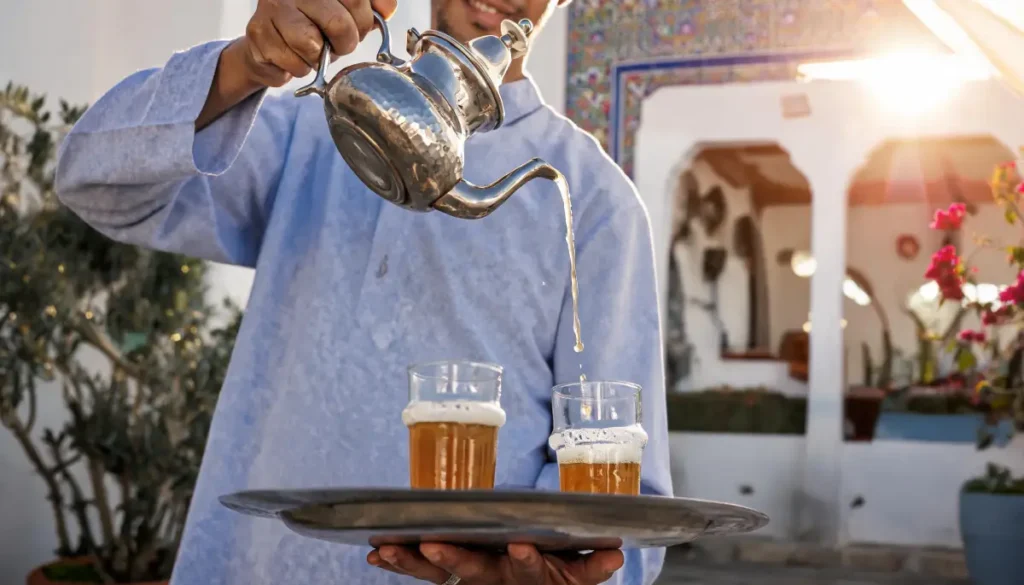
Mint Tea Ritual
That beautiful green tea in every photo is not just decoration:
- It’s brewed strong with gunpowder tea, fresh mint and lots of sugar (you can ask “bshwiya sukkar” – little sugar).
- It’s poured from a height to create foam – a small performance, as the art & crafts chapter notes about tea sets.
- Three glasses is the classic pattern:
- Stronger
- Balanced
- Light
Two glasses is fine; refusing all three can be read as a bit cold.
On my desert tours I always explain the triangle rule before the first tagine arrives…
Sacred Spaces & Photography
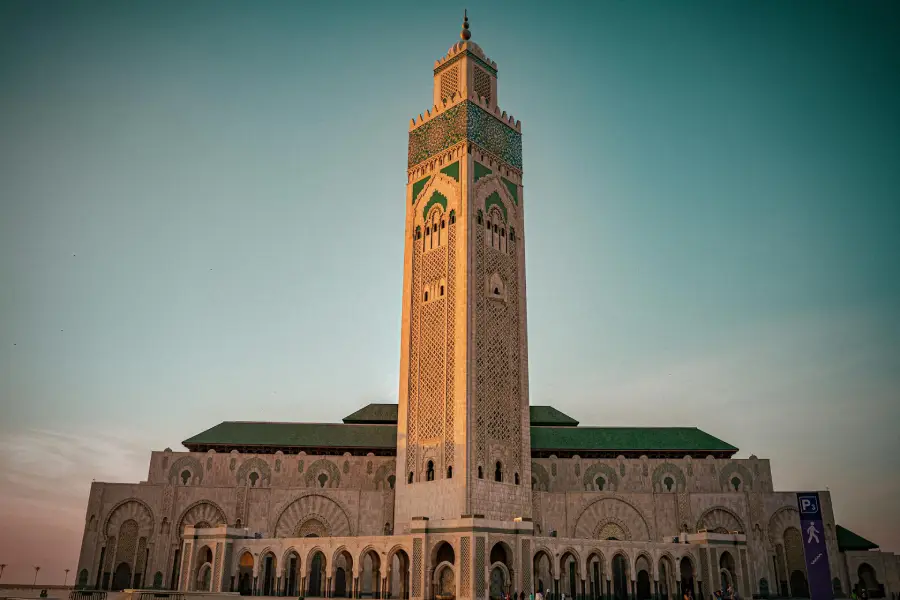
Mosques: What Non‑Muslims Can & Can’t Do
The architecture chapter mentions how impressive Moroccan mosques are. For visitors, the key points:
- Most mosques are closed to non‑Muslims inside.
- Main exception:
- Hassan II Mosque, Casablanca – guided visits available and highly recommended. official Hassan II Mosque visitor information
- You can:
- Admire from outside.
- Photograph exteriors respectfully.
- Keep distance at prayer times, especially Friday noon.
If you’re not sure: ask me, your guide, or a local “mumkin ndkhol?” (can I enter?). If they look unsure, take it as a no.
Photos: People, Police & “No Pictures Here”
From long experience (and yes, a few warnings):
- Always ask before photographing:
- Women (especially older ones)
- Children
- Street performers in Jemaa el‑Fna (they expect a tip – usually 10–20 MAD)
- Never photograph:
- Police, soldiers, military bases.
- Government buildings, embassies.
- Certain borders and checkpoints.
I’ve seen guests politely told to delete photos near police posts. It’s not dramatic if you respect the request, but it’s avoidable.
A simple “Mumkin taswira?” with a smile works wonders.
Social & Business Interactions: How to Say Hello (and When to Stop Talking)
Everyday Greetings
The Lonely Planet “Need to Know” section mentions how important greetings are. In real life:
Best all‑purpose greeting
- “As‑salamu alaykum” (peace be upon you)
- Response: “Wa alaykum as‑salam”
With friends / in cities:
- “Salam” or “Labas?” (all good?) is fine.
A warm greeting + eye contact + slight smile = half your cultural problems solved.
Often we add a small gesture: after shaking hands, we touch the right hand to the chest – meaning “I greet you from my heart.”
Gender Etiquette
This is where visitors worry most:
- As a male tourist:
- Don’t initiate a handshake with a Moroccan woman unless she offers first.
- A nod and “salam” is always safe.
- As a female tourist:
- You can offer your hand; most men will shake.
- Some religious men may put their hand over their heart instead of shaking. It’s respect, not rejection.
Moroccan Business Etiquette
If you’re coming for work, some quick reality:
Relationships first, contracts second.
- Meetings often:
- Run late.
- Include tea, small talk, sometimes family questions.
- Have interruptions – phones, people walking in.
- Pushing for efficiency immediately can feel rude. Invest time in the human side; decisions usually follow trust, not the other way around.
This is why books like “Morocco – Culture Smart! The Essential Guide to Customs & Culture” emphasise patience – and they’re right.
If you’re coming for work and want a soft cultural landing, I can organize airport pick‑up and a short ‘Morocco business etiquette’ briefing on your first evening.
Special Interest: Solo Women, Digital Nomads & Ramadan
Is Morocco Safe for Solo Female Travelers?
The file’s FAQs already summarise it well: generally yes, with street‑smart awareness.
From my own tours with solo women:
What you can expect
- Catcalling / comments (“hello beautiful”, “hey gazelle”) – especially in big city medinas.
- Very rare physical harassment in tourist areas if you stay alert.
What works best
- Ignore comments; don’t engage in banter with groups of young men.
- Walk with purpose, head up, like you know where you’re going (even if you don’t).
- Dress modestly to reduce attention, especially away from tourist zones.
Many women tell me after a week: “It was noisy and sometimes annoying, but not threatening.”
Fake husband strategy:
Some solo women find it easier to say “my husband is at the hotel/restaurant” if someone is too persistent. It works because family is deeply respected here.
I’ve written a full solo female Morocco guide with specific areas to stay, how to handle ‘sweet tongues’, and sample 7–10 day itineraries.
Digital Nomad Life in Morocco (2026 Snapshot)
The “Morocco Today” and coastal chapters hint at this: the country is moving fast, and remote workers have noticed.
Hotspots I see most:
- Marrakech – good cafés with Wi‑Fi, co‑working spaces, international flights.
- Taghazout & Tamraght – surf + laptops; very popular for winter sun.
- Agadir – more “normal” city life, long beach, decent internet.
- Casablanca / Rabat – best for business links, stable internet, but less “exotic”.
Time zone:
Most of the year Morocco is UTC+1, handy for Europe and manageable for North America.
Typical monthly budgets (very approximate, 2026):
Marrakech
- Simple studio: 4,000–7,000 MAD / month.
- Eating out & groceries: 3,000–5,000 MAD.
- Cafés, co‑working, transport: 2,000–3,000 MAD.
⇒ Comfortable life from around 9,000–15,000 MAD (≈ 900–1500 EUR) depending on lifestyle.
Agadir / Taghazout / Tamraght
- Room in shared flat: 2,500–4,500 MAD
- Food & cafés: 3,000–4,000 MAD
⇒ Many nomads survive from 7,000–12,000 MAD.
If you stay long‑term, learn a bit of Darija (Moroccan Arabic) – even “bzaf” (a lot), “shwiya” (a bit) – locals appreciate it and prices suddenly become more local too.
Traveling During Ramadan
The religion & history parts of the file remind us how central Islam is here. During Ramadan:
- Locals fast sunrise to sunset:
- No food, no water, no smoking in public.
- Tourists are not expected to fast, but:
- Avoid eating/drinking/smoking in the street.
- Many cafés and some restaurants close in the day, especially in smaller towns.
- After sunset, it’s beautiful:
- Families gather for iftar (breaking the fast – often with harira soup, dates, chebakia pastries).
- Streets come alive till late.
If you’re here in Ramadan, plan:
- Late breakfast + early dinner at iftar time.
- Or cook for yourself during the day in riads/apartments that allow it.
I also have a separate guide about visiting Morocco during Ramadan, with real photos and sample daily routines.
Practical Logistics: Bargaining, Tipping & Customs
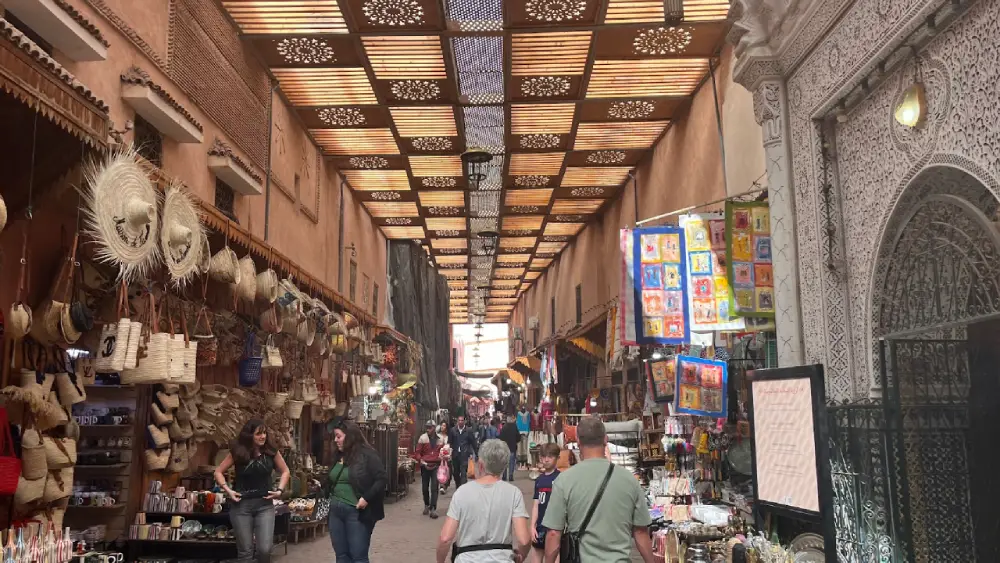
Bargaining in the Souks: The Social Dance
The guide’s A–Z directory calls it a social ritual, and that’s exactly right.
A simple method I teach on tour:
- Ask the price, smile.
- Expect a high first offer.
- Counter with 40–50% of that.
- Slowly meet somewhere in the middle.
- Keep it playful – jokes, smiles, light teasing.
If you look angry or insulted, everyone loses. If both sides end with a smile, the price is probably fair.
For a practical example with current price ranges and a step-by-step shopping route, read my Marrakech market and bargaining guide.
Tipping Guide (Realistic for 2026)
Tipping (baksheesh) is part of Morocco customs for tourists:
Restaurants
- Locals tip around 10%; tourists often give 10–15% in mid‑range places.
Porters
- 10–20 MAD per bag, depending on distance/effort.
City guides / drivers
- 100–200 MAD per traveler per day for good service on a private tour.
Desert camp staff
- Around 50–100 MAD total per guest for a 1‑night stay in a standard camp; more if luxury and you’re happy.
Small coins are your friends – keep them.
On my multi‑day tours I give you a simple printed tipping & bargaining cheat sheet so you don’t have to calculate in your head every time.
“Morocco Customs” at the Airport: What to Know
Many people search “Morocco customs website” or worry about Morocco customs airport rules. Key points:
Currency
- You’re not supposed to take large amounts of Moroccan dirhams in or out.
- Bring euros/dollars and change gradually.
Alcohol
- Allowed in limited quantities in checked luggage; you can also buy in duty‑free when leaving.
Drones
- Usually confiscated on arrival unless you have special permission. Don’t bring one unless it’s for authorised work.
Food
- Normal snacks for personal use are fine; large quantities of meat/dairy not recommended.
At Casablanca or Marrakech airports, customs are usually efficient; if they scan your bag, just stay relaxed, answer politely and you’ll be through.
Health, Weather & Mosquito Reality
The health chapter in the file is clear: prevention is key.
Are There Mosquitoes in Morocco?
People keep asking very specific questions:
- Are there mosquitoes in Morocco in January?
- In winter (December–February) they’re usually minimal in most cities and mountains.
- You may see some in coastal wetlands or very humid oases, but they’re not a big problem.
- Are there mosquitoes in Morocco in November?
- November is shoulder season: still mild in many places, so yes, you can meet some mosquitoes – especially near water and in the south.
- Are there mosquitoes in Morocco Agadir?
- Agadir and the nearby coast (Taghazout, Tamraght) can have mosquitoes on warm, still evenings, especially near gardens or standing water.
- It’s rarely a “cloud of insects” situation, but repellent is smart.
My advice:
- Bring a small repellent if you:
- Stay in desert camps (oases can attract bugs in warmer months).
- Book cheap hotels with open windows and no screens.
- Spend evenings near water on the coast.
No need to panic – just be prepared.
People Also Ask: Fast Answers
Is Morocco safe for solo female travelers?
Yes, overall it is, provided you use normal urban street sense. The main issue is verbal attention – catcalling and flirtatious comments (“sweet tongues”) in busy areas. Dressing modestly, walking confidently, ignoring comments and avoiding very quiet alleys at night go a long way. Many solo women tour with me every year and travel safely.
What is the dress code for tourists in Morocco?
Respectful modesty: cover shoulders and knees in most situations, especially in medinas, rural areas and near religious sites. In Marrakech, Casablanca and on some beaches you’ll see more relaxed outfits, but conservative choices will always make interactions smoother and earn you respect.
Can non‑Muslims enter mosques in Morocco?
In general, no – most Moroccan mosques are reserved for Muslims. The major exception is the Hassan II Mosque in Casablanca, which offers guided tours. Some historic religious schools (medersas) are open as museums and can be visited by everyone.
Is it okay to drink alcohol in Morocco?
Yes – but discreetly. Alcohol is sold in licensed hotels, bars, some restaurants and certain shops, particularly in big cities and resort areas. Drinking in the street, near mosques or in front of fasting people during Ramadan is considered very inappropriate.
Why is the left hand considered “unclean” in Morocco?
Traditionally, the left hand is used for personal hygiene, so it’s seen as unclean in a symbolic way. That’s why you should avoid using your left hand for eating from shared dishes, shaking hands, or giving/receiving money or gifts. In practice, no one will arrest you for it, but using the right hand shows cultural sensitivity.
Is bargaining expected in Moroccan markets (souks)?
Absolutely. Haggling is part of the social game, not an insult. Vendors expect you to counter their first price and enjoy the negotiation. Stay friendly, know your maximum budget, and don’t feel obliged to buy just because you chatted.
What should I know about traveling to Morocco during Ramadan?
During Ramadan, locals fast between sunrise and sunset. Tourists are not expected to fast but should avoid eating, drinking or smoking in public during the day, especially outside tourist zones. Expect some cafés and shops to open later and close earlier by day – but enjoy the lively evenings when families gather and the streets fill after iftar.
Conclusion: Respect Opens Every Door
Morocco rewards the curious. If you come only for the Instagram photos, you’ll still have fun. But if you come with respect, patience and a bit of Darija, Morocco will open homes, hearts and back‑alley workshops you didn’t know existed.
Remember:
- Learn and use a few words:
- salam, shukran, bslama.
- Dress with “modest intention”.
- Accept tea and bread when you can.
- Avoid hshuma moments – especially around religion, the King and the Sahara.
- Treat bargaining and tipping as part of the cultural game, not a battle.
If you’re planning a trip and want this etiquette turned into a real‑world itinerary, the easiest way is to send me a WhatsApp or use my contact form.
Written by Youness Labchir
Licensed Morocco Tour Guide