
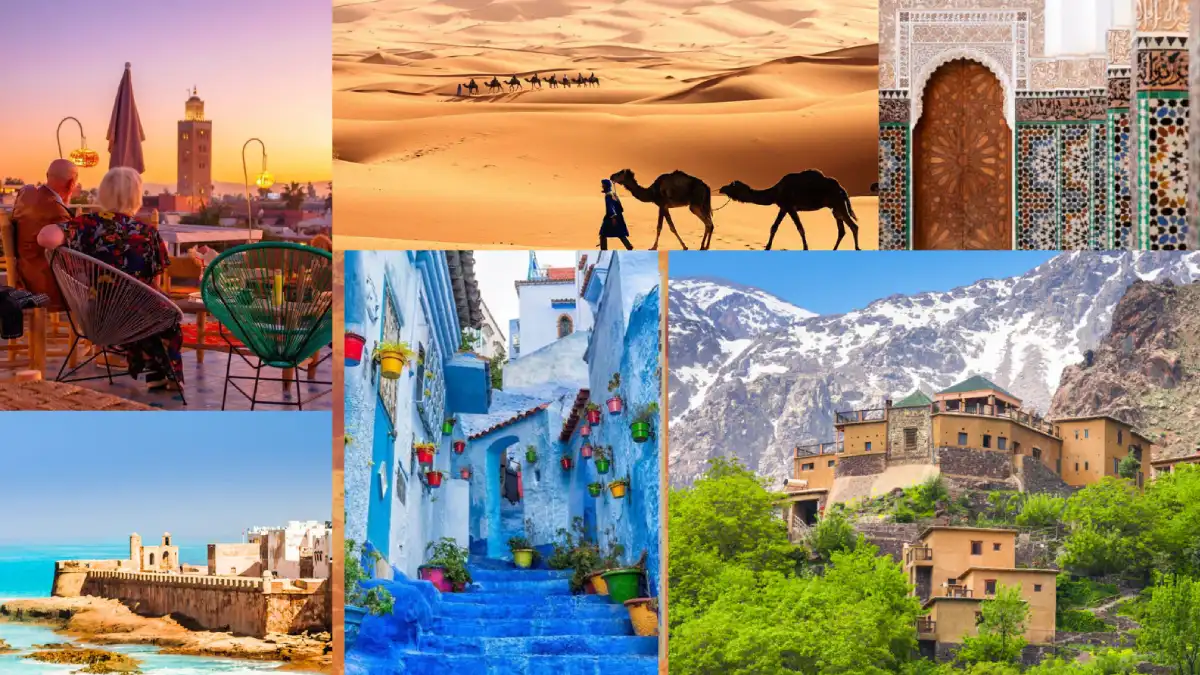
21 Days in Morocco: 3-Week Morocco Itinerary (Golden Loop + Coast)
Planning 21 days in Morocco and want more than just Marrakech and the desert?
This 3 week Morocco itinerary is built from the ground up by a licensed Moroccan guide (20+ years) and insurance professional. It connects the Golden Loop (Marrakech – Desert – Fes – Chefchaouen) with the Atlantic coast (Essaouira), with realistic driving times, safety considerations, and cultural context.
This page is part of my main Morocco Itineraries Hub. If you’re still comparing trip lengths, also see:
Table of Contents
Table of Contents
Why 21 Days in Morocco Is the Sweet Spot
Who This 3-Week Morocco Itinerary Is For
This itinerary is designed for travelers who:
- Have 3 full weeks (not counting international flights).
- Want to see Marrakech, the Atlas, the Sahara, Fes, Chefchaouen, and Essaouira without rushing.
- Prefer comfort over backpacker chaos, but don’t need ultra-luxury.
- Care about logistics, safety, and cultural understanding, not just photo spots.
It suits:
- Couples and friends in their 30s–50s.
- First-time visitors who already have some travel experience.
- Slow travelers who appreciate several nights in each stop, not daily packing.
Golden Loop + Coast: What You’ll Actually Experience
In 21 days you will:
- Land in Marrakech and learn how the medina really works (not just a list of monuments).
- Cross the High Atlas Mountains and sleep among kasbahs and canyons.
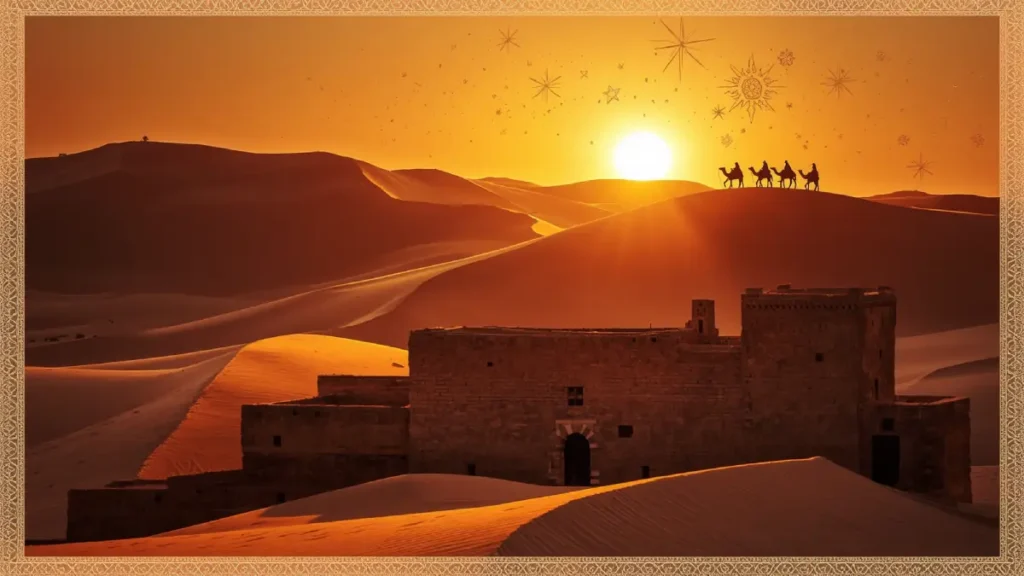
- Spend two nights in the Sahara desert (Erg Chebbi, near Merzouga).
- Dive deep into Fes, Morocco’s intellectual and artisan heart.
- Slow down in the blue town of Chefchaouen and the Rif foothills.
- Follow the Atlantic coast to Essaouira, with wind, waves and art galleries.
- Return to Marrakech with enough time for last shopping and a final hammam.
Quick Snapshot: Route, Driving Hours & Trip Style
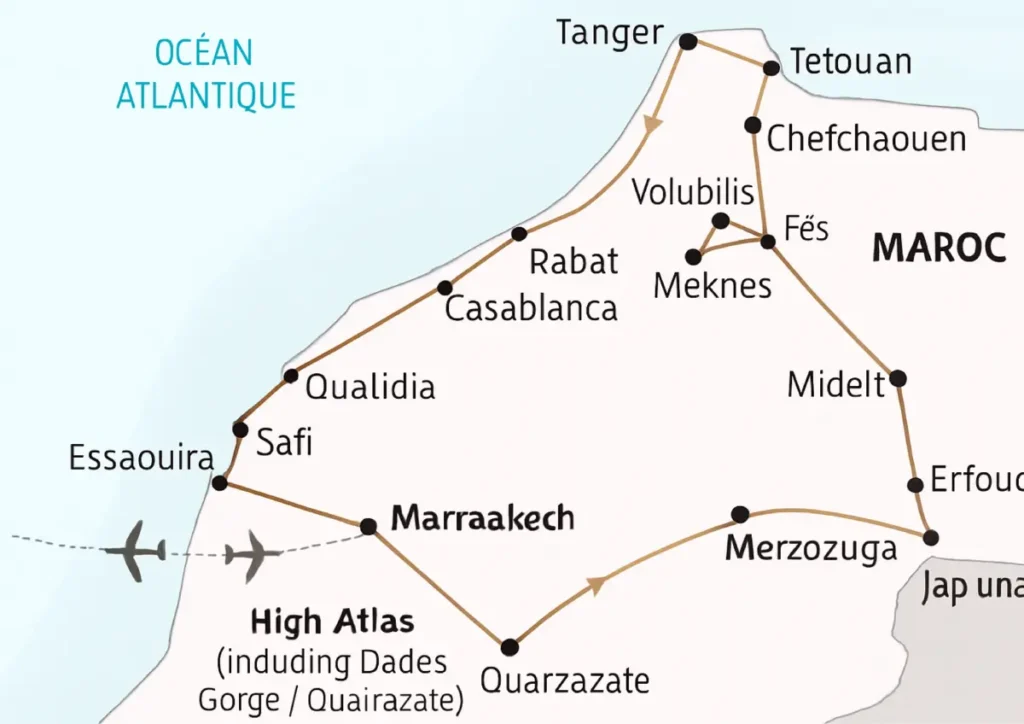
Core route (loop):
Marrakech → Atlas & Dades/Ouarzazate → Merzouga (Sahara) → Midelt → Fes → Chefchaouen → Tangier/Rabat → Essaouira → Marrakech
Longest driving days (approx):
- Marrakech → Dades/Ouarzazate: 4.5–6 hours
- Dades → Merzouga: 4–5 hours
- Merzouga → Midelt: 4–5 hours
- Fes → Chefchaouen: 3.5–4.5 hours
- Tangier/Rabat → Essaouira (if in one shot): long travel day, better with breaks
Trip style (recommended):
- Hybrid: base assumption is private driver / driver-guide for the long and complex legs
- With notes for self-drivers and where to use trains/buses if preferred.
If you prefer to join a curated tour instead of planning everything yourself, I’ve collected my favorite options here:
Best Morocco Tours for First-Timers – including trips that mirror this Golden Loop.
21-Day Morocco Route Overview (Golden Loop + Coast)
Main Phases of the Trip
- Days 1–4 – Marrakech & Atlas Mountains
- Days 5–8 – Sahara Desert (Erg Chebbi)
- Days 9–12 – Fes & Middle Atlas
- Days 13–16 – Chefchaouen & the North
- Days 17–21 – Atlantic Coast (Essaouira) + Return to Marrakech
For deeper background on each major stop, pair this itinerary with:
- Marrakech Travel Guide
- Merzouga Desert Guide
- Fes Travel Guide
- Chefchaouen Travel Guide
- Best Things to Do in Essaouira
Transport Options: Driver, Self-Drive, and Trains
Recommended baseline: private driver / driver-guide
- You avoid fatigue on mountain roads and during long desert legs.
- Someone local handles weather, road works, and timing, so you don’t gamble with safety.
Self-drive is possible if:
- You’re confident with mountain switchbacks, mixed traffic, and small town driving.
- You’re okay with no driving at night and more conservative daily distances.
Where trains and buses fit:
- Trains (ONCF / Al Boraq) are excellent between big cities, especially:
- Tangier – Rabat – Casablanca – Marrakech
- Tangier – Fes (classic trains)
- Buses (CTM / Supratours) work well in the north.
- The desert segment (Marrakech – Merzouga – Fes) is where you really benefit from a driver or a strong self-drive plan.
For more detail on moving around, see Getting Around Morocco in 2026.
If you’d rather join a well-structured tour instead of arranging drivers yourself, start with Best Morocco Tours for First-Timers and look for itineraries that include Marrakech, the desert, Fes and Chefchaouen.
Safety & Insurance Over a 3 Week Trip
Over 21 days, there is enough time for small things to go wrong:
- Stomach issues
- Twisted ankle or minor fall
- Dental pain
- Lost luggage or delayed flights
From an insurance professional’s lens, look for policies that:
- Cover emergency medical (at least €/$50,000–100,000).
- Include emergency evacuation (important for desert and mountain travel).
- Don’t aggressively exclude light adventure (camel rides, easy hikes, quad bikes).
You can dive deeper into this on Morocco Travel Insurance Guide and read real-world risk breakdowns in Morocco Safety Guide.
Days 1–4 – Marrakech & Atlas Mountains (Landing and Mindset Reset)
Day 1 – Arrival in Marrakech: First Contact with the Medina
- Land at Marrakech Menara Airport (RAK).
- Use a pre-booked transfer to your riad; first-timers don’t need taxi negotiations after a flight.
- Check in, rest, then do a gentle orientation walk:
- Around your riad’s neighborhood
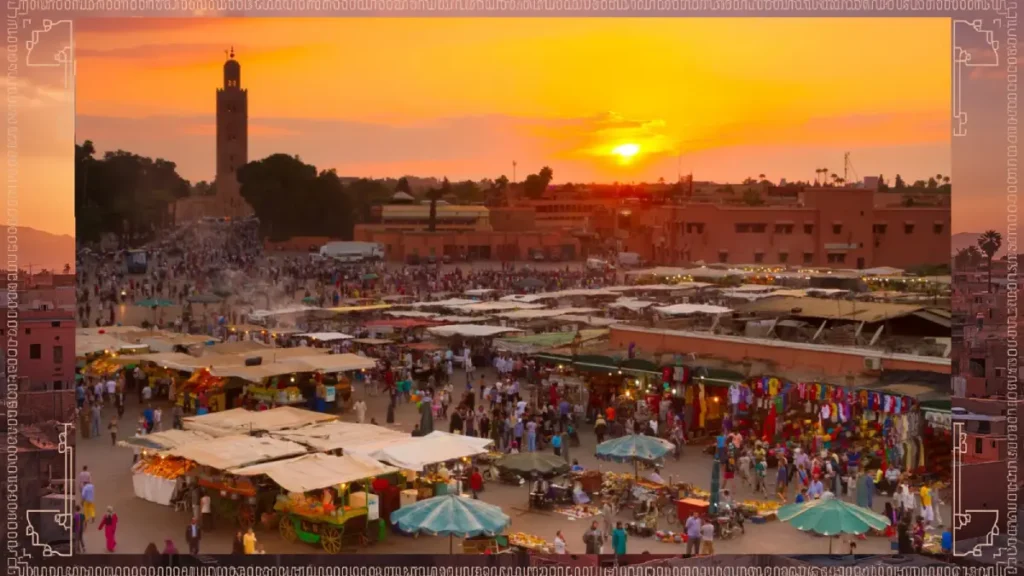
- Toward Jemaa el-Fnaa and the Koutoubia area
Psychological note:
- The medina is sensory overload by design: noise, scooters, calls to you.
- This is not aggression; it’s a commercial and social rhythm.
- Practice “La, shukran” (no, thank you) and keep walking. You don’t owe anyone a conversation.
For a full breakdown of the city, bookmark the Marrakech Travel Guide.
Day 2 – Marrakech Highlights with a Licensed Guide
Full-day guided visit focusing on:
- Koutoubia surroundings
- Bahia Palace (or alternative if under renovation)
- Ben Youssef Madrasa (if open)
- Key souk areas, but in a logical progression, not a random maze
As a licensed guide, the goal is not to show you “everything”, but to:
- Explain how the medina is organized (religious, commercial, residential).
- Decode bargaining, tipping, and photo etiquette.
- Make Marrakech feel navigable, not like a trap.
Evening:
- Rooftop dinner to watch the square from above.
- Short, confident night walk, then early rest.
Day 3 – Atlas Mountains Day Trip (Imlil or Ourika)
Option 1: Imlil & Toubkal Area
- 1.5–2 hours from Marrakech.
- Walk through villages, terraced fields, and walnut trees.
- Lunch with an Amazigh family or in a simple guesthouse.
Option 2: Ourika Valley
- Shorter drive, more accessible, more visited.
- River cafes, short walks, and lower-level hikes.
Insurance/safety lens:
- Wear proper shoes: slips on wet stones and loose gravel are common claims.
- If you have knee/back issues, don’t push for steep waterfall climbs; the view from lower is often enough.
Day 4 – Hidden Marrakech: Neighborhoods, Hammam & Food
Use this day to see Marrakech as a living city, not just monuments:
- Morning: explore Gueliz (the modern area – cafes, boutiques) or Sidi Ghanem (design district).
- Afternoon: traditional hammam or a spa-style hammam, depending on comfort.
- Evening: guided food walk:
- Tangia, harira, msemen, chebakia
- Street foods in a controlled, hygienic way
This day is about adjusting your mindset and expectations before the more demanding legs of the trip.
Days 5–8 – Sahara Desert (Golden Dunes & Kasbahs)
Day 5 – Marrakech to Dades or Ouarzazate (Kasbah Road)
Route:
- Cross the Tizi n’Tichka pass in the High Atlas.
- Stop at panoramic viewpoints.
- Visit or view Ait Benhaddou (UNESCO ksar).
Travelers with a flexible schedule can stay near the ksar and visit after the day-trip groups leave. Use my guide to the best things to do in Ait Ben Haddou for viewpoints, walking times, local dining, accommodation, and responsible-visit advice.
Stay in either:
- Dades Gorge – more rural, spectacular rock formations.
- Ouarzazate – film studios, easier access, more hotel-style options.
- Ouarzazate: A practical base with film studios, Kasbah Taourirt, restaurants, and easier hotel options. Read my Ouarzazate travel guide before deciding whether to stay one or two nights.
Driving notes (self-drive):
- Avoid arriving in the dark.
- Watch speed limits near villages – fines are common and justified.
Day 6 – Dades to Merzouga (Erg Chebbi) + First Desert Night
Via:
- Tinghir and Todgha Gorge (short stop / light walk).
- Continue to Merzouga / Erg Chebbi dunes.
Typical plan:
- Park at the edge of the dunes or meet your camp team.
- Camel or 4×4 transfer to your camp at sunset.
- Dinner, music, stargazing.
Health note:
- If you have serious back, hip, or knee issues, choose a 4×4 transfer instead of a camel.
- Bring a small bag with meds, layers, and water on the camel, not just your phone.
For detailed camp advice, see the Merzouga Desert Guide.
Day 7 – Full Desert Day: Dunes, 4×4 and Nomad Encounters
Ideas:
- Sunrise or sunset camel ride.
- 4×4 circuit:
- Fossil sites
- Khamlia (Gnawa music)
- Nomad family visit if done respectfully
Insurance angle:
- Quad biking and some dune activities may sit in “adventure” categories in policies.
- Check your coverage for motorized activities before you go.
Day 8 – Merzouga to Midelt (Breaking the Long Transfer)
Instead of an exhausting desert-to-Fes marathon:
- Travel Merzouga → Midelt (Middle Atlas) – about 4–5 hours.
- Enjoy cooler air and mountain landscapes.
This simple overnight stop:
- Reduces driver fatigue, which is one of the real risks on this route.
- Gives you time to enjoy scenery instead of chasing arrival times.
Days 9–12 – Fes & Middle Atlas (History, Crafts and Leather)
Day 9 – Midelt to Fes via Cedar Forest & Ifrane
Route highlights:
- Azrou cedar forest – possible Barbary macaques (do not feed).
- Ifrane – clean, surprising alpine-style town.
Arrive in Fes el-Bali:
- Check into your riad (ideally with good recent reviews for noise and access).
- Short evening walk near your riad only – don’t try to master the whole medina night one.
For an in-depth orientation, use the Fes Travel Guide.
Day 10 – Fes Medina with a Professional Guide
Full-day visit:
- Main gates (Bab Boujloud, etc.).
- Al-Qarawiyyin area (historic university, mosques, madrasas).
- Tanneries and artisans’ quarters (wood, metal, textiles).
The focus here is:
- Understanding how a medieval medina still functions today.
- Avoiding the classic “souvenir sprint” where you’re dragged from shop to shop.
- Learning to read the space so you can explore more confidently on your own.
Day 11 – Leather & Handicrafts: How to Buy Quality in Fes
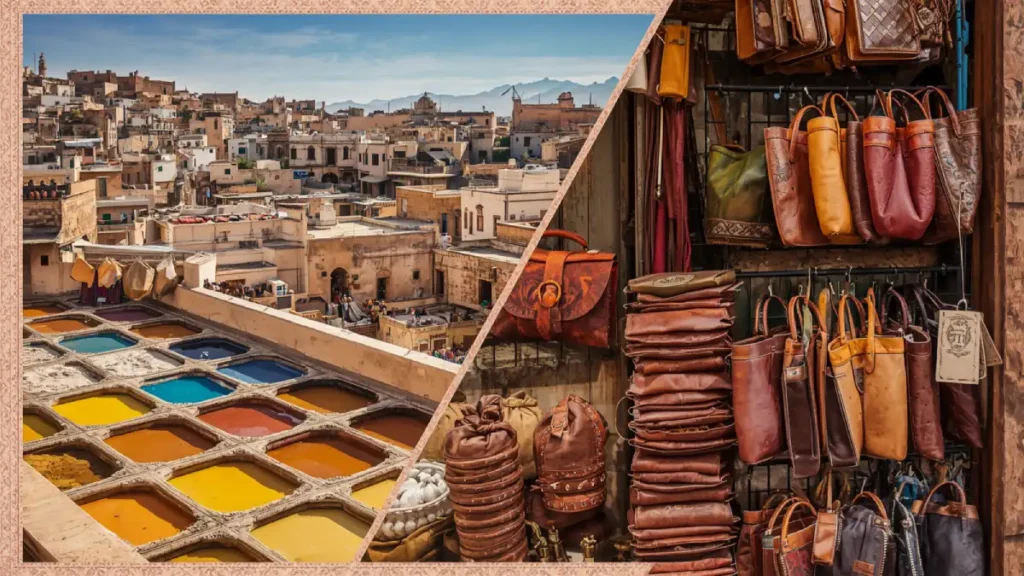
This is where my FCG fine crafts and leather background helps you.
When you visit tanneries and leather shops:
- Check texture: quality leather is not plastic-shiny or overly perfect.
- Check stitching: even stitches, solid thread, no loose ends.
- Check lining and hardware: cheap synthetic linings and flimsy zippers are red flags.
Price logic:
- A well-made leather bag cannot be €20.
- Expect real quality to start higher; bargaining usually lands at 20–40% below first price if done respectfully.
Shipping:
- Use reputable couriers with tracking.
- Avoid shops that won’t give proper documentation or a clear receipt.
You don’t need to buy everything. Aim for one or two serious pieces that you’ll use for years.
Day 12 – Day Trip: Volubilis & Moulay Idriss or Sefrou
Option 1: Volubilis & Moulay Idriss
- Volubilis: Roman ruins, mosaics, and big skies.
- Moulay Idriss: important religious town, white houses folded over hills.
Option 2: Sefrou
- Smaller town near Fes with a quieter medina and small waterfalls.
- Good for photography and daily-life observation.
Practical health tip:
- In Volubilis, there’s little shade. Bring a hat, sunblock, and water.
Days 13–16 – Chefchaouen & The North (Blue, Green, Slow)
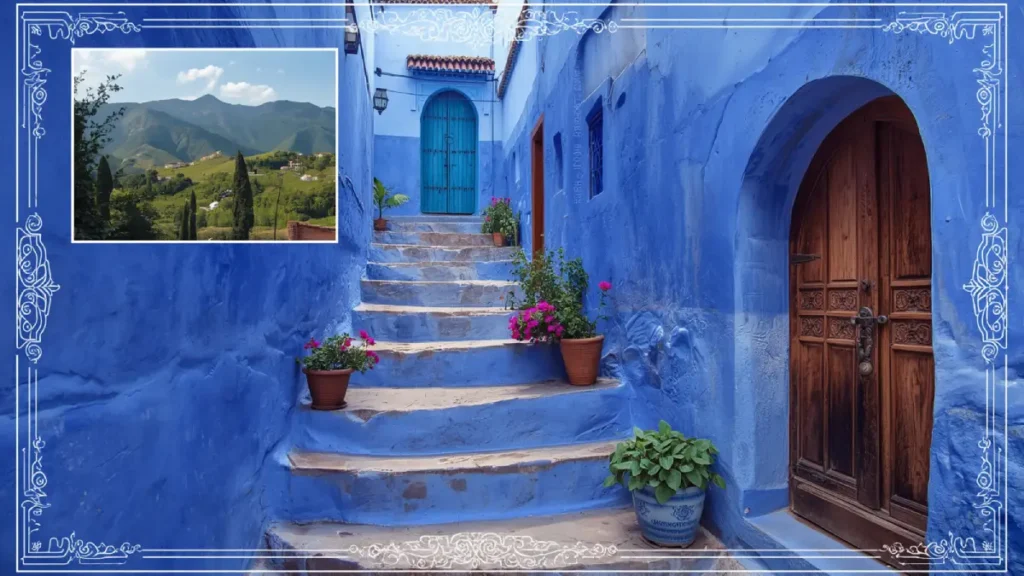
Day 13 – Fes to Chefchaouen
- Private transfer: ~3.5–4 hours, flexible stops.
- CTM bus: cheaper, fixed times, slower boarding/unboarding.
Arrival:
- Stay in or near the medina, but avoid very steep uphill lanes if you have knee or heart issues.
- Evening: explore Outa el-Hammam square, main alleys, and viewpoints.
Use the Chefchaouen Travel Guide for specific viewpoint suggestions.
Day 14 – Chefchaouen’s Blue Medina & Ras el-Maa
- Early morning: photograph blue streets before day visitors arrive.
- Visit the Kasbah and walk to Ras el-Maa (water source).
- Coffee or tea near the stream, watch local life.
Chefchaouen is also a psychological reset:
- Less noise and pressure than Marrakech or Fes.
- More time to sit, watch, and think about the journey so far.
Day 15 – Extra Day in Chefchaouen or Akchour Hike
If you want more nature:
- Day trip to Akchour (with guide if not confident on trails):
- Hike to waterfalls or “Bridge of God”.
- Bring good shoes and enough water.
Safety note:
- Most real incidents I’ve seen in these areas are twisted ankles and slips, not dramatic falls.
- Take your time; the hike is not a race.
If you prefer rest:
- Stay in Chefchaouen, find local cafes, do short, easy walks only.
Day 16 – Transfer to Tangier or Rabat
You now move towards the west coast axis:
- Option 1: Chefchaouen → Tangier
- Option 2: Chefchaouen → Rabat (often via Tetouan and the highway)
Why this stop:
- It breaks up the journey to Essaouira.
- You get a taste of either:
- Tangier: port city energy, international crossroads.
- Rabat: calm, official capital with wide boulevards and ocean views.
If you choose Rabat rather than Tangier for this stage, see the best things to do in Rabat and allow at least one night if possible.
From here, you can also use trains (ONCF) comfortably.
Days 17–21 – Atlantic Coast: Essaouira & Back to Marrakech
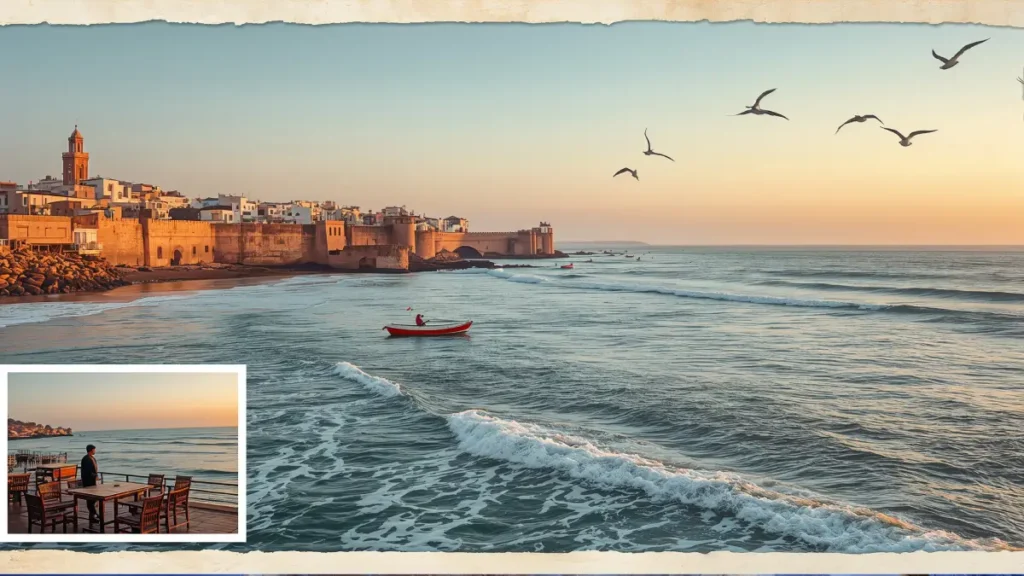
Day 17 – Tangier/Rabat to Essaouira
Route options:
- Train Tangier/Rabat → Casablanca, then driver or bus Casablanca → Essaouira.
- Starting a 3-week Morocco trip in Casablanca? My 2-Day Casablanca Travel Guide can help you decide whether to spend one or two nights there before moving on. With three weeks available, you have more flexibility, so the goal is to see Casablanca properly without letting it take time away from the stronger stops later in your route.
- Or private transfer directly to Essaouira (long but simple).
Arrival:
- Check into a riad near the medina walls or inside the old town.
- Evening stroll on the ramparts at sunset, dinner in a calm restaurant.
For detailed activity ideas, see Best Things to Do in Essaouira.
Day 18 – Essaouira Medina, Port & Food
- Morning at the port: fishing boats, seagulls, and fish auctions.
- Walk the medina’s white and blue lanes – calmer than Marrakech.
- Lunch with fresh fish if you enjoy seafood.
Essaouira is also excellent for:
- Woodwork, art galleries, and textiles.
- Relaxed, low-pressure shopping compared to big cities.
Day 19 – Surf, Ride or Just Watch the Ocean
Choose:
- Surfing / kitesurfing lessons with a reputable school.
- Horse or camel ride on the beach with established stables.
- Or pure slow travel: coffee, books, and sea breeze.
Health & insurance note:
- Ask schools about equipment condition and basic first aid arrangements.
- Protect electronics from sea spray and sand – more claims come from water damage than theft.
Day 20 – Essaouira to Marrakech: Last Souks & Hammam
- Drive back Essaouira → Marrakech (about 2.5–3 hours).
- Stay near an area you now know – the medina feels different on your second visit.
Use this day to:
- Do targeted shopping: you now understand quality and pricing better.
- Enjoy a final hammam or spa treatment.
- Have a quiet, celebratory dinner.
If you want a shorter version of this loop, compare it with the 10-Day Morocco Itinerary and 14-Day Morocco Itinerary.
Day 21 – Departure Day: Airport Logistics & Wrap-Up
- Pre-book your airport transfer and allow a time buffer for traffic and security.
- Keep:
- Essential medications in hand luggage.
- Fragile crafts padded and, if allowed, in carry-on.
Avoid big, impulsive purchases on day 21. You’ve had 3 weeks to choose – trust what you already bought.
Practical Logistics for 21 Days in Morocco
Budget Ranges for a 3-Week Trip
Per person, excluding international flights:
- Backpacker: ~€50–80/day
- Simple guesthouses, buses, street food.
- Comfort (this itinerary’s default): ~€90–150/day
- Good riads, private rooms everywhere, mix of private transfers and trains.
- Boutique-plus: €150–250+/day
- Top riads, desert glamping, full-time private driver/guide.
For cost breakdowns by city, see Morocco Travel Cost 2026.
Booking Strategy: Riads, Hotels, Camps
Desert camps – avoid the absolute cheapest; they often cut corners on safety and hygiene.
Riads – best in Marrakech, Fes, Chefchaouen, Essaouira
Prioritize: cleanliness, noise levels, access with luggage.
Hotels – useful in modern areas (Rabat, Tangier) and some transit stops.
Money, ATMs & Paying Your Way for 3 Weeks
Over 21 days you’ll withdraw cash multiple times and pay a mix of card + cash.
- ATMs (including Al Barid Bank) are widely available in cities and many towns.
- Your home bank may impose lower daily limits than Moroccan ATMs.
- Always keep 1–2 days of expenses in cash before long transfers (desert, mountain legs).
More detail (fees, limits, examples) in Morocco Travel Cost 2026.
Safety, Travel Insurance & Health Over 21 Days
Realistic Risks (Not Clickbait)
Most common:
- Digestive issues
- Minor injuries (slips, uneven medina alleys, simple hikes)
- Sunburn and dehydration
- Trip fatigue
Less common but serious:
- Road accidents (speed, night driving, fatigue)
- Chronic conditions flaring under heat or stress
Travel Insurance: What to Look For
Focus on:
- Emergency medical: €/$50,000–100,000+
- Evacuation: essential for desert/mountain routes
- Trip interruption/delay: valuable on long, multi-leg trips
- Adventure clauses: camel rides, quad biking, hiking
If you have pre-existing conditions:
- Confirm they’re declared and covered.
- Bring enough meds plus a buffer.
Detailed breakdown: Morocco Travel Insurance Guide.
Safety mindset & common scams: Morocco Safety Guide.
When to Travel: Best Seasons & How to Adjust
This route is ideal for:
- March–May
- September–November
Good balance of:
- Desert temperatures
- City walking comfort
- Coast and mountain conditions
Summer (June–August)
- Very hot in Marrakech, Fes, Sahara.
- Shorten desert stay or prioritize A/C-equipped camps and riads.
- Add more coast (Essaouira, possibly Agadir) and Atlas time.
- Plan activities for early morning / evening, rest midday.
Winter (December–February)
- Cold desert nights; possible snow and road closures on passes.
- Pack real layers, including warm sleepwear for the desert.
For alternative loops at other trip lengths, compare with:
10 Days in Morocco and 14 Days in Morocco.
Variations of This 3-Week Morocco Itinerary
1) Beach-First (Hot Summer Strategy)
- Start: Marrakech (shorter stay) → Essaouira/coast first.
- Then: inland to Fes and Chefchaouen.
- Optional: shorten or skip the desert if extreme heat is a concern.
2) Non-Drivers Version (Trains, Buses & Local Drivers)
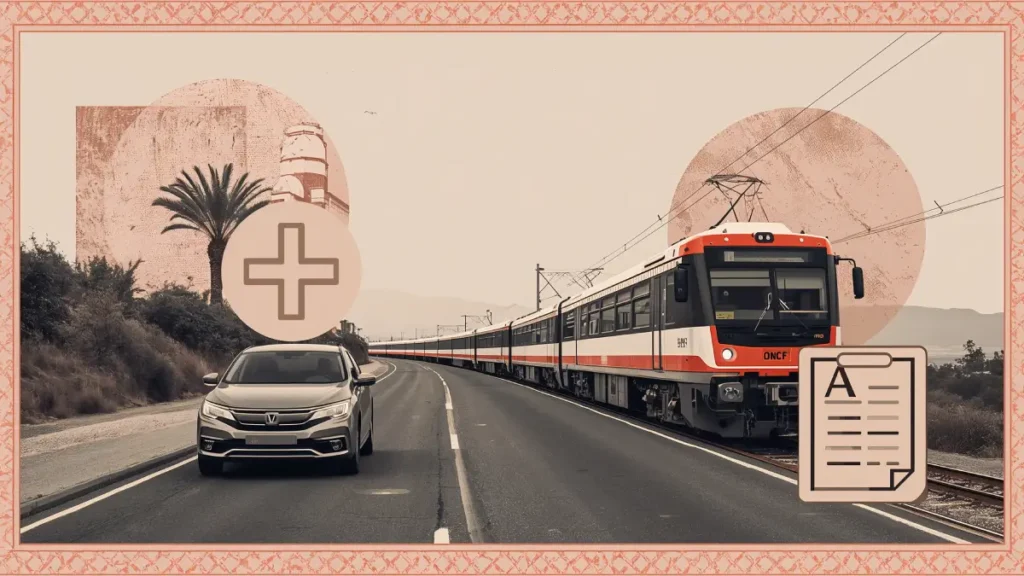
Use:
Add private drivers specifically for:
- Marrakech → Dades/Ouarzazate → Merzouga → Midelt → Fes
- Fes → Chefchaouen (if bus times aren’t ideal)
Transport guidance: Getting Around Morocco in 2026.
3) Amazigh Heritage–Focused
- Add extra nights in Atlas villages and southern valleys.
- Choose family-run guesthouses where people are happy to share language, agriculture, and seasonal life.
- Trim 1 night from big cities to add 1–2 rural overnights.
Final Thoughts: Customizing Your 21 Days in Morocco
Treat this 21-day itinerary as a solid base:
- Add nights where you feel a strong pull (Fes, Chefchaouen, Essaouira).
- Remove a night if your total is 18–19 days, keeping the same sequence.
If you prefer a fully organized tour that mirrors this loop, start here:
Best Morocco Tours for First-Timers – look for itineraries that include Marrakech, the desert, Fes, Chefchaouen, and the coast.
If you’re still choosing trip length, explore the full Morocco Itineraries Hub from 3 to 21 days.
3 Week Morocco Itinerary FAQS
Is 3 weeks in Morocco too long?
No. Three weeks is the sweet spot to see Marrakech, the Atlas Mountains, the Sahara desert, Fes, Chefchaouen and the Atlantic coast without rushing. A 3 week Morocco itinerary lets you slow down, add rest days and still cover the classic Golden Loop.
How much does 21 days in Morocco cost?
For a comfort-level 21 days in Morocco, most travelers should plan around €90–150 per person per day, excluding international flights. This covers boutique riads, some private transfers, guided visits and a quality desert camp. Budget travelers can go lower with buses and simpler guesthouses, while boutique-plus itineraries with a private driver and luxury camps will cost more.
Is it safe to do a 3 week Morocco road trip?
Yes, with realistic driving days and good planning, a 3 week Morocco road trip is generally safe. The main risks are fatigue, speeding and night driving on unfamiliar roads. That’s why this itinerary breaks up long legs (like Merzouga to Fes), avoids driving after dark and suggests a private driver for the desert and mountain segments. Good travel insurance and common-sense precautions complete the safety picture.
Can I do this 3 week Morocco itinerary without driving?
You can follow most of this 3 week Morocco itinerary without self-driving by combining trains, buses and local drivers. Use ONCF/Al Boraq trains between big cities, CTM or Supratours buses in the north, and arrange private transfers for the desert segment between Marrakech, Merzouga and Fes. If you prefer a fully organized option, consider one of the routes in my Best Morocco Tours for First-Timers guide.
What is the best month for a 3 week Morocco itinerary?
The best months for a 3 week Morocco itinerary are March–May and September–November. In these seasons, Marrakech, Fes and the desert are warm but not extreme, the Atlas is pleasant, and the Atlantic coast is comfortable. In summer you’ll need to adapt the route for heat; in winter you’ll need extra layers and flexibility for mountain passes.
Does this 21-day Morocco itinerary include the Sahara desert?
Yes. This 21 days in Morocco route includes two nights around the Erg Chebbi dunes near Merzouga, with a camel or 4×4 transfer to your desert camp. The itinerary is built to reach the Sahara gradually via the High Atlas and Dades, and to break the long return route with a night in Midelt for safety and comfort.
Is this 3 week Morocco itinerary suitable for first-time visitors?
It’s ideal for first-time visitors who want more than a quick highlights tour. The itinerary balances cities, desert, mountains and coast, with 2–4 nights in each place so you’re not packing every day. It also includes guidance on safety, travel insurance, money and cultural mindset, making it especially helpful for first-timers who value structure and local insight.
Can I shorten this 21-day itinerary to 10 or 14 days?
