
If you want to understand Morocco beyond the pretty tiles and Instagram doors, you have to step into the steam.
A Moroccan Hammam Experience is not just a wash; it’s a centuries-old ritual of purification for both body and soul, where the social heat of the community meets the deep, wet heat of the bathhouse. Every week, Moroccans go to shed dead skin and daily stress at the same time – and as a guide, I always say: you haven’t really “done” Morocco until you’ve done a hammam.
In this guide, I’ll walk you through everything: public vs. private hammams, what really happens inside, what to wear, what to bring, and how to choose between a traditional neighborhood bathhouse and a luxury spa in Marrakech or beyond.
If this will be your first hammam in Morocco and you want practical advice on what to wear, what to bring and what happens step by step, see my Moroccan Bath in Morocco first-timer guide.
What Is a Hammam in Morocco – More Than Just a Bath
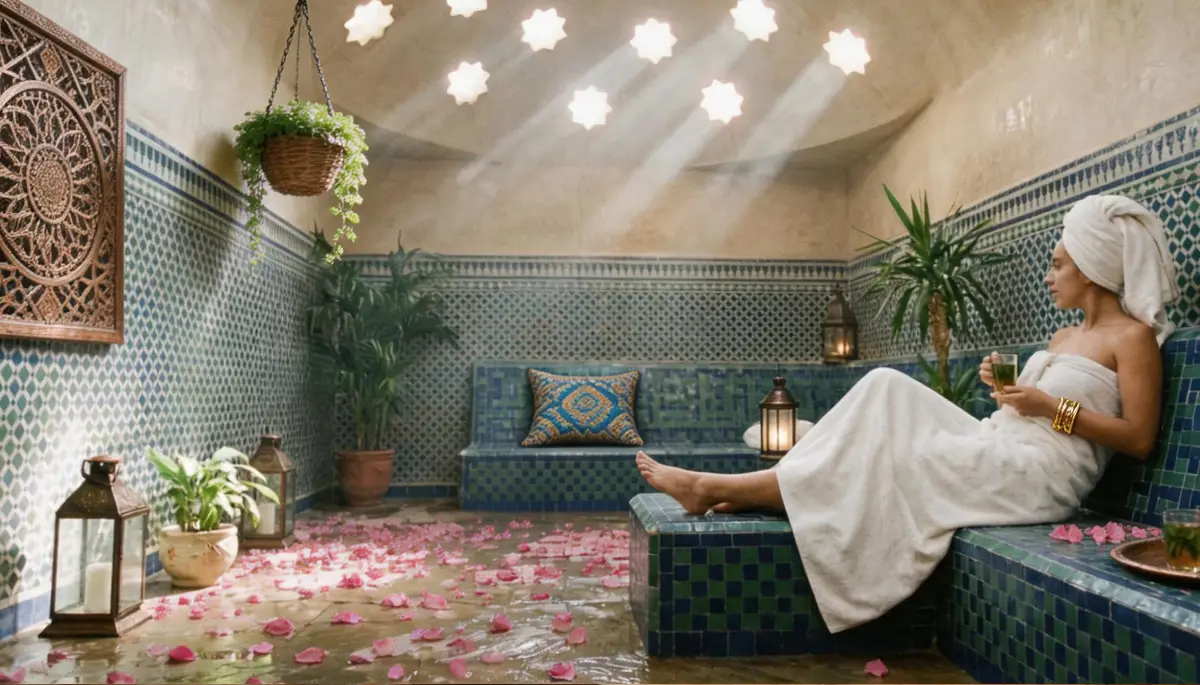
When visitors ask me, “What is a hammam, really?”, I tell them this:
- It is a centuries-old ritual of purification, where water, heat, and soap meet community, gossip, and a bit of controlled suffering, and you come out feeling reborn.
Historically, the Traditional Moroccan Bath Ritual grew around mosques and neighborhoods. It was the place to get truly clean, but also to socialize, find out who is getting married, and discuss everything from football to politics.
Moroccan Hammam vs Turkish Bath
People often compare the Moroccan hammam experience vs Turkish bath. They’re cousins, but not twins:
- Turkish bath (hamam):
- Inspired by Roman baths.
- Big, marble spaces.
- Drier, intense steam and high heat.
- Lots of bubbles and foam massage.
- Moroccan hammam:
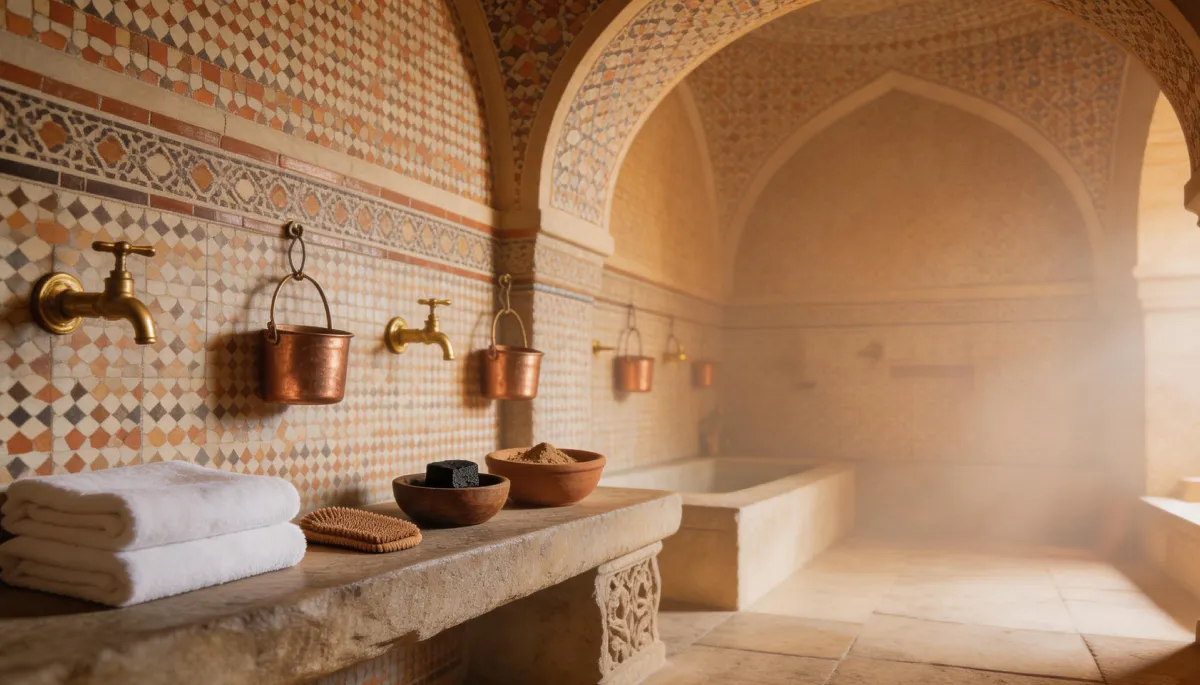
- More intimate, “earthy” spaces – tiled rooms, vaulted ceilings.
- Uses a coil heating system to create wet heat; it’s hot but not usually a thick steam cloud.
- Focus is on deep exfoliation with:
- Olive-based Beldi black soap.
- A rough Kessa glove.
- Mineral Ghassoul clay from the Atlas Mountains.
If you like rituals that feel both raw and deeply cleansing – physically and emotionally – the traditional Moroccan hammam experience is for you.
Public vs. Private Hammams in Morocco: Which One Is for You?
In my tours, I usually split hammams into two main experiences: public neighborhood hammams and private/luxury spas. Both are “real,” just different flavors of Morocco.
Traditional Public Hammams: Where the Community Gathers
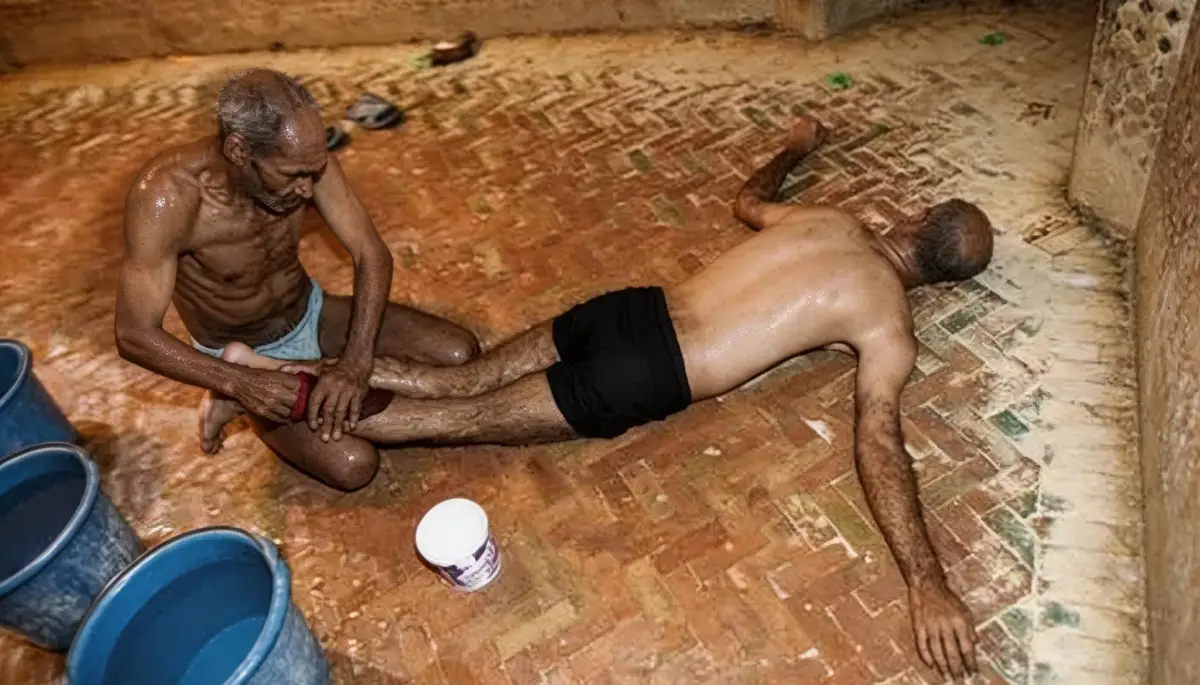
A public hammam is where you see everyday Moroccan life:
- Separate areas or times for men and women.
- Simple tiles, no candles, no fancy music.
- Buckets everywhere, people talking, kids running around.
- Older ladies scrubbing younger ones like they’re polishing a tajine.
Typical hammam Morocco price (public) in 2026, especially in cities like Marrakech:
- Entry: 10–25 DH
- Scrub by an attendant: 70–100 DH (paid in addition to entry).
This is the “no filter” version of Morocco. If you want a traditional Moroccan bath ritual and you are culturally curious and flexible, choose this.
Private & Luxury Hammams: Zen Meets Tradition
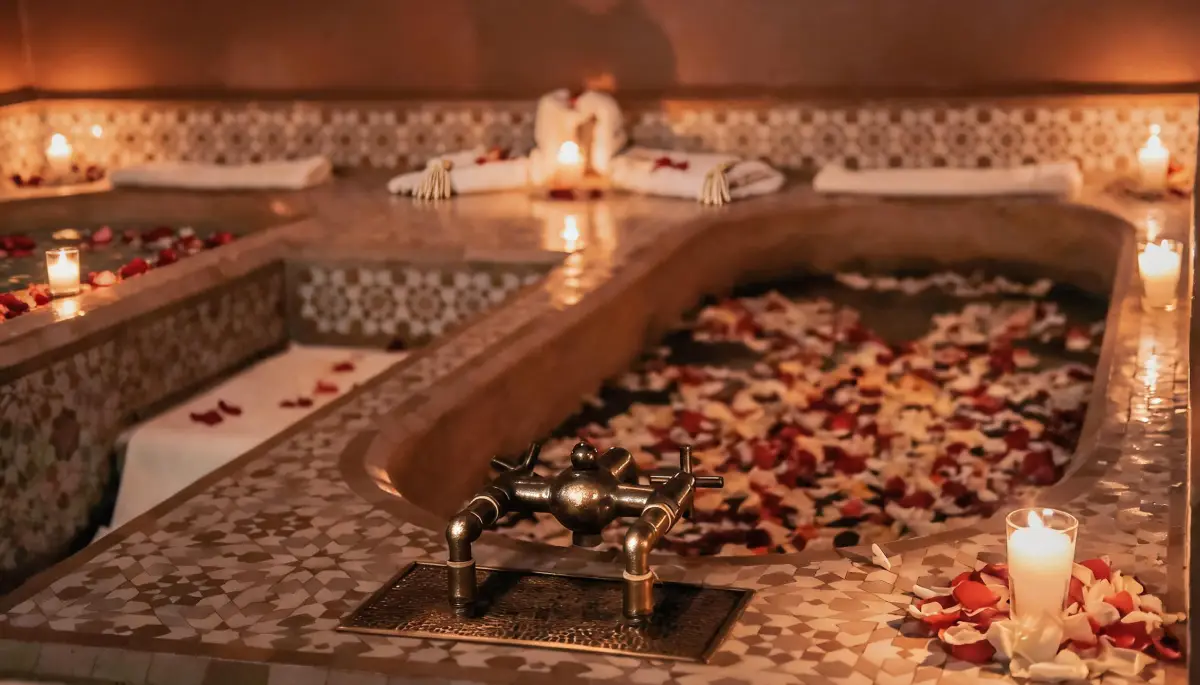
Then you have the Moroccan hammam spa experience in riads and hotels:
- Candlelight, soft music, essential oils.
- Individual or couple rooms, more privacy.
- Therapists trained for international guests.
- Lower “shock factor” for first-timers.
In Marrakech, good references are:
- Heritage Spa – excellent for first-timers; they use quality argan oil and natural products, professional staff.
- Les Bains de Marrakech – popular, beautiful setting, strong but controlled scrubs.
Typical prices in Marrakech (2026):
- Mid-range spa: 500–600 DH per person
- High-end/luxury hammam: 1,000–1,600+ DH ($100–$155+ USD).
Some travelers compare these places with a Turkish hammam & Moroccan bath experience they’ve tried in Europe or the Gulf. The big difference here is: in Morocco you’re closer to the source — ingredients like Ghassoul clay and argan oil are local, and the technique is grounded in daily culture, not just spa marketing.
Quick Comparison: Public vs Private Hammams in Morocco
| Feature | Public Neighborhood Hammam | Private / Luxury Hammam & Spa |
|---|---|---|
| Price | 10–25 DH entry + 50–70 DH scrub | 500–1,600+ DH package |
| Privacy | Shared room, communal, same gender | Private or semi-private rooms |
| Ambience | No-frills, busy, noisy, very local | Zen, candles, music, “Instagrammable” |
| Products | Basic black soap, simple oils/clay | Curated oils, organic products, full spa menu |
| Language & Guidance | Little English/French instruction | Staff used to tourists, explain every step |
| Cultural Immersion | Maximum – like stepping into daily life | Softer, curated introduction to the tradition |
| Best For | Adventurous & culturally curious | Nervous first-timers, honeymooners, spa lovers |
If you’re nervous about Moroccan hammam etiquette and nudity, I often suggest:
- First time? Try a private/luxury spa to understand the ritual.
- Second time? Let’s go to a public hammam and meet the real Morocco.
The 5-Step Moroccan Ritual: What Happens in a Moroccan Hammam?
Let’s break down exactly what happens in a Moroccan hammam. Whether you’re in a public bathhouse or a spa, the core ritual is usually the same.
Step 1: Acclimatization – Entering the Heat
You leave your clothes (and your modesty, a little) in the changing area, then move into a warm room first. From there:
- You sit on the floor or a small mat.
- Buckets of warm water around you.
- Your body slowly adjusts to the heat.
In some places, you’ll move through warm → hotter → hottest rooms. Temperatures can reach up to 50°C (122°F) in the hottest area, but in Morocco it’s usually a wet heat, not a sauna blast.
For first-timers, I always say:
- Start in the warm room.
- Only 5–10 minutes at a time in the very hot room.
- If you feel dizzy or your heart races, step out, cool down, drink water.
Step 2: Beldi Black Soap – The Softening
Next comes the Beldi (or savon noir) – a thick, olive-based black soap that is the signature of a traditional Moroccan bath ritual.
- It’s massaged all over your wet skin.
- You sit or lie down and let it work for 10–15 minutes.
- It softens the skin and prepares it for exfoliation.
This is one of the things people ask about in Moroccan hammam experience reviews – that strange jelly-like soap that smells earthy and slightly olivey. It doesn’t foam like normal soap; it’s more like a mask.
Step 3: The Kessa Scrub – “Eraser Shavings” of Dead Skin
Now, the part that makes most first-timers nervous: the scrub.
An attendant (or you, if DIY) uses a rough Kessa glove to scrub your entire body with impressive enthusiasm:
- Arms, legs, back, stomach, feet – everything.
- Circular or long strokes, quite firm.
- Dead skin starts rolling off in grey “eraser shavings.”
This is where many guests go from “this feels like sandpaper” to “I can’t believe that was all on my skin.” If it’s too strong:
- Just say: “shwiya shwiya” (a bit softer)
- Or in French: “plus doucement, s’il vous plaît”
In a luxury spa, this phase is usually more controlled and less aggressive, but still very effective.
If you’ve ever read a Moroccan hammam experience Reddit thread where someone says they lost half their body in dead skin – they’re only half joking.
Step 4: Ghassoul Clay – Detox from the Atlas Mountains
After the scrub, the skin is like a canvas: open pores, super clean. Time for Ghassoul:
- A mineral-rich clay from the Atlas Mountains.
- Mixed with water (and sometimes rose water or herbs).
- Spread over body and sometimes hair as a mask.
You let it sit a few minutes. It:
- Draws out impurities.
- Helps with oil balance.
- Leaves skin feeling incredibly smooth.
This is where you really feel the spa side of the Moroccan hammam spa experience, even in a humble public bath.
Step 5: Cold Rinse & Argan Oil Hydration
Finally, you rinse:
- Buckets of warm, then cooler water.
- All the clay and soap are washed away.
- Pores slowly close.
After you dry, the best finish:
- A light argan oil massage or self-application.
- Focus on elbows, knees, feet, and any dry areas.
You walk out lighter, looser, and a little bit high on endorphins. Many guests tell me:
“I feel like I have brand-new skin.”
That is exactly the point of a proper traditional Moroccan hammam experience.
Moroccan Hammam Etiquette and Nudity: The Unspoken Rules
This is the big topic everyone worries about. So let’s be very clear.
What Should I Wear in a Moroccan Hammam?
In public hammams and most spas in Morocco:
- Men:
- Must keep underwear or swim trunks on at all times.
- Full nudity is a strict taboo.
- Women:
- Most Moroccan women wear underwear or bikini bottoms.
- Some go topless, some fully nude, especially in very local hammams.
- As a visitor, keeping underwear or bikini bottoms on is totally fine and respected.
In spa settings, you may get:
- Disposable underwear (often mesh and very minimal).
- Your own swimsuit or bikini bottom is usually more comfortable.
Footwear:
Always wear flip-flops or waterproof sandals to avoid slipping and for hygiene.
Social Rules Inside a Hammam
In a public vs. private hammams in Morocco, etiquette is similar but applied differently.
In public neighborhood hammams:
- No photos. Ever. This is very important.
- Keep voices at a normal, respectful level – people talk, but don’t shout.
- Don’t splash or waste water – it’s seen as disrespectful.
- Don’t stare. Yes, you’ll be curious. But avoid long looks.
You’ll also see a nice cultural habit:
- Women or men often help each other scrub backs or hard-to-reach areas.
- If you feel comfortable and someone offers politely, it’s part of the “back-scrubbing” culture.
In private spas:
- Staff will guide you through everything.
- Nudity is more controlled – usually covered with towels and disposable underwear between steps.
Tipping Your Attendant
How much does a Moroccan hammam experience cost including tips? Don’t forget the last part:
- Public hammam scrub:
- Tip around (usually 70–150 DH).
- Spa hammam + massage:
- 20–30% is appreciated. So, for a 600 DH treatment, 120–180 DH is fair.
I always tell my guests: the woman or man who just scrubbed you like a new tajine deserves a proper thank-you.
What to Bring to a Moroccan Hammam: The Ultimate Packing Checklist
People often ask me what to bring to a Moroccan hammam, especially for public ones. Think of it as a BYO wellness kit.
For a Public Neighborhood Hammam
Equipment:
- Plastic bucket.
- Small cup/bowl for pouring water.
- Plastic mat or small stool to sit on.
- Flip-flops (essential).
Care Kit:
- Beldi black soap (savon noir).
- Kessa glove.
- Ghassoul clay.
- Regular shampoo and conditioner.
- Basic body soap if you want extra after the ritual.
Personal Items:
- 2 towels (one for body, one for hair).
- Clean underwear and clothes to change into.
- Small bottle of water (for drinking after).
- An orange – this is my favorite “secret item”.
Why Do People Eat an Orange After a Hammam?
This is one of those small local traditions I love. After the hammam:
- You’re hot, a bit drained, very clean.
- Eating a fresh orange gives:
- Quick natural sugar.
- Hydration.
- A refreshing, bright taste after all the steam and soap.
Is it mandatory? No. Does it feel perfect? Absolutely.
Health and Wellness Benefits of a Moroccan Hammam
A good hammam is not just cosmetic; it’s a real wellness treatment.
Physical Benefits
- Deep exfoliation.
- Removes layers of dead skin.
- Helps ingrown hairs and rough patches.
- Improved circulation & lymph drainage.
- Heat, scrubbing, and massage get the blood moving.
- Detoxification.
- Open pores + Ghassoul clay pull out impurities.
- Muscle relaxation.
- The heat penetrates deeply, perfect after hiking or a Sahara trip.
Mental & Emotional Benefits
- The hammam is a tiny retreat from the world:
- No phones.
- No emails.
- Just water, heat, and your breathing.
Most of my guests sleep incredibly well the night after a hammam. If you struggle with jet lag or stress, a Moroccan hammam spa experience is one of the best resets you can give your body.
Top Hammam Destinations: Marrakech, Rabat & Beyond
You can find hammams all over Morocco, but here are some highlights I often recommend.
Marrakech
If you want a Marrakech 2 hour traditional Moroccan hammam experience, you have some great options.
Traditional / Authentic:
- Hammam Mouassine
- One of the oldest hammams in Marrakech (16th century).
- Very local, no-frills, simple tiles and buckets.
- Around 50 DH for a truly traditional experience.
- You’ll see real Marrakech life, not a staged show.
Accessible Luxury:
- Heritage Spa
- Excellent for first-timers.
- Staff explain every step, use high-quality, often organic products.
- Calm, intimate atmosphere, strong but careful scrubs.
- Les Bains de Marrakech
- Beautiful design, popular with visitors.
- Combines the core Moroccan ritual with a full spa menu.
Typical Moroccan hammam Marrakech price (2026):
- Public: 10–25 DH entry, 70–100 DH scrub.
- Mid-range spa: 500–600 DH.
- High-end: 1,000–1,600+ DH.
Rabat
- Marassa Hammam
- Large, well-known public hammam outside the medina.
- It’s a local institution and even has a popular Instagram page.
- Ideal if you want to mix a local crowd with slightly more “organized” facilities.
Fes & Moulay Yacoub
Near Fes, the village of Moulay Yacoub is like a spa village:
- Famous for its sulfur-rich hot springs.
- The smell is strong, but the waters are believed to help:
- Respiratory issues.
- Rheumatic pains.
There’s a modern thermal complex plus simpler public baths.
This isn’t your standard **Moroccan hammam spa experience**; it’s more of a therapeutic journey. I recommend it for those curious about traditional healing and natural hot springs.
When to Go and How Often: Timing Your Hammam
Traditionally, many Moroccans go to the hammam once a week. It’s a rhythm: work, life, hammam, reset.
For travelers, I usually suggest:
- After the Sahara or desert trip
- Perfect for washing off dust and tiredness.
- Perfect for washing off dust and tiredness.
- At the end of your holiday
- A symbolic “reset” before flying home.
- A symbolic “reset” before flying home.
- In the evening
- You’ll sleep like a baby.
If you’re in Marrakech for a few days, one nice combo is:
- Hammam + scrub in the late afternoon.
- Light dinner and mint tea.
- Early bed, deep sleep.
Embracing the “B’saha” Culture
When you finish a good hammam, you feel lighter – like you took off a heavy jacket you didn’t know you were wearing.
In Morocco, when someone sees you fresh and clean after eating or bathing, we say:
“B’saha!” – “To your health!”
The proper response is: “Allah ya’tik saHa” – “May God give you health too.”
The hammam is part of this culture of wishing health and well-being to each other. Whether you choose a humble public bathhouse or a luxury spa ritual, go in with respect, openness, and a bit of courage.
You’ll come out not just cleaner, but closer to understanding Morocco from the inside.
If you’d like help picking the right hammam in Marrakech for your comfort level and budget – or you want to combine it with a medina walk, food tour, or Sahara trip – feel free to contact me. I’m always happy to build a made-to-measure Morocco around your hammam day.
Written by Youness Labchir
Licensed Morocco Tour Guide
FAQs About the Moroccan Hammam Experience
What should I wear in a Moroccan hammam?
In public hammams, men must keep underwear or swim trunks on at all times; full nudity for men is not accepted. Women usually wear underwear or bikini bottoms, and some will go topless or fully nude depending on how traditional and local the hammam is. In spas, you may receive disposable underwear, but many guests prefer their own bikini bottoms or trunks. Always bring or wear flip-flops to move safely on wet floors.
Is a Moroccan hammam the same as a Turkish bath?
They are similar but not the same. A Turkish bath usually has big marble rooms and intense dry or steam heat, focusing on foam and soap massage. A Moroccan hammam uses a wet heat system and emphasizes deep exfoliation using Beldi black soap and a Kessa glove, followed by Ghassoul clay and often argan oil. Many people who have tried both say the Moroccan scrub feels more “intense” and detoxifying.
How much does a Moroccan hammam experience cost?
It depends where you go. A traditional public hammam usually costs 10–25 DH for entry and 50–70 DH for a scrub by an attendant. A mid-range spa in Marrakech is around 500–600 DH per person, while a luxury hammam in a palace hotel or high-end spa ranges from 1,000–1,600+ DH ($100–$155+ USD). Always check what’s included: some prices are for scrub only, others for scrub plus massage or facial.
What are the main benefits of a Moroccan hammam?
Physically, the hammam gives you deep skin exfoliation, improved blood circulation, and a feeling of detox as the heat, scrub, and clay pull out impurities. Muscles relax, joints feel looser, and your skin becomes incredibly soft. Mentally, the quiet time without phones, plus the rhythmic nature of the ritual, brings stress relief and often leads to a very deep sleep afterward.
Can I visit a Moroccan hammam while pregnant?
Many pregnant women in Morocco still go to the hammam, but as a visitor I strongly recommend you consult your doctor first. The high heat and steam, plus the vigorous scrubbing, can be too intense depending on your stage of pregnancy and health. If your doctor approves, avoid the hottest rooms and opt for a gentler spa-style hammam rather than a very hot public bath.
What do I need to bring to a public hammam?
For a real neighborhood hammam, bring: a bucket, a small cup, a mat or stool, flip-flops, Beldi black soap, a Kessa glove, Ghassoul clay, shampoo, and two towels. Also pack fresh clothes to change into afterward. Many locals also bring an orange or other fruit to eat after the bath, as a refreshing way to restore energy and hydration.
Why do people eat an orange after a hammam?
Eating an orange after the hammam is a simple, beloved local tradition. After the heat and scrubbing, your body feels both relaxed and slightly drained; the orange gives a quick boost of natural sugar, vitamin C, and hydration. It’s not an official part of the ritual, but it’s a small pleasure that perfectly matches that post-hammam feeling of lightness and “rebirth.”
How often should I go to a hammam?
In Morocco, many people go once a week as part of their regular routine, especially before weekends or special occasions. As a traveler, going once during your trip is usually enough to feel the full effect, though some guests repeat the experience in different cities (for example, a Marrakech authentic Moroccan hammam experience in Mouassine and then a spa day in Fes or Rabat). If your skin is very sensitive, give it at least a couple of weeks between intense scrubs.