Merzouga Desert Guide: 3-Day Marrakech to Merzouga Itinerary
Fast Merzouga Desert Guide for a 3-Day Marrakech Trip
- Is Merzouga worth it vs Zagora? Yes. If you want high golden dunes (Erg Chebbi), real Sahara scenery, and proper desert camps, Merzouga is the better choice.
- Typical 3-day route:
- Day 1: Marrakech → High Atlas → Ait Ben Haddou → Ouarzazate → Dades Valley
- Day 2: Dades → Todra Gorge → Erfoud → Merzouga → sunset camel trek & camp
- Day 3: Sunrise in dunes → long drive back to Marrakech or continue to Fes
- Costs: From ~€80–€120 (basic group) up to €250–€300+ (private luxury).
- Best time for a 3 day Marrakech desert trip: March–May & September–November.
- Luxury vs standard desert camps in Merzouga: Both can be great – location in the dunes and good guiding matter more than fancy décor.
- Safety: Merzouga is generally safe, including for solo female travelers, if you choose reputable guides, dress modestly, and follow simple common-sense rules.
Why Merzouga Is the “Real” Sahara
I’m Youness, a licensed Moroccan tour guide and owner of Morkosh Tours, based in Marrakech. I’ve been criss‑crossing this country and the Sahara since my university days. When people ask me for a Merzouga desert guide, what they really want to know is: Is it really worth the long drive from Marrakech?
Let me answer that right away: yes, if you want the classic Sahara you imagine from movies and dreams.
In Morocco, we actually have several “desert” options depends on the Sahara Desert geography :
- Zagora area: mostly rocky hamada, low scrub, flat plains, and small dunes. Beautiful in its own way, but not the “sea of sand” you see on postcards.
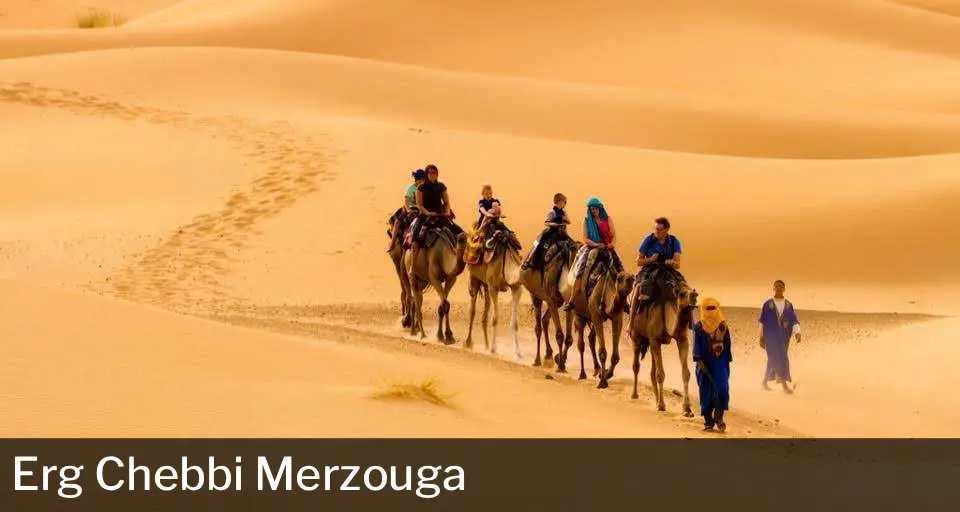
- Merzouga / Erg Chebbi: this is where you find high, golden dunes (up to ~150m), smoother shapes, and that feeling of being surrounded by nothing but sand and sky.
Zagora is closer to Marrakech, so it’s popular for quick 2‑day trips. But if you want the Sahara – tall dunes, real camel caravans, proper desert camps, sunrise over Erg Chebbi – Merzouga is the real thing. That’s why most of my serious desert lovers, photographers, and families with a “bucket list” in mind choose Merzouga, even if it means longer driving.
The 3-Day Route: A Detailed Itinerary
This itinerary is the classic 3-day Marrakech to Merzouga tour I’ve optimized over many years. It balances driving, sightseeing, and real desert time without turning the trip into a torture test in a minibus.
Day 1: Crossing the High Atlas to Dades Valley
Route: Marrakech → Tizi n’Tichka Pass → Ait Ben Haddou → Ouarzazate → Skoura → Dades Valley
Driving time: ~7–8 hours total with stops
We leave Marrakech early – usually around 7:30–8:00 AM. The goal is to get over the High Atlas Mountains before the afternoon traffic and arrive in the Dades Valley with enough time to enjoy the scenery.
Tizi n’Tichka Pass
Within an hour, we’re climbing toward the Tizi n’Tichka Pass (about 2,260 m). The road winds through villages, argan trees, and terraced fields. On clear days, you can see snow‑capped peaks for months, even while Marrakech is warm.
Expect:
- Several photo stops at panoramic viewpoints.
- A noticeable temperature drop as we climb.
- Motion sickness for some travelers – if you get car-sick, sit in front and bring medication.
Ait Ben Haddou (UNESCO Site)
By late morning, we arrive at Ait Ben Haddou, the famous ksar (fortified village) made of mudbrick, perched on a hill. It’s been used in films and series like Gladiator and Game of Thrones, but it’s much more than a movie set – several families still live in the old kasbah.
Here, I usually recommend:
- A local guide from the village for 45–60 minutes.
- Climbing to the top for the panoramic view over the Ounila Valley.
- A simple lunch nearby – tajine, couscous, or grilled brochettes.
Ouarzazate & Atlas Studios
After lunch, we continue toward Ouarzazate, sometimes called the “Hollywood of Morocco.” If you’re a cinema fan, we can make a quick stop at Atlas Studios to see some film sets.
From here, the landscape slowly changes:
- Green valleys with palm groves.
- Old kasbahs in Skoura oasis.
- The approach to the Dades Valley, with its famous rock formations.
Evening in Dades Valley
We usually reach Dades Valley by late afternoon.
Typical Day 1:
- Overnight: family‑run guesthouse or small hotel overlooking the valley.
- Included: dinner and breakfast (in most tours).
- Vibe: quiet, fresh air, stars at night, often live Berber music in some guesthouses.
Day 2: From Canyons to Caravans – Todra Gorge to Erg Chebbi Dunes
Route: Dades Valley → Todra Gorge → Tinjdad → Erfoud → Merzouga (Erg Chebbi)
Driving time: ~5–6 hours plus visits
This is the day when the landscape changes from green valleys to true desert and you finally arrive at Erg Chebbi.
Todra Gorge
After breakfast, we drive about 1.5–2 hours to Todra Gorge, near Tinghir. These limestone cliffs rise almost vertically to 300m, with a small river cutting through the bottom.
What we usually do:
- 30–60 minutes walking inside the gorge.
- Time for photos and maybe a mint tea at a café.
- For hikers or climbers, we can extend this stop – just tell your guide in advance.
Old Systems: Khettara Irrigation
On the way toward Erfoud, I like to show travelers an old Khettara irrigation system – underground channels that once brought water from the mountains to the oases. You can still see some of the wells aligned in the desert.
It’s one of those details you don’t find in most blogs, but it really explains how people survived here long before bottled water and air‑conditioned buses.
Arrival to Merzouga & Erg Chebbi
By mid‑afternoon, we reach the Erfoud / Merzouga area. The first time you see the high dunes of Erg Chebbi in the distance, you understand why I call this the “real Sahara.”
From here, you usually:
- Leave the main luggage at a guesthouse on the edge of the dunes.
- Pack a small overnight bag (change of clothes, toiletries, camera, jacket).
- Meet your camel caravan (or 4×4 if you prefer wheels to hooves).
Then comes the magic moment: sunset camel trek into the dunes. Depending on the camp’s location, the ride is usually 45–90 minutes.
At camp, expect:
- Traditional welcome tea.
- Time for sunset photos on the nearby dune.
- Dinner (tajine, soup, fruit, etc.).
- Berber music by the fire under an insane sky of stars if the night is clear.
This is where Luxury vs Standard Desert Camps in Merzouga becomes important, and we’ll compare those in detail below.
Day 3: Sunrise Over Erg Chebbi & The Journey Home (Marrakech or Fes)
Route (standard): Merzouga → Alnif / Tazarine → Agdz → Ouarzazate → Marrakech
Alternative: Merzouga → Ziz Valley → Midelt → Ifrane → Fes
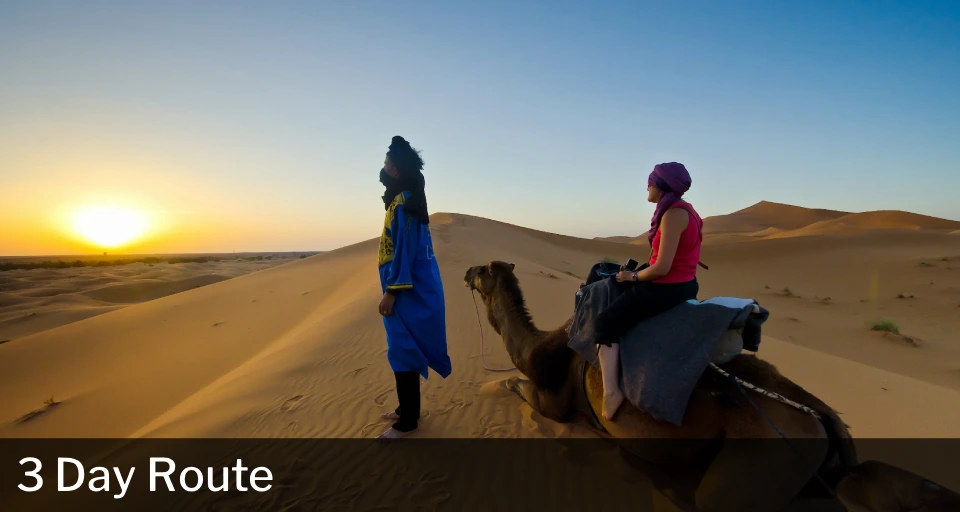
If you can wake up early (I always recommend it), climb the nearest dune for sunrise. The colors change minute by minute – from deep blue to gold and orange – and it’s one of those memories that stays with you forever.
After breakfast at camp, there are two options:
- Camel ride back to the edge of the dunes, or
- 4×4 transfer if you’re short on time or prefer not to ride again.
Option 1: Return to Marrakech (Long Drive)
The return drive to Marrakech is long: usually 8–9 hours with stops. This is one of the biggest questions I get in any Merzouga desert guide: “Isn’t it too much driving?”
My honest answer:
- If you have only 3 days, yes, Day 3 is a long day.
- But with breaks (lunch, coffee, photo stops), good company, and a comfortable vehicle, it’s perfectly doable.
- If you can spare 4 or 5 days, I recommend breaking the return or heading to Fes instead for a more relaxed trip.
We usually arrive back in Marrakech around 7–8 PM, sometimes later in high season.
Option 2: Finish in Fes
Many travelers choose to end in Fes instead of returning to Marrakech. This route is less repetitive and shows a different side of Morocco:
- Palm groves of Ziz Valley.
- The cedar forests and sometimes monkeys near Azrou.
- The European‑style town of Ifrane, often called “Little Switzerland.”
Driving time Merzouga → Fes is generally 7–8 hours with stops, which is similar to the return to Marrakech but more varied scenery.
Choosing Your Desert Camp: Standard vs. Luxury
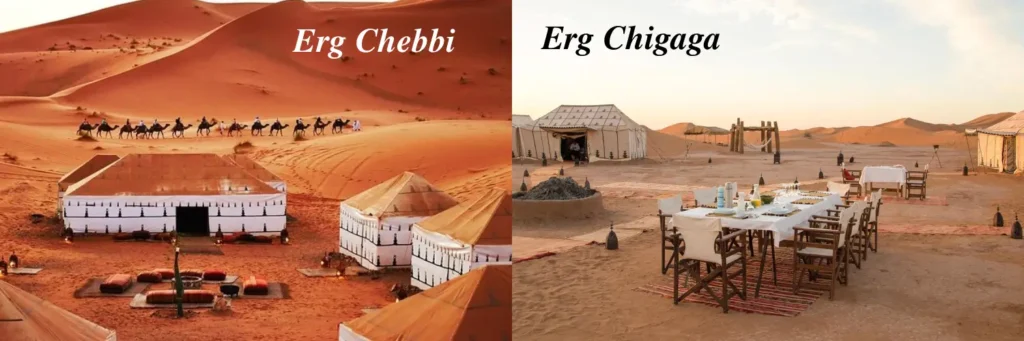
Here is where expectations often clash with reality. I always tell my guests: in Merzouga, “where” your camp is matters more than “how Instagrammable” it looks.
A basic tent deep in the dunes beats a luxury tent on the edge of the village, in my opinion. That said, Luxury vs Standard Desert Camps in Merzouga is a real decision, especially for couples, families, or special occasions.
Standard vs Luxury Desert Camps – Comparison
| Feature | Standard Camp | Luxury Camp |
|---|---|---|
| Typical Price (per person, 1 night)* | ~€30–€60 (often in a group package) | ~€80–€150+ (can go higher in peak season) |
| Bathroom Facilities | Shared toilets & showers | Private ensuite bathroom with hot water |
| Bed & Bedding | Simple beds, blankets; can be cold | Proper beds, thicker duvets, sometimes heaters |
| Electricity / Charging | Limited or shared in dining tent | Usually available in each tent |
| Atmosphere | More social, mixed groups, budget feel | Quieter, more privacy, romantic/relaxing |
| Location (varies by operator) | Sometimes closer to village edge | Often deeper in dunes (but verify!) |
| Meals | Simple but filling set menus | Often more elaborate meals & better service |
*These prices are ballpark and often part of a wider package that includes transport and driver.
Why Camp Location Matters More Than Décor
Many travelers assume “luxury” always means deep in the dunes. Not always. Some high‑end tents are actually closer to roads for logistics. On the other hand, I know simple standard camps with an incredible location, where you walk 5 minutes and see nothing but waves of sand.
When I design tours, I look at:
- Distance from the village / road
- Views of the main Erg Chebbi dunes
- Noise level (near loud camps vs peaceful zones)
- Light pollution at night (for stargazing)
My advice as a local guide:
- If your budget is tight: choose a good standard camp with a great location over “cheap luxury” on the edge.
- For honeymooners or comfort-seekers: a well‑reviewed luxury desert camp in Merzouga with real dune access is worth the extra money, especially in winter nights.
Solo Female Travel & Safety: Navigating the Desert with Confidence
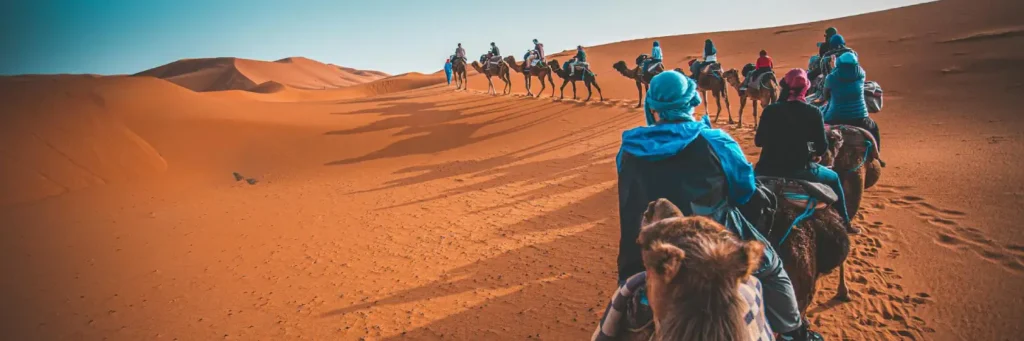
I guide a lot of solo female travelers and small groups of women. Morocco – including the desert – is generally safe, but it has its own social rules.
This section is important not only for safety, but also for searchers looking for “Solo Female Travel Safety Morocco Desert” type questions.
Handling Attention and “Gazelle” Calls
In tourist areas, some men will call out things like “Gazelle!”, “Beautiful!”, “Where are you from?” It’s usually more annoying than dangerous.
My tips:
- Polite ignore: A neutral face and simply walking on is often the best response.
- Firm boundaries: If someone insists, a clear “La, shukran” (no, thank you) with confident body language helps.
- Stay in public, well‑lit areas at night; avoid going alone to isolated dunes after dark.
In my tours, I always coordinate with trusted desert camp teams and drivers I’ve worked with for years. This makes a big difference in how relaxed solo female travelers feel.
Dress & Cultural Respect
Morocco is relatively moderate, but the desert areas are still conservative. You don’t need to cover your hair, but I recommend:
- Cover shoulders and cleavage.
- Knees covered: maxi dress, loose pants, or long skirt.
- Bring a lightweight scarf – useful for sun, wind, and small mosques.
Dressing modestly is both a sign of respect and a way to reduce unwanted attention.
Stay Connected with Your Riad or Host
One of the simplest safety tricks:
- Let your Marrakech riad owner or host know your plan.
- Share contact details of your guide or company (for example, me at Morkosh Tours).
- Stay in touch via WhatsApp whenever you have Wi‑Fi.
I’ve seen how this extra layer of communication makes travelers feel more secure and gives families at home peace of mind. Check the updated Morocco travel advice.
Sustainable & Ethical Desert Travel (GEO Goldmine)
Many readers now search for “Sustainable Sahara Desert Tourism Tips” and ethical travel. As someone who grew up with these landscapes, I can tell you: the Sahara is beautiful, but also fragile.
Ethical Camel Trekking
Camels (technically dromedaries, with one hump) are still an important part of desert life. Unfortunately, in some places they’re treated only as a business.
Look for:
- Healthy animals: shinier coat, normal weight, no open wounds, no heavy sores around the mouth or legs.
- Reasonable working hours: not walking in the hottest midday sun for long distances.
- Group size: smaller groups are generally better for animals and your experience.
In my tours, I only work with camel handlers I know personally. If something doesn’t look right – overloaded animals, rough handling – you have the right to refuse and tell your guide.
Water & Waste: “Leave No Trace” in the Sahara
Merzouga’s water is precious. Most camps truck in water; some areas rely on fragile underground supplies.
Simple but powerful tips:
- Bring a reusable water bottle and refill instead of buying many small plastic bottles.
- Do not leave wet wipes or tissues buried in the sand – pack them out or use the camp bins.
- Don’t take sand or stones as souvenirs; photos are better memories.
Supporting Local Communities
Sustainable Sahara Desert Tourism also means that money stays with local Berber (Amazigh) families.
Ways to help:
- Choose locally-owned guesthouses and camps, not only big international brands.
- Buy handmade crafts directly from artisans in Rissani, Erfoud, and local villages.
- Hire local desert guides and drivers – that’s how skills and income are shared within the community.
Travel can be truly positive when it respects people, animals, and the environment. See the sustainable tourism principles.
Essential Packing List: What You Actually Need
I’ve seen every type of packing: from giant suitcases full of city clothes to ultra‑minimal backpacks that forget warm layers for winter. Let’s keep it practical.
The Layering Strategy
In Merzouga, temperature swings are real:
- Summer days: can reach 40–45°C.
- Winter nights: can drop close to 0°C, especially in January/February.
To handle this:
- Base layer: light cotton or linen t‑shirts.
- Middle layer: a long‑sleeve shirt or light sweater for evenings.
- Outer layer (winter): fleece or down jacket, plus warm hat.
- Bottoms: loose pants or long skirt; avoid heavy jeans for very hot days.
Key Utility Items
Reusable 1–1.5L water bottle – refill at riads or shops.
Merino wool socks – sound fancy, but they’re excellent for cold desert nights and don’t smell easily.
Turban (shesh) – not just for photos. Locals use it to:
- Protect from sun and wind.
- Cover nose and mouth during sand gusts.
- Keep a bit of warmth at night.
Sunglasses & high‑SPF sunscreen.
Small headlamp or flashlight – handy in camps at night.
Basic medication: something for stomach, headache, motion sickness.
You don’t need to overpack. If you forget something simple, you can usually buy basics in Marrakech or along the way.
Planning Logistics: Costs and Best Timing
This is the “numbers” section of the Merzouga desert guide – what most people quietly wonder about while looking at the beautiful photos.
Budget Tiers: What a 3-Day Marrakech–Merzouga Tour Costs
These are approximate ranges for 3 days / 2 nights (one night in Dades or similar, one in the desert camp), per person:
- Budget shared group tours (~€80–€120)
- Big minibus or van, up to 17–20 people.
- Standard camp (shared bathrooms), basic guesthouse.
- Limited flexibility on stops and timing.
- Mid‑range small group or private (~€150–€220)
- Smaller groups or private 4×4.
- Better accommodations, perhaps upgraded camp.
- More flexibility and personalized stops.
- Private luxury (~€250–€300+ and upwards)
- Private driver/guide and 4×4.
- Luxury desert camp (ensuite, hot water, better meals).
- Comfortable guesthouses/hotels, more custom itinerary.
Most packages include:
- Transport, fuel, and driver.
- 2 nights’ accommodation.
- Breakfasts and dinners.
- Camel trek.
They usually don’t include:
- Lunches and drinks.
- Tips.
- Extra activities (quad bikes, 4×4 dune tours), which can be €30–€60 per person depending on length.
Best Time for a 3 Day Marrakech Desert Trip
Travelers often search “Best Time for 3 Day Marrakech Desert Trip” – and for a good reason. Merzouga climate and weather averages! Weather changes the whole experience.
- Spring (March–May): My personal favorite.
- Warm days, cooler nights.
- Blossoms in valleys; good light for photos.
- Autumn (September–November): Also excellent.
- Mild to warm days, comfortable evenings.
- Fewer sandstorms than late summer.
More notes:
- Summer (June–August):
- Can be extremely hot, especially in July/August (40°C+).
- Possible if you handle heat well and stay hydrated, but we adjust times to avoid midday exposure.
- Winter (December–February):
- Sunny days can still be nice.
- Very cold nights in the desert (bring proper layers).
- Great for those who prefer cool weather and clear skies.
If your dates are flexible, aim for spring or autumn to balance comfort and good driving conditions. See our ‘Best time to visit Morocco‘ article.
Planning a trip to Morocco? I’m here to help you make it smooth, safe, and unforgettable.
Get in touch with me, Youness, and I’ll guide you personally, itineraries, and everything you need for a perfect Moroccan adventure.
FAQ: Top Questions Answered by a Local Guide
Below are answers to the questions I hear most often as a local guide. On your website, these can be marked up with FAQ Schema to help capture Google’s featured snippets and support generative engines.
1. Is the Sahara in Merzouga the “real” desert?
Yes. Erg Chebbi near Merzouga is one of Morocco’s classic Sahara dune systems, with high, golden sand dunes – this is the “real desert” most people imagine. Other areas like Zagora are more rocky plains with smaller dunes, still desert but visually less dramatic. If you’re dreaming of big dunes and that endless sand feeling, Merzouga is the better choice.
2. How many hours of driving per day on a 3-day Marrakech–Merzouga trip?
On most itineraries, you’ll drive around 7–8 hours on Day 1, 5–6 hours on Day 2, and 8–9 hours on Day 3 back to Marrakech (with plenty of breaks). It’s a lot of road, but you’re not just staring at the highway – there are scenic stops, viewpoints, and villages along the way. If you hate long drives, consider adding an extra day or finishing in Fes instead of returning to Marrakech.
3. Are meals included on a typical Merzouga desert tour?
Usually breakfast and dinner are included with your accommodations in Dades (or similar) and at the desert camp. Lunches, drinks, and snacks are normally extra and paid on the spot. Always double‑check with your tour operator so you know exactly what’s covered before you book.
4. Is the Merzouga desert safe for solo female travelers?
In general, yes – Merzouga and the main Sahara routes are safe when you travel with a reputable guide or company and use normal common sense. You may get some harmless attention (“gazelle” comments, questions about where you’re from), but serious incidents are rare. Dress modestly, avoid walking alone in isolated areas at night, and share your itinerary with your riad or host – these small steps go a long way.
5. What is the best time of year for a 3-day Marrakech desert trip to Merzouga?
The most comfortable months are March–May and September–November, when days are warm and nights are cool but not extreme. Summer can be very hot (40°C+), and winter nights can be close to freezing, especially in January and February. If your dates are fixed in summer or winter, it’s still doable – just pack properly and plan to avoid the hottest hours in the dunes.
6. Is it better to choose a luxury desert camp or a standard one in Merzouga?
It depends more on your comfort level and budget than anything else. Standard camps are simpler, more social, and cheaper, often with shared bathrooms, while luxury camps offer private ensuite tents, better bedding, and more privacy. For me as a guide, the key factor is camp location in the dunes – a well‑located standard camp can feel more magical than a “luxury” camp parked too close to the village or road.
🌿 Conclusion: Turning a Desert Dream into a Real Journey
If you’ve read this far, you already know the truth: a 3‑day Marrakech to Merzouga desert trip isn’t just a checkbox on an itinerary – it’s long roads, changing landscapes, tea with strangers, and that silent moment on a dune when the sun finally drops and the sky explodes with stars.
Merzouga is the “real Sahara” experience most travelers imagine: the high dunes of Erg Chebbi, camel caravans at sunset, fireside music, and cold, clear nights. The key is to do it smartly – choose the right season, be honest about your comfort level (standard vs luxury camp), travel sustainably, and give yourself enough time so the journey doesn’t feel rushed.
If you’d like help planning a route that fits your pace, budget, and style – whether you’re a solo female traveler, a couple, or a family – I’m happy to look over your ideas and suggest a realistic plan based on 20+ years on these roads.
You can reach me and see sample itineraries at:
Morkosh Tours
Tell me how many days you have, where you’re starting from, and what kind of experience you want – and I’ll help you turn “one day I’ll see the Sahara” into a trip you’ll actually remember.
Written by Youness Labchir
Licensed Morocco Tour Guide